Two men have been sentenced to 12 and a half years in prison each for their roles in a large illegal cannabis-growing operation in regional Victoria that produced what the County Court described as the largest reported cannabis seizure by weight in the state.
Duy Duc Dao and Quoc Van Tran pleaded guilty to cultivating a large commercial quantity of cannabis at a Toolamba property near Shepparton.
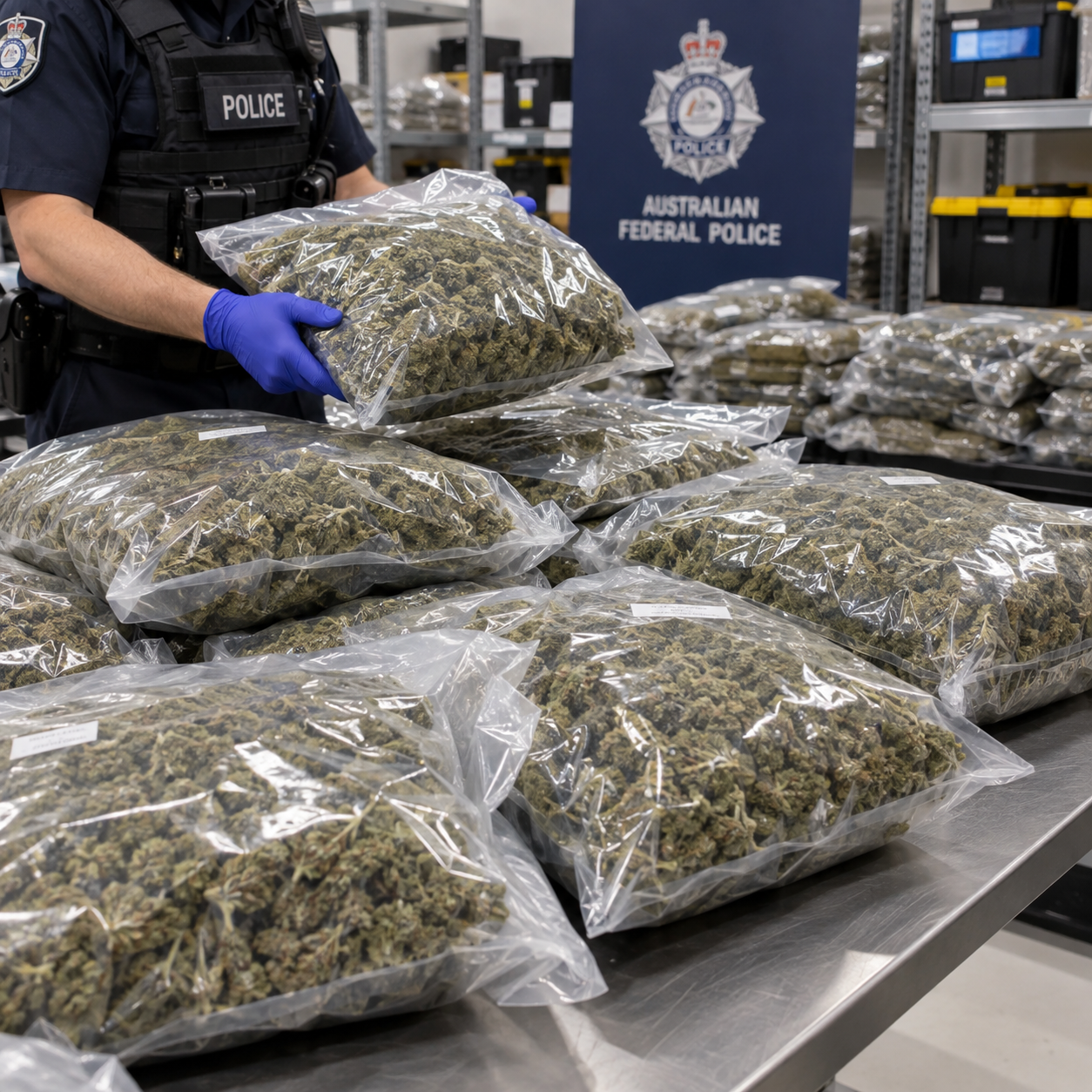
When Victoria Police raided the site in February 2022, officers found 8,805 cannabis plants spread across large greenhouses. The crop weighed 5.1 tonnes.
Both men were ordered to serve at least eight years and four months before becoming eligible for parole.
The Toolamba operation was far beyond a small grow house.
The County Court heard that the site included two large greenhouses equipped with lighting and irrigation systems, along with water tanks, power tools, fertilisers and electrical equipment.
Power and water meters had been tampered with as part of the operation.
Police discovered thousands of plants at different stages of growth and needed trucks and a weighbridge to establish the total weight of the seized crop.
Judge Pardeep Tiwana said the 5.1-tonne seizure represented the largest reported cannabis seizure by weight in Victoria.
The amount was more than 20 times the legal threshold for a large commercial quantity.
Police estimated the crop could have been worth between $22 million and $26 million if it had matured and been sold in bulk.
That valuation should be understood as a police estimate of potential value, not money the offenders were proved to have received.
The plants were seized before the crop could be completed and sold.
Drug valuations depend on factors including maturity, usable yield, quality, wholesale prices and how the product would ultimately have been distributed.
The concrete facts are the number of plants, the 5.1-tonne seizure and the court’s finding that the operation involved cultivation on a large commercial scale.
Dao and Tran were both 36 at the time of sentencing and had no prior criminal records before the cannabis case.
The court heard they had experienced financial pressure during the COVID-19 pandemic and had moved through a range of jobs before becoming involved in the Toolamba operation.
Both men said they did not initially understand that the work they had agreed to involved illegal cannabis cultivation.
However, the judge found they continued participating after the true nature of the operation became clear.
He rejected any suggestion that they were merely passive crop sitters, finding they had been trusted to help maintain and bring the commercial crop to maturity.
Australian drug laws distinguish between possession for personal use and commercial cultivation or trafficking.
Large commercial quantity offences are treated much more seriously because they involve production intended for a substantial illicit market.
In sentencing, courts generally consider the scale of the operation, the offender’s role, the duration of their involvement, financial motivation, criminal history, guilty plea, prospects for rehabilitation and the need for general deterrence.
The 12-and-a-half-year terms imposed on Dao and Tran reflect the scale of the crop and the court’s assessment that they played meaningful roles in the operation.
The non-parole period means neither man can be considered for release until serving at least eight years and four months, although parole eligibility does not guarantee release.
The court was told that three other people allegedly involved in the operation skipped bail before their trial and remain on the run.
Those individuals have not been convicted in relation to the allegations described in the current reporting, so they should not be treated as guilty.
The distinction is important because Dao and Tran have admitted their offending and have now been sentenced, while the legal status of the other three remains unresolved.
Police investigations into outstanding accused people can continue separately from the completed sentencing of offenders who have pleaded guilty.
Commercial indoor or greenhouse cannabis cultivation demands significant electricity, water, ventilation, lighting and labour.
Large illegal operations therefore often leave a physical and financial footprint.
Investigators can examine abnormal electricity consumption, altered meters, water use, property leases, equipment purchases and movements of people and vehicles.
At Toolamba, the presence of large greenhouses, irrigation, lighting and modified utilities showed that the crop had been organised as a sustained commercial operation rather than an opportunistic planting.
That infrastructure also helps courts assess the degree of planning and sophistication involved.
Large rural or semi-rural sites offer space, privacy and access to sheds, greenhouses and water systems.
They can also be far enough from neighbours that unusual activity is less visible.
But remote properties create other risks for offenders: vehicles and equipment can be noticed, utilities can show unusual patterns, and large crops are difficult to move quickly if police identify the site.
Police in Victoria and other states have repeatedly investigated large-scale cannabis farms in regional areas, often involving organised groups that separate property management, cultivation, financing and distribution roles.
That does not mean every person living or working at a rural property is involved in criminal activity. Each person’s role has to be proved individually.
The police raid on 9 February 2022 prevented the Toolamba crop from reaching its intended final market.
Officers seized the plants and equipment, and the site became the basis of a long court process that has now produced sentences for Dao and Tran.
Large criminal cases can take years to reach sentencing because investigators must analyse evidence, accused people may contest charges, courts face scheduling delays and defendants may eventually enter guilty pleas after negotiations.
The gap between the 2022 raid and the 2026 sentencing does not mean the case was inactive; it reflects the time required to move a serious multi-accused matter through the justice system.
Dao and Tran pleaded guilty, meaning there was no need for prosecutors to prove their charges at a full trial.
A guilty plea can be relevant to sentence because it saves court time and can demonstrate acceptance of legal responsibility, although the weight given to it depends on timing and circumstances.
The court still had to determine the seriousness of the offending and impose a sentence that reflected the scale of the enterprise.
The judge also considered their personal backgrounds and lack of previous convictions.
Those mitigating factors did not outweigh the seriousness of helping operate a crop measured in tonnes.
The court heard that Tran is likely to face immigration consequences after completing his sentence.
Criminal sentencing and immigration decisions are separate processes.
A court imposes punishment for the offence, while immigration authorities apply federal migration law to determine whether a non-citizen can remain in Australia.
The possibility of deportation does not replace the prison sentence and does not change the court’s finding about the cannabis cultivation offence.
Calling the Toolamba matter Victoria’s largest cannabis seizure by weight is specific.
It does not automatically mean it was the most profitable drug operation in Victorian history, the largest by number of plants, or the biggest illicit-drug case of any type.
The record cited by the court relates to the weight of the cannabis seized.
That precision matters because crime headlines can easily become broader than the underlying evidence.
For Dao and Tran, the next stage is serving their sentences and eventually becoming eligible to apply for parole after the minimum period.
For investigators, attention may continue on the three alleged participants who were said to have skipped bail.
Police can also use evidence from the farm to examine whether other people financed, directed or planned the operation.
The current court outcome, however, should not be stretched beyond what has been established.
Two men pleaded guilty to cultivating a large commercial quantity of cannabis and were each sentenced to 12 and a half years. Police seized 8,805 plants weighing 5.1 tonnes at Toolamba in 2022. Police estimated the crop could have been worth $22 million to $26 million if matured and sold in bulk. Three other alleged participants remain at large.
Those facts establish the extraordinary scale of the operation without needing to turn unresolved allegations into conclusions.