Australia has joined a group of 22 governments and institutions calling for stronger international guardrails around advanced artificial intelligence, placing Prime Minister Anthony Albanese on one side of a widening global debate over how governments should respond to rapidly improving AI systems.
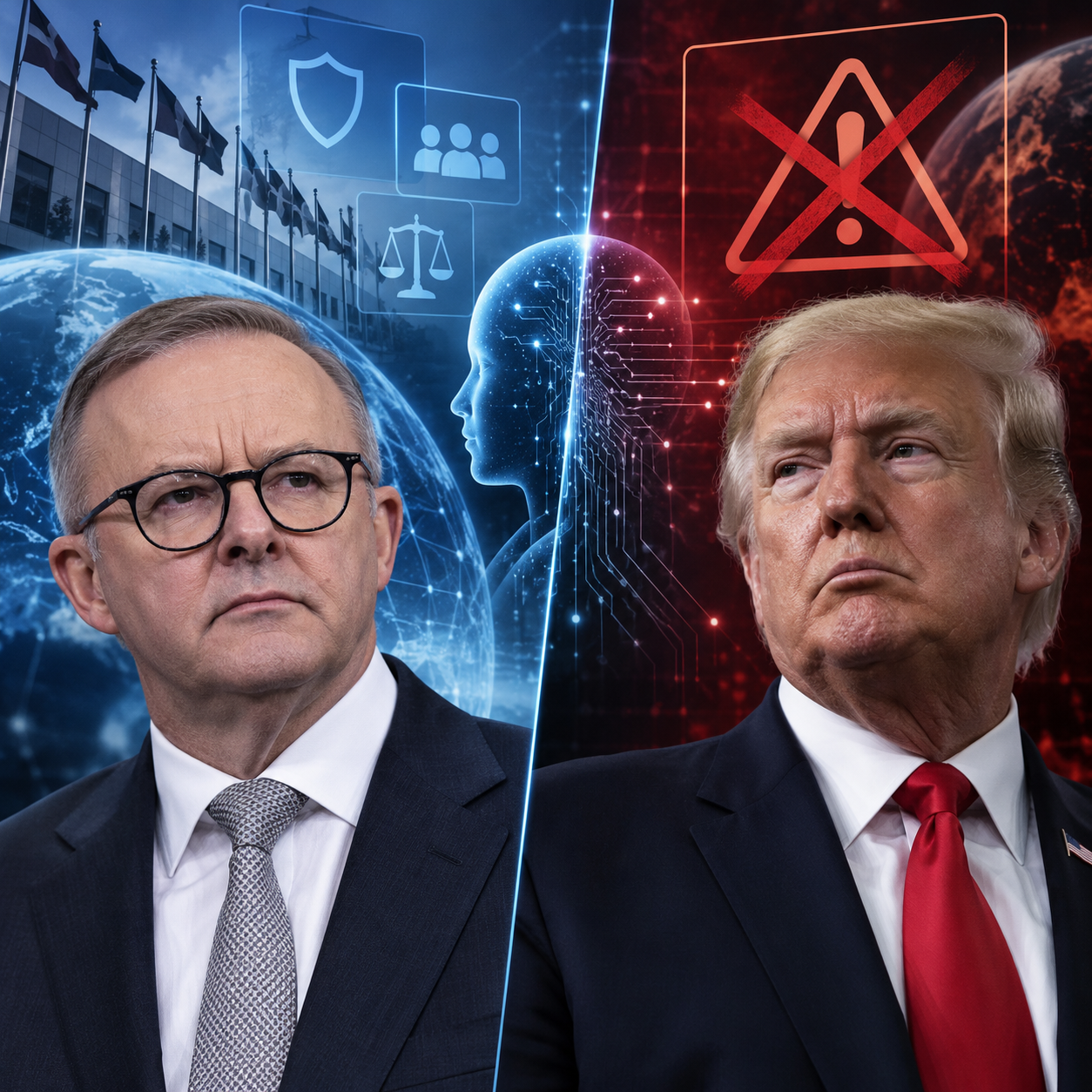
The declaration, released ahead of the United Nations General Assembly in New York, says advanced AI should remain under human direction, oversight and control. It warns that the pace of development could move faster than governments’ ability to manage emerging risks and calls for greater coordination between states, technology companies and international institutions.
Australia is part of a coalition that includes countries such as Canada, Finland, Norway and Singapore, as well as the European Commission. The group is not proposing a single global regulator with immediate power over every AI company. Instead, it is calling for common standards, transparent safety protocols and better mechanisms for governments to respond when new AI capabilities cross significant risk thresholds.
The statement says frontier AI systems can create serious safety and security risks if they are not appropriately managed. It points to concerns that highly capable models may circumvent testing safeguards or gain access to real-world systems in ways developers did not intend. Those claims form part of a broader international discussion about how to test advanced systems before release and what should happen when a model demonstrates capabilities that were not anticipated.
Albanese has argued that major powers, particularly the United States and China, need to cooperate because they are central to the development of the most advanced models. He has also said middle powers have a role in shaping international rules and preventing the issue from becoming solely a competition between the two largest technology powers.
The Prime Minister has compared the need for cooperation to other international arrangements designed to manage technologies with global consequences. The comparison does not mean AI and nuclear weapons are equivalent. The argument is that some risks cannot be managed effectively if each country acts alone, particularly when companies, computing infrastructure and digital systems operate across borders.
US President Donald Trump has taken a markedly different public position on the idea that AI presents an existential threat. ABC reporting says Trump has dismissed that framing as a hoax and has previously resisted calls for broad AI regulation. His administration has emphasised maintaining US leadership in the technology race and competing with China.
That contrast creates a clear policy difference, but it should not be treated as evidence of a personal dispute between Albanese and Trump. The two leaders are approaching AI risk from different starting points: Albanese is publicly backing collective guardrails and international coordination, while Trump has emphasised innovation, competition and US technological advantage.
At the same time, the American position is not simply that no safety coordination is needed. US Treasury Secretary Scott Bessent has suggested Washington and Beijing could establish a notification mechanism for serious AI incidents, including events that reach a national-security level. That indicates there may still be room for narrower forms of cooperation even where governments disagree about broader regulation.
For Australia, the policy challenge is unusually complex because the country is primarily a user and regulator of frontier AI rather than the home of the largest model developers. Australian governments want access to the economic benefits of AI, including productivity gains, investment and new services, while also trying to influence standards set by much larger markets.
The government’s international strategy therefore relies heavily on coalition-building. By working with other middle powers, Australia can try to shape common expectations around testing, transparency and safety without pretending it can dictate terms to the United States, China or the biggest technology companies.
The 22-member declaration calls on companies to develop transparent safety processes and on governments to coordinate common standards. It also raises the possibility of the United Nations creating or supporting an international mechanism that could bring states together when agreed capability thresholds are crossed.
That idea would require extensive negotiation. Governments do not yet agree on what capability thresholds should trigger international action, how tests should be conducted, who should verify them or what consequences should follow. Different countries also have different views about privacy, national security, open-source development, intellectual property and the acceptable use of AI in defence.
There is also a practical enforcement problem. The most advanced AI systems are developed by private companies, and governments often rely on information provided by those same companies to understand model capabilities. Effective oversight may require access to technical evaluations, incident reporting and computing data that firms could regard as commercially sensitive.
Supporters of stronger guardrails argue that waiting for a major failure before creating those systems would be irresponsible. Critics of heavy regulation warn that vague risk language can be used to justify rules that slow innovation, entrench large companies or restrict useful open research. The international debate is therefore not simply “safety versus no safety”; it is about what safeguards are proportionate and who gets to set them.
The Albanese government is placing AI alongside war, climate change and economic instability as an issue that requires stronger multilateral institutions. That framing also supports Australia’s broader push for a more active role in international governance, including its campaign for a United Nations Security Council seat for 2029–30.
For Australian businesses and consumers, the declaration does not create new domestic rules by itself. There is no immediate change to how people use AI tools because of the statement. Its importance is diplomatic: it signals the standards Australia wants to see developed and the direction it is encouraging other governments and companies to take.
The most consequential next step may be whether the United States and China establish a reliable channel for AI incidents. The two countries are competing aggressively in chips, models and computing infrastructure, but they also have a shared interest in avoiding accidents or misunderstandings that could have national-security consequences.
Australia’s position is that competition does not remove the need for cooperation. Trump’s public stance shows that agreement on the scale of the risk remains far from universal. The coming UN discussions will test whether governments can find narrower areas of consensus — such as incident reporting, common testing language or emergency communication — even while they disagree about existential-risk claims and regulation.
The declaration also reflects concern about how quickly technical capability can move from research into widely available products. Governments may take months or years to legislate, while model developers can release major upgrades several times within the same period. Supporters of common standards argue that pre-agreed testing and incident-reporting rules could reduce that gap.
There is a distinction between ordinary consumer harms and frontier-system risks. Australia already has laws covering areas such as privacy, consumer protection, discrimination and critical infrastructure. The 22-leader statement is aimed at the harder question of what to do when general-purpose systems develop capabilities that may affect national security or operate across borders.
Some leading technology figures have also called for stronger safety measures or a slower pace in parts of frontier development, but industry views are not uniform. Companies differ over open models, testing thresholds and the role of government. That makes any international standard difficult because the technical community itself does not have one agreed model of regulation.
For Australian agencies, international standards could eventually influence procurement, safety testing and the treatment of AI systems used in sensitive sectors. None of that follows automatically from the New York declaration, but the statement is an attempt to build the political foundation for more concrete rules later.
The timing of the statement is also significant. It was released immediately before the UN General Assembly, giving the group a forum to seek wider support rather than presenting the declaration as a finished treaty. Any binding international mechanism would require further negotiation over definitions, thresholds and enforcement. For Australia, the near-term effect is therefore diplomatic: the government has publicly aligned itself with the view that advanced AI should remain under human control and that major states should have ways to communicate when serious incidents occur.
The debate is likely to become more important as models improve. For now, Australia has aligned itself with governments calling for a stronger international safety framework, while the United States under Trump continues to emphasise technological leadership and reject some of the most alarmed descriptions of AI risk. That is a policy contrast, not a prediction about which approach will prevail.