Victoria’s fight over the powers of its anti-corruption watchdog has widened into a second argument about public interest immunity, as the Labor government moves to expand IBAC’s reach and the Coalition pushes for tougher changes around what ministers and former ministers can withhold from inquiries.
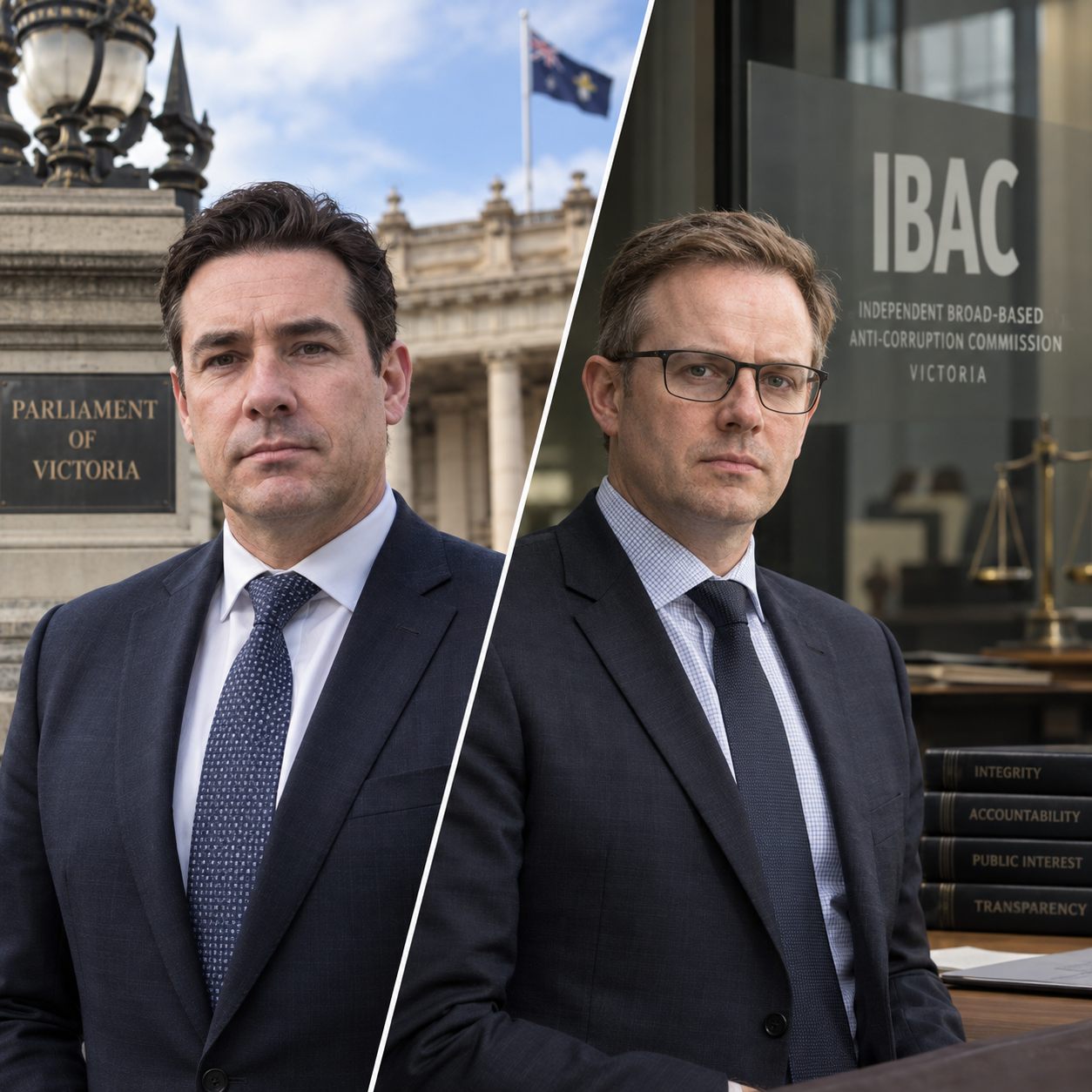
The immediate debate centres on the Independent Broad-based Anti-Corruption Commission Amendment Bill 2026. The Carroll government says the bill is designed to give IBAC broader “follow-the-money” powers, including the ability to examine the conduct of private contractors and subcontractors involved in government work where integrity concerns arise. The government has also argued that the changes would make it easier for the watchdog to investigate serious misconduct that may not fit neatly within the existing requirement for a direct link to a relevant criminal offence.
The Coalition has backed stronger integrity laws in principle but says the package should go further. Its current push includes stronger retrospectivity and changes to the way public interest immunity can be used when ministers, former ministers or government bodies are asked to provide documents or evidence to bodies such as IBAC or a royal commission. Premier Ben Carroll has indicated he is open to discussing amendments, but the final shape of the legislation remains unsettled.
That distinction matters because public interest immunity, usually shortened to PII, is not the same thing as a personal exemption from scrutiny. Victorian government guidelines describe PII as a legal doctrine that can protect certain documents or information from disclosure where a competing public interest — such as the confidentiality of Cabinet deliberations — is judged to outweigh the public interest in disclosure. The guidelines apply across Victorian government bodies and Victoria Police and can become relevant in court proceedings, royal commissions and other formal inquiries.
Cabinet material receives especially strong protection under those guidelines because governments argue that ministers need to be able to debate policy freely before collective decisions are made. The protection can extend to Cabinet minutes and submissions prepared for Cabinet consideration. At the same time, the guidelines are intended to make decisions about PII more consistent and transparent, including by setting out who should authorise a claim and how competing public interests should be weighed.
The political disagreement is therefore not simply about whether secrecy should exist. It is about where the boundary should sit, who should be able to assert the protection, and how readily an independent inquiry should be able to test or overcome a claim when accountability questions are at stake. The Coalition argues the current arrangements can impede scrutiny. Labor, while moving to strengthen IBAC in other areas, has not committed to removing PII protections altogether.
The timing has added intensity to the debate. Victoria’s Royal Commission into misconduct in the major infrastructure construction industry is beginning its public work as the state heads toward an election later this year. Former premiers and other senior figures may be called as witnesses as the inquiry examines allegations and systems around major construction projects. The existence of an inquiry, however, does not establish wrongdoing by any particular person, and being asked to give evidence is not an allegation of criminal conduct.
The state government has separately introduced legislation intended to give the construction royal commission stronger tools. It has announced plans for a special prosecutor who could receive relevant material from the commission and refer evidence to Victoria Police, IBAC, regulators or other authorities where appropriate. A royal commission itself does not charge or prosecute people. Its role is to investigate, compel evidence within its legal powers, make findings and recommend action.
That legal separation is important in a political environment where terms such as “corruption”, “immunity” and “investigation” can easily be compressed into stronger claims than the evidence supports. An IBAC investigation, a royal commission examination or a dispute about PII does not by itself prove misconduct. The current argument is about institutional powers and legal rules, not a finding that a named politician has committed an offence.
The government’s IBAC bill is significant because it seeks to address a long-running limitation in the watchdog’s jurisdiction. Under the existing framework, IBAC has faced constraints where conduct involves private parties or complex contracting chains and does not immediately present as a conventional criminal offence tied directly to a public officer or public body. The proposed “follow-the-money” model is intended to let investigators trace public funds through contractors and related entities where serious integrity concerns arise.
Labor has framed the package as a major strengthening of the integrity system. The government says Victorians should be able to expect public money to be spent properly and that integrity bodies need powers capable of following complex procurement and contracting arrangements. It also says the reforms would support more public hearings and broader examination of serious misconduct.
The Coalition’s argument is that wider investigative powers will not be enough if important evidence can still be withheld under PII in circumstances where an inquiry believes disclosure is necessary. Opposition figures have linked the issue to previous commitments around ministerial transparency and are pressing for a framework that, in their view, would make it harder for governments to shield material from scrutiny.
There are competing institutional considerations. Cabinet confidentiality is recognised in Westminster systems because ministers are expected to debate policy privately and then take collective responsibility for the final decision. Integrity bodies, on the other hand, rely on access to documents and testimony to test how decisions were made, whether public money was handled properly and whether private interests influenced government processes. A durable legal framework has to reconcile those interests rather than assume one always overrides the other.
The practical effect of any amendment will depend on the wording Parliament ultimately passes. A change could affect which documents can be claimed as protected, who authorises a claim, whether an inquiry can challenge it, and how a court or commissioner balances competing public interests. Those details matter more than the political shorthand because they determine how the law operates when a real dispute arises.
For Victorians, the broader issue is whether the state’s integrity architecture is equipped for modern government contracting, where large projects often involve layers of private firms, consultants and subcontractors. The proposed IBAC changes are aimed directly at that complexity. The PII argument is about the other side of the system: whether the flow of evidence into investigations is sufficiently open when senior government decision-making is involved.
Both debates will now move through Parliament and the wider integrity process. Labor wants the IBAC legislation passed before the November election. The Coalition is seeking amendments and stronger retrospectivity. The construction royal commission is also beginning to test how existing inquiry powers work in practice.
The Coalition is also pressing the government over whether the new integrity laws should operate retrospectively. Retrospective application is a separate question from PII: it determines whether new powers can reach conduct or arrangements that pre-date the commencement of the law. Governments generally have to balance accountability arguments against legal certainty when deciding how far retrospectivity should extend.
Victoria’s own PII guidelines show why the issue cannot be reduced to a simple claim that a minister can “refuse to answer”. They say Cabinet documents are generally protected as a class because disclosure can reveal collective deliberations, but they also require an authorisation process and consideration of the public interest. The appropriate decision-maker can differ depending on the type of material and the inquiry involved.
That means the coming parliamentary debate will turn on legal drafting as much as political rhetoric. A broad promise to “remove immunity” could operate very differently depending on whether the law changes the categories of protected material, the authorisation process, the ability of an inquiry to contest a claim, or the weight a court gives Cabinet confidentiality.
The official Victorian guidelines also make clear that authorisation is not automatic or identical in every case. Depending on the material, responsibility for a PII claim may sit with Cabinet, a minister, a departmental secretary or another senior decision-maker. They also say a claim should be supported with sufficient precision and evidence for the body deciding it. That makes the Coalition’s proposed changes a question about the architecture of scrutiny, not simply whether a politician can choose personally to keep material secret.
The key point is that none of those processes should be treated as a verdict on any individual. The current story is a contest over how much power Victoria’s anti-corruption and inquiry bodies should have, how public interest immunity should be used, and what safeguards should apply when transparency and Cabinet confidentiality collide.