More than one in four paid parking spaces controlled by Brisbane City Council are now in app-only payment zones, prompting warnings that the shift away from physical meters is creating barriers for older people, visitors and residents who cannot easily use mobile payment systems.
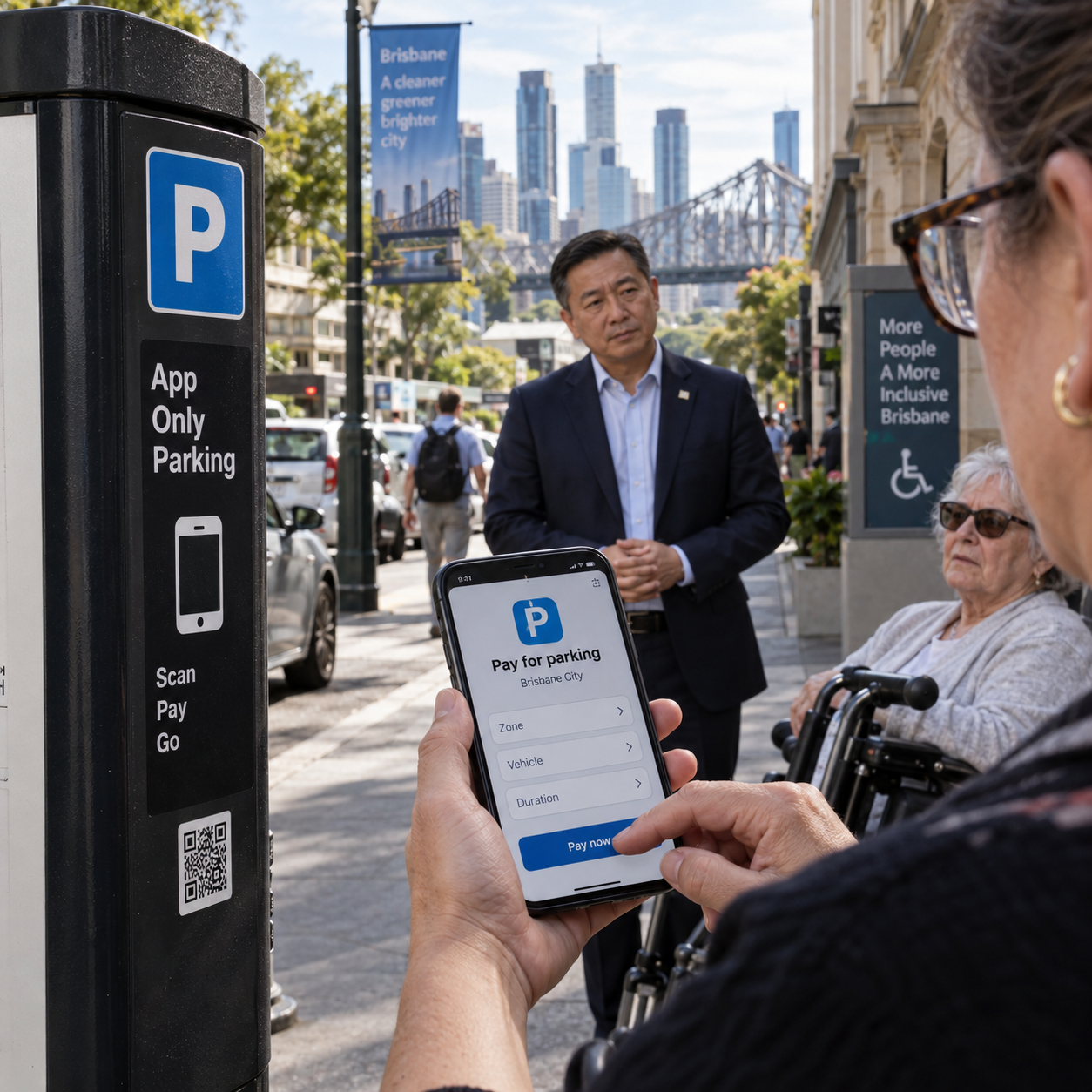
Council data reported by the ABC shows 2,483 of roughly 9,000 paid parking spaces require motorists to use a mobile app rather than a nearby meter. Brisbane is unusual among major Australian cities in having a substantial number of areas where app payment is the only on-street option.
The change is most visible in inner-city suburbs where physical meters have been removed from some streets. For regular users with a smartphone, an account and a stored payment method, the system can be quick. For a person arriving for a one-off hospital appointment or unfamiliar with the area, it can mean downloading an app, creating an account and solving login or payment problems while the parking clock is already running.
Residents near the Wesley Hospital in Auchenflower have described helping visitors who could not work out how to pay. ABC reporting says about 60 per cent of paid parking spaces in that area are app-only. One resident recalled assisting an older visitor who had already downloaded the app but could not remember a password and could not easily access the email account needed to reset it.
The issue is therefore not simply whether someone owns a smartphone. Digital access also depends on mobile data, battery life, passwords, payment cards, confidence with apps and the ability to troubleshoot when something goes wrong. A system that works smoothly for frequent users can become difficult for people who only encounter it occasionally.
Greens councillor Seal Chong Wah, whose Paddington Ward includes areas with high numbers of app-only spaces, has argued that parking apps can create barriers for older people and people on lower incomes. Her position is that physical meters should remain available so motorists have a non-digital option.
Council on the Ageing Australia chief executive Patricia Sparrow has made a similar argument at a broader level. She says digital services are increasingly common but should not automatically become digital-only, because some people cannot or do not want to manage essential transactions online.
The debate reflects a wider accessibility problem faced by governments and businesses. Moving services online can reduce operating costs and make transactions faster, but a fully digital system can exclude people with limited internet access, disability, language barriers or lower confidence using technology. The question is where convenience becomes a barrier to basic access.
Parking adds a particular complication because motorists may be under time pressure. Someone going to a medical appointment, court appearance, job interview or school event cannot always spend several minutes downloading an app or walking to find another payment point. If the process fails, the person may have to choose between being late and risking a parking fine.
Some users also worry about scanning QR codes in public places. Security agencies regularly warn that malicious QR codes can direct people to fake websites. That does not mean official parking codes are unsafe, but it does mean councils need clear signage and payment methods that let users verify they are dealing with the correct provider.
Brisbane City Council says it is not planning to remove every physical parking meter. A spokesperson said the council would continue to operate meters alongside its two parking payment providers, CellOPark and PayStay. The council also says some payments can be made by phone or through provider websites.
Those alternatives are relevant, but they do not completely answer the accessibility criticism. A phone payment still requires a user to understand the system and have access to the right information. A website may be easier for some people than an app, but less practical for a visitor standing beside a parked car.
The council faces legitimate operational considerations as well. Physical parking meters cost money to install, maintain, repair and replace. Cash handling creates additional security and servicing requirements. App-based systems can also provide better information about parking use and make it easier to change rates or extend a session remotely.
The policy question is whether those efficiencies justify removing a physical option from particular locations. Hospitals and areas with large numbers of older or infrequent visitors may present a different accessibility case from commercial districts where most users are regular commuters.
There is also a fairness issue around enforcement. If a council creates a payment system that some motorists struggle to access, it needs to ensure signage is clear and that reasonable alternatives are genuinely available. Otherwise, people may see fines as punishment for digital difficulty rather than for deliberately avoiding payment.
Brisbane’s experience could become relevant to other councils considering similar changes. Local governments around Australia are digitising permits, payments and customer services, and parking is one of the most visible examples because it affects residents and visitors directly in public space.
A balanced system does not necessarily require every street to have a meter. Councils could keep physical payment points in high-need locations, improve phone-payment instructions, provide clearer signs showing the nearest meter, or ensure apps can be used without complicated account creation. The right mix will depend on cost and local demand.
For now, the council’s own figures show app-only parking is no longer a small trial. With 2,483 spaces already operating that way, the system affects more than a quarter of Brisbane’s paid on-street parking network. That scale explains why accessibility advocates are asking for the digital divide to be considered as a core part of parking policy rather than as a minor technical problem.
The experience described in Newstead shows how quickly a routine task can become complicated. Retiree Margaret McCormack told the ABC she was running late for an appointment when she found an app-only space and had to spend time working through the payment process. Her concern was not only inconvenience but also whether scanning a public QR code was safe.
Hospital precincts are a particularly useful test of the policy because they attract people from outside Brisbane who may not know the local payment system. Residents around the Wesley Hospital say some visitors arrive from regional areas such as Toowoomba or Boonah and may need parking only once. Requiring a new account for a single visit can feel disproportionate even when the technology works as designed.
The accessibility argument also extends beyond age. People with cognitive or physical disabilities, people using older phones, visitors without Australian payment arrangements and low-income users with limited data can all face different barriers. A digital system can therefore be technically available while still being practically inaccessible to part of the community.
Council’s position that meters will remain in the network gives it room to adjust the mix without reversing digital payment altogether. The policy question is whether physical alternatives are close enough to the places where they are most needed, and whether signs make those alternatives obvious before a motorist commits to a space.
That is likely to be the next pressure point for Brisbane: not whether apps disappear, but whether app-only zones are redesigned around accessibility. Data about complaints, failed payments, fines and usage by location could give council a clearer basis for deciding where a meter remains necessary.
ABC reporting also identifies Brisbane as the only major Australian city where motorists are forced to use a digital-only payment option in some council parking areas. That makes the city a useful case study for other councils. The challenge is not whether digital payment should exist — many motorists prefer it — but whether a public parking network should retain a practical fallback for people who cannot complete an app transaction at the point they need to park.
For drivers, the practical safeguard is straightforward: check the official sign at the space, use the payment method identified by council, and avoid assuming that an unfamiliar QR code is legitimate simply because it appears near a parking area. For council, the policy test is whether the official alternatives are clear enough that a visitor can comply without needing local knowledge or help from a passer-by.
The council says all meters are not disappearing, while critics want stronger guarantees that non-digital payment will remain practical. The next question is whether Brisbane changes the way app-only zones are selected or adds new accessibility safeguards as the network continues to evolve.