Prime Minister Anthony Albanese has used a Climate Week appearance in New York to argue that governments can no longer avoid the economic and security costs of climate change, while Australian climate advocates have responded by saying the government’s international rhetoric is not matched by a sufficiently strong position on fossil fuel expansion.
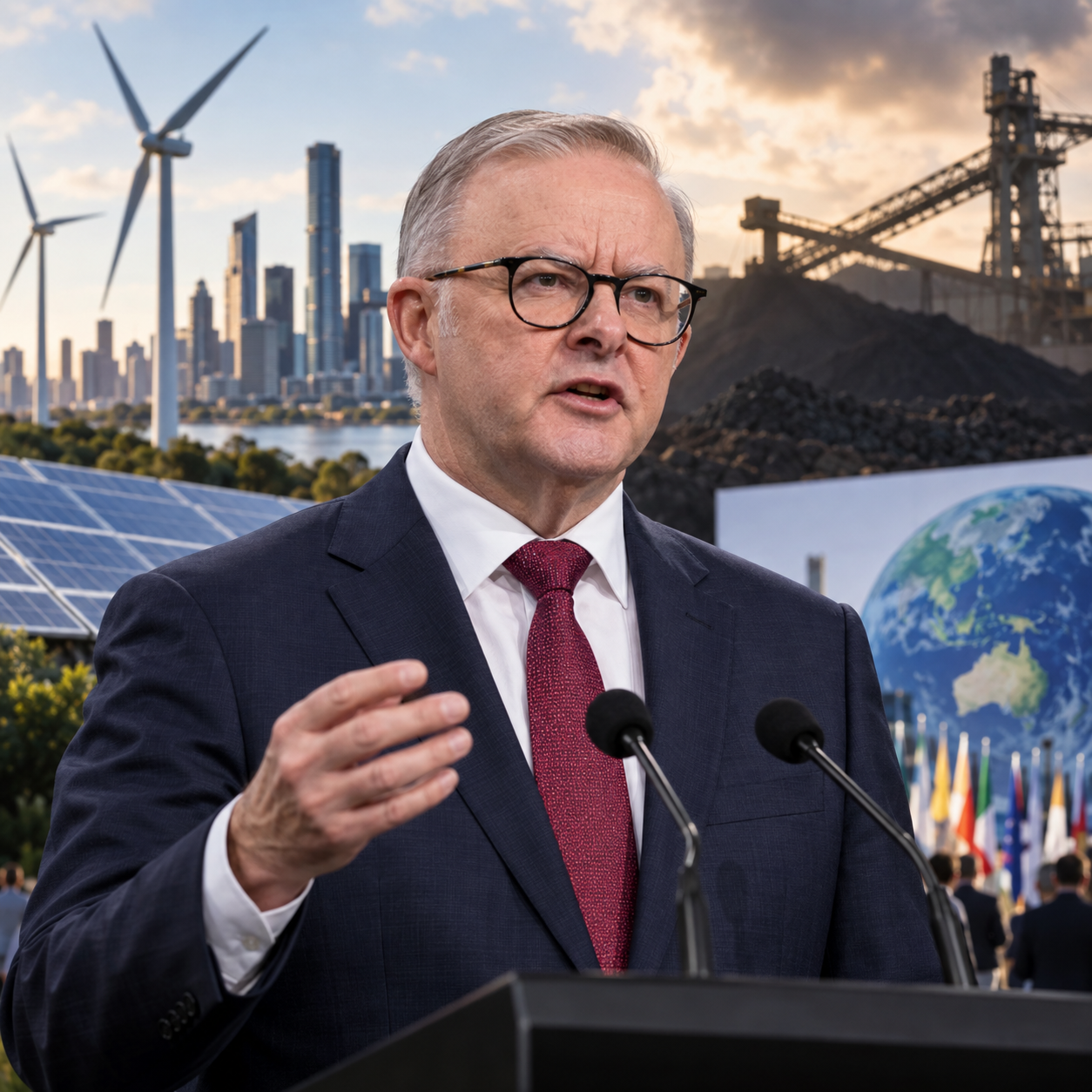
The speech places Australia’s climate policy in a familiar tension. The Albanese government points to legislated emissions targets, rapid renewable-energy growth and a national pathway to net zero. Environmental groups and other critics argue that those measures are undermined when governments continue to approve or support new and extended fossil fuel projects.
Albanese’s central message in New York was that climate policy should be treated as part of national security and economic planning rather than as a separate environmental issue. Australia has experienced repeated bushfires, floods, cyclones and heat events, and the government argues that the cost of inaction will be felt through damaged infrastructure, insurance pressure, disrupted communities and lower economic resilience.
Australia’s current national target is to reduce greenhouse gas emissions by 62 to 70 per cent below 2005 levels by 2035. That target was set in 2025 after advice from the Climate Change Authority and sits between the existing 2030 target of 43 per cent below 2005 levels and the legislated goal of net zero by 2050.
The federal government says the 2035 target can be reached through a combination of cleaner electricity, industrial decarbonisation, transport changes, energy efficiency and technologies already available or developing. Its Net Zero Plan is supported by sector-specific plans covering major parts of the economy.
Government reporting says renewable energy now supplies more than 40 per cent of electricity in Australia’s two largest electricity grids. The government presents that shift as evidence that emissions reductions and economic growth can occur together, while also arguing that clean-energy investment can create new export industries and jobs.
Climate advocates quoted in current reporting do not dispute that renewable energy has expanded. Their criticism is that Australia is trying to claim international climate leadership while allowing continued development of coal and gas projects. They argue that emissions targets should be assessed not only against renewable-energy construction but also against decisions that lock in future fossil fuel production.
That criticism is political and contested. The government argues that Australia is managing an orderly transition and that energy security, jobs and export relationships have to be considered alongside emissions reductions. Advocates seeking a faster end to new fossil fuel projects argue that continued expansion creates additional emissions and weakens the credibility of Australia’s climate diplomacy.
The disagreement matters internationally because Australia is seeking a more prominent role in climate negotiations. The country’s diplomatic pitch is that it can combine major renewable resources, critical minerals, industrial capability and regional relationships in the Pacific with a credible emissions-reduction pathway.
Pacific countries have repeatedly pushed major emitters, including Australia, to treat climate change as an immediate security issue. Rising sea levels, extreme weather and damage to water, food and infrastructure systems are not theoretical concerns for low-lying island states. Australia’s climate diplomacy therefore has consequences for its broader regional relationships.
Albanese’s national-security framing is designed to connect those international concerns with domestic risks. Climate change can affect defence infrastructure, disaster-response capacity, supply chains and the ability of governments to protect communities from repeated extreme events. That does not mean every fire, flood or storm can be attributed to climate change alone, but long-term warming can alter the frequency and severity of certain hazards.
The government’s 62–70 per cent target is also a test of implementation. Setting a target is different from delivering the emissions reductions required to meet it. Australia’s official projections and annual climate statements are intended to track progress, but future outcomes depend on policy design, investment, technology costs, electricity transmission, industrial decisions and behaviour across the economy.
Industry policy is another part of the debate. The government wants Australia to attract investment in renewable energy, batteries, green metals and other lower-emissions industries. Supporters argue this can create a new economic base as global markets decarbonise. Critics warn that transition policies can become inconsistent if governments simultaneously encourage clean investment and expand fossil fuel production.
For households, the climate debate is often experienced through practical questions rather than diplomatic speeches: electricity prices, insurance costs, transport choices, jobs and the reliability of the grid. Governments therefore face pressure to show that emissions policy can reduce long-term climate risk without creating avoidable short-term cost or reliability problems.
The politics are sharpened by the fact that different sectors cannot decarbonise at the same speed. Electricity has relatively mature renewable alternatives, while heavy industry, aviation, shipping and some industrial processes remain more difficult. The government argues that its sector plans recognise those differences. Environmental groups argue that difficult sectors make it even more important to reduce emissions quickly where alternatives already exist.
Albanese’s New York message is that delay carries its own price. His critics are asking a different question: whether Australia’s current policy choices are consistent with the urgency he is describing internationally. Those two positions can be assessed against the same evidence — actual emissions, project approvals, renewable deployment and progress toward the 2030 and 2035 targets.
The next stage will be implementation rather than another target announcement. Australia’s 2035 commitment is already set. The government must now show how sector policies, energy infrastructure and investment decisions add up to the required reduction, while climate advocates will continue scrutinising fossil fuel approvals and arguing for a faster shift.
The government points to existing measures as evidence that the target is supported by policy rather than standing alone. These include the Safeguard Mechanism for large industrial emitters, the New Vehicle Efficiency Standard, renewable-energy investment and household programs such as the Cheaper Home Batteries initiative. The effectiveness of those measures will be judged by the emissions reductions they ultimately deliver.
Official government reporting says renewables now account for more than 40 per cent of electricity across Australia’s two largest grids. That is a substantial change in the generation mix, but electricity is only one part of the national emissions task. Industry, transport, agriculture and land use also have to contribute to the 2035 target.
Guardian reporting on the New York speech says critics pointed to dozens of new or extended fossil-fuel projects approved since 2022 as evidence of what they see as a contradiction in the government’s position. That figure and interpretation are part of the advocates’ case; the government’s response is that approvals operate within a broader transition that must also consider energy security, jobs and export demand.
Australia’s Pacific relationships add another test. Regional leaders have consistently framed climate change as an immediate security threat, so Australian credibility is measured not only by domestic targets but also by the decisions it makes on energy, adaptation finance and regional cooperation. That diplomatic pressure is likely to remain regardless of which party is in government.
The practical benchmark will be annual emissions data and progress against the legislated 2030 target and the 2035 commitment. If emissions fall at the required pace, the government will have evidence for its claim that the transition is working. If they do not, pressure for additional measures will increase.
The government’s own 2025 Annual Climate Change Statement sets out six sectoral decarbonisation plans under the Net Zero Plan, reflecting the fact that the national target cannot be met through electricity alone. The electricity and energy sector accounted for about 34 per cent of national emissions in 2024, according to the statement, while emissions from that sector had fallen from their 2009 peak as renewables displaced coal. Those figures provide a measurable policy backdrop to the current argument: renewable growth is material, but the remaining emissions task extends well beyond the power grid.
That distinction is useful when assessing political claims on either side. A national target is an economy-wide commitment measured against a 2005 baseline; it is not a guarantee that every individual project or sector will fall at the same rate. Conversely, approval of a fossil-fuel project does not by itself show that the national target will be missed. The relevant test is whether the combined policy settings and actual emissions trajectory remain consistent with the legislated and announced goals.
The debate should not be reduced to a personal clash. Albanese is presenting the government’s case that Australia is taking ambitious, economically practical climate action. Advocacy groups are challenging the consistency of that claim in light of ongoing fossil fuel development. Both the target and the criticism are part of the current record, and future emissions data will provide the clearest test of how the policy performs.