Two men have been charged with drug trafficking after Tasmania Police seized 17 kilograms of methamphetamine in the state’s north-west, in what investigators believe is the largest single seizure of the drug commonly known as ice in Tasmania.
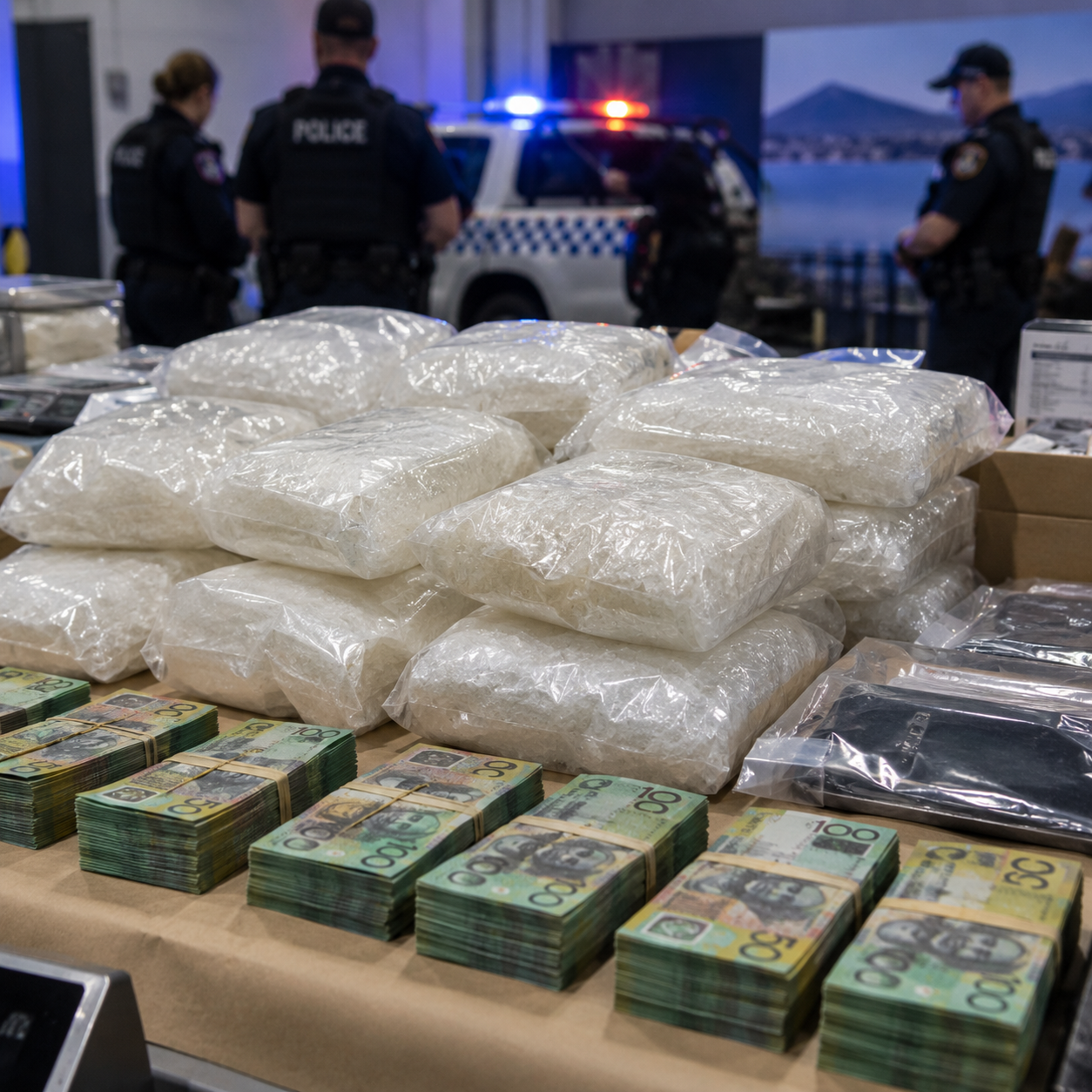
The seizure followed a targeted operation near Burnie on Friday, 18 September, involving the Tasmania Joint Organised Crime Task Force, the Western Drugs and Firearms Unit and the Special Operations Group.
Police said officers intercepted two vehicles at a beachside car park and took a 40-year-old New South Wales man and a 41-year-old Hobart man into custody.
The men have been charged. They have not been convicted, and the allegations will be tested through the court process.
What police say they found
Tasmania Police said the vehicle interception led to the discovery of 17 kilograms of methamphetamine.
Investigators estimate the drugs would have had a street value of about $8.5 million.
Police also said about $100,000 in cash was found during searches of the vehicles and other locations. Investigators allege the cash is directly linked to drug trafficking.
The 41-year-old Hobart man is alleged by police to be a member of an outlaw motorcycle group. That is a police allegation and should not be treated as proof of broader criminal conduct beyond the charges before the court.
Both men were charged with trafficking in a controlled substance and were expected to appear in the Devonport Magistrates Court.
The investigation is continuing, and police have said further arrests are anticipated.
Why the size of the seizure is significant
Police describe the 17-kilogram quantity as the largest single seizure of methamphetamine in Tasmania that they are aware of.
A large seizure can affect supply temporarily, but its wider significance depends on what investigators learn about the network behind it.
For law enforcement, the most important questions are likely to include where the methamphetamine came from, how it entered Tasmania, how it was transported within the state, who financed the shipment and who was expected to distribute it.
Those questions explain why police have emphasised that the operation is ongoing rather than presenting the seizure as the end of the case.
The quantity also gives investigators a chance to examine packaging, communications, vehicles, financial records and other evidence that may identify additional participants.
A multi-agency organised-crime operation
The operation involved the Tasmania Joint Organised Crime Task Force, which brings together state and federal agencies including Tasmania Police, the Australian Federal Police and Australian Border Force.
Joint task forces are designed for cases that can cross state or national borders. Drug supply chains often involve importation, interstate transport, money movement and local distribution, meaning no single agency necessarily holds all the relevant intelligence.
Tasmania Police said the Western Drugs and Firearms Unit and Special Operations Group were also involved in the interception, with the Southern Drugs and Firearms Unit assisting in later searches.
Detective Inspector Troy Morrisby said the task force would continue working against the broader criminal network allegedly involved in bringing drugs into Tasmania.
Police say they expect further arrests, but no additional person should be described as a suspect unless investigators identify them publicly or charges are laid.
The $8.5 million figure is a police estimate
The reported street value is useful for conveying the scale of a seizure, but it is not the same as money actually earned by an alleged trafficking network.
Police street-value estimates generally depend on assumptions about how a drug would be divided and sold at retail level.
Wholesale values can be lower, and prices can vary by purity, location, availability and transaction size.
For that reason, the most concrete figure in this case is the weight: police say 17 kilograms of methamphetamine was seized.
The $8.5 million value should remain attributed to Tasmania Police rather than presented as an independently verified market price.
Why methamphetamine remains a public-safety concern
Methamphetamine is a powerful stimulant. Public-health agencies associate heavy or dependent use with serious physical and mental-health harms, including cardiovascular problems, sleep disruption, anxiety, psychosis and increased risk of injury.
The community impact also extends beyond individual users. Drug markets can be associated with violence, debt, property crime and pressure on emergency, health and social services.
Police therefore frame large seizures as harm-prevention operations as well as criminal investigations.
Morrisby said removing the drugs from circulation prevented potential harm to individuals and the broader community.
That statement reflects the policing perspective. Measuring the long-term effect of one seizure is more complicated because illicit markets can adapt and replacement supply may emerge.
Tasmania’s geography creates a different enforcement environment
As an island state, Tasmania has fewer major entry points than mainland jurisdictions, but that does not make drug trafficking simple to stop.
Illicit substances can arrive through legitimate freight systems, passenger travel, postal routes or other supply chains. Interstate criminal networks can also use local contacts to move drugs after arrival.
A seizure near Burnie is therefore important not only because of the quantity but because it may help police map how supply enters and moves through north-west Tasmania.
The involvement of federal agencies suggests investigators are looking beyond a purely local transaction.
Police have said the broader network includes participants in Australia and overseas. That remains an investigative claim and does not establish the identity or guilt of any person who has not been charged.
Cash and financial evidence can matter as much as the drugs
The approximately $100,000 in cash that police say was seized may form part of the evidentiary picture.
Investigators in organised-crime cases often examine bank records, cash movements, asset ownership and communications to test whether money can be linked to alleged drug transactions.
In this case, Tasmania Police allege the cash found during searches was directly linked to trafficking.
That allegation will also need to be proved through the legal process if relied upon in court.
Financial investigation can help authorities identify people who organise or profit from supply without necessarily handling the drugs themselves.
Why purity and distribution matter
The 17-kilogram headline does not tell authorities how many individual retail transactions the shipment might have produced. That depends heavily on purity and how the drug would have been diluted, divided and sold.
Forensic testing can establish what was actually in the packages and provide chemical information that may assist investigators. Packaging methods and laboratory profiles can sometimes be compared with evidence from other seizures, although any claimed connection would require specific investigative support.
Police may also examine phones and other digital devices lawfully seized during the operation. Messages, location data and financial records can help reconstruct movements and relationships, but each item still has to be connected to an accused person and admitted under the rules of evidence.
What happens next in court
The laying of charges begins the criminal court process; it does not determine guilt.
Prosecutors will need to establish the elements of the alleged trafficking offences using admissible evidence. Defence lawyers can challenge the prosecution case, including the circumstances of searches, the connection between each accused person and the seized items, and any statements or electronic evidence.
The men are entitled to the presumption of innocence unless and until they are found guilty.
Because police say the investigation is still active, evidence may also develop after the first court appearance. Additional charges can sometimes be laid, withdrawn or amended as investigators analyse seized devices and other material.
The bigger question is the network behind the load
A record-sized seizure attracts attention because of the volume on the table, but the more important test for investigators is whether the operation disrupts a supply chain rather than simply intercepting one consignment.
If police can identify where the drugs were sourced, how transport was organised and how distribution was intended to work, the case may lead to further enforcement action.
If not, other suppliers may attempt to fill the gap.
That is why the Joint Organised Crime Task Force says the work is continuing.
For now, the verified facts are limited but significant: police say 17 kilograms of methamphetamine and about $100,000 in cash were seized; two men have been charged with trafficking; investigators believe the drug seizure is Tasmania’s largest single ice seizure; and further arrests are anticipated.
Everything beyond those established facts — including the full structure of the alleged network and the guilt of the accused — remains to be determined by the investigation and the courts.