A Senate inquiry has recommended removing a key Triple Zero function from Telstra and creating a new national authority to manage emergency-call operations, as part of a broader package of reforms aimed at making Australia’s emergency telecommunications system more resilient.
The final report makes 11 recommendations after an inquiry that began in response to major network failures and expanded as further problems affecting emergency calls emerged across the telecommunications sector.
The recommendations are not yet law. The federal government would need to accept, design and implement the measures before the proposed national authority, domestic roaming requirements or text-to-000 capability became part of the operating system.
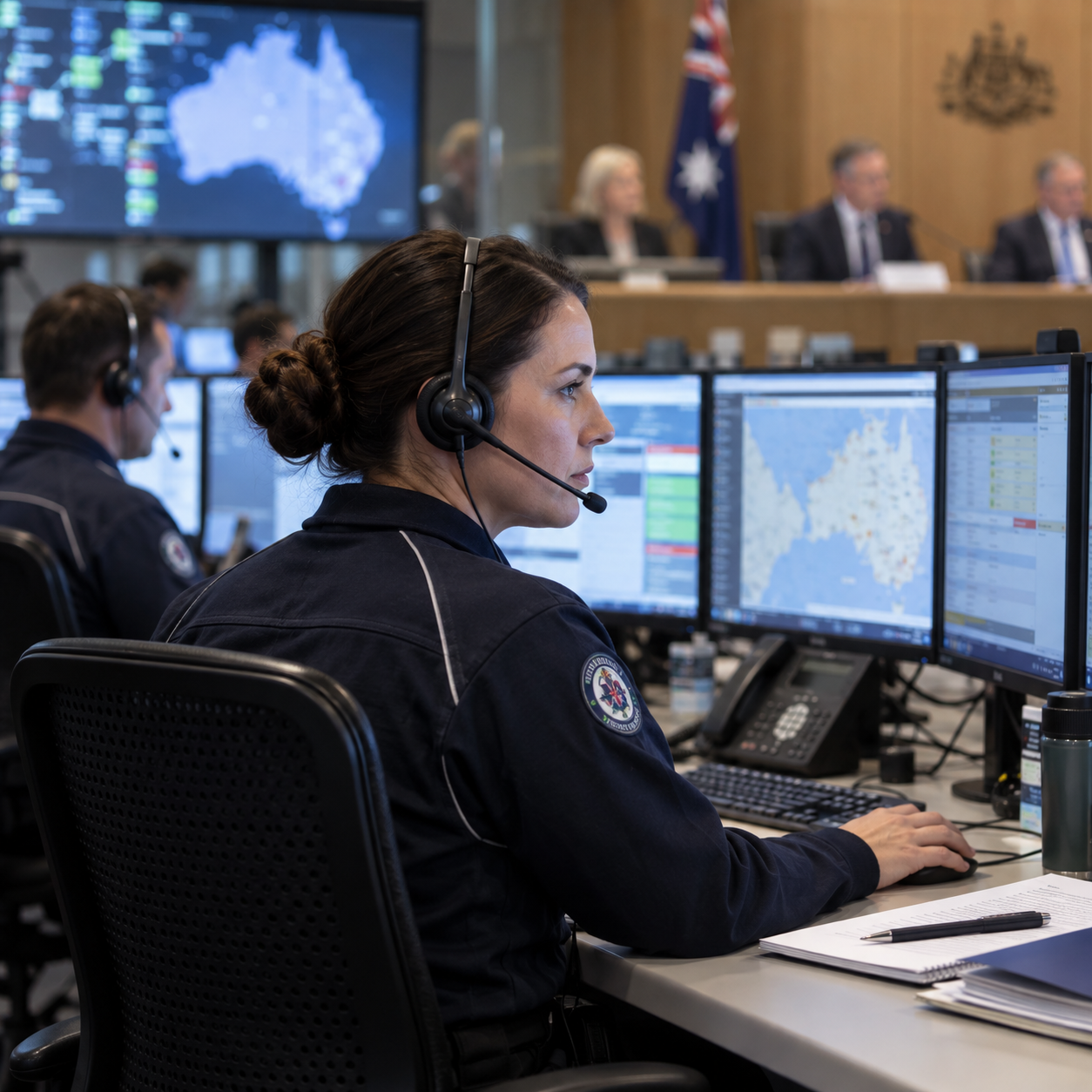
Telstra currently performs the Emergency Call Person function for Triple Zero.
That role involves receiving emergency calls and transferring them to the appropriate police, fire or ambulance service.
The Senate committee has recommended creating a national authority to take responsibility for that function instead of leaving it with a commercial telecommunications provider.
The inquiry’s chair, Greens senator Sarah Hanson-Young, has argued that an essential emergency function should be controlled through a national public authority rather than a private company.
Importantly, that recommendation was supported by committee members from multiple parties, giving the proposal broader parliamentary backing than a single-party position.
The investigation began after a major Optus outage in September 2025 that disrupted communications, including access to emergency calling.
It later widened as problems involving other telecommunications providers and mobile devices raised questions about how Australia’s emergency-call arrangements perform when individual networks fail.
That broader focus matters because the problem is not simply whether one company had a bad outage.
Triple Zero depends on multiple layers: the customer’s handset, their mobile or fixed network, routing infrastructure, the Emergency Call Person function and the local emergency service that ultimately answers the transferred call.
A failure at any point can create risk, so the inquiry has looked at both operational responsibility and the rules that govern the wider telecommunications system.
The committee has recommended mandating domestic roaming during outages.
The basic concept is that if a customer’s normal network is unavailable, their phone could use another carrier’s functioning network for essential connectivity.
Supporters argue that this could provide redundancy when one provider suffers a major failure.
Telecommunications companies have previously warned that forced roaming during a large outage could create new technical problems by suddenly shifting very large numbers of users onto networks that were not designed to absorb the extra load.
That is one of the implementation questions the government would need to resolve if it adopts the recommendation.
Any roaming framework would have to define when it activates, which services are prioritised, how network capacity is managed and who pays for traffic carried by another provider.
The inquiry has recommended developing the ability for people to contact Triple Zero by text as well as voice.
A pilot is already being developed to test whether the technology can be delivered safely and effectively.
Text access could be useful for people who cannot safely make a voice call, people with some disabilities, or situations where voice communications are difficult.
But emergency texting is not as simple as turning on an ordinary messaging inbox.
Operators need reliable location information, systems for assessing urgency, safeguards against spam or automated abuse, and procedures for situations where a person stops responding.
The pilot process is therefore important before any nationwide rollout.
The Senate report also recommends minimum performance and reliability standards for telecommunications providers.
That would move the policy debate beyond general obligations to a clearer set of measurable expectations.
The committee has also proposed automatic compensation for customers affected by outages in specified circumstances.
Such a system would need detailed rules covering the length and severity of an outage, the services affected, exemptions for disasters or events beyond a provider’s control, and whether compensation should differ between ordinary service loss and failures involving emergency communications.
The recommendation signals a shift toward stronger accountability when network reliability falls below an acceptable threshold.
The inquiry has recommended an independent review of the Australian Communications and Media Authority, the regulator responsible for much of the telecommunications framework.
The committee wants the review to consider whether ACMA has adequate powers, resources and regulatory settings to oversee Triple Zero effectively.
It has also recommended giving the regulator stronger powers to compel evidence from telecommunications companies during investigations and enforcement work.
That reflects concern that emergency communications cannot rely only on providers voluntarily explaining failures after an outage.
A regulator needs access to technical records, incident timelines and internal decision-making if it is to identify causes and enforce standards.
Moving the Emergency Call Person function into a national authority would not prevent network outages by itself.
The major potential change is governance.
Instead of the central answering and transfer function sitting with one commercial provider, it would sit with a body whose primary purpose is emergency-call operation and resilience.
That could create clearer public accountability, but it would also require funding, staffing, technology, security and transition planning.
Telstra already has infrastructure and operational experience in the role, so transferring the function would need to avoid creating disruption during the handover.
The government would also need to decide whether the new authority would operate its own technical platform or contract parts of the service while retaining public responsibility.
Australia’s emergency-call system is national at the front end but ultimately connects people to state and territory emergency services.
That means reform requires coordination across jurisdictions.
Police, ambulance and fire services use their own dispatch systems and operating procedures, while telecommunications networks are regulated nationally.
A new authority would therefore need formal arrangements with each jurisdiction so transfers, location data and service continuity work consistently.
It would also need disaster-recovery capability because the system must continue operating during bushfires, floods, storms, cyber incidents and power failures — exactly when communications networks can be under their greatest pressure.
Most telecommunications outages are frustrating because people lose internet, mobile calls or business services.
Triple Zero failures are different because delayed contact with emergency services can involve immediate risks to life and safety.
That is why the inquiry has treated the emergency-call system as critical national infrastructure rather than an ordinary customer-service function.
The public expectation is that even when a provider experiences a network problem, emergency calling should have multiple layers of redundancy.
No system can guarantee zero failures, but regulators can require providers to design for resilience, test backup pathways and report incidents quickly.
The report does not itself transfer control away from Telstra.
It does not activate nationwide domestic roaming, create automatic outage compensation or allow Australians immediately to text Triple Zero.
Those steps would require government decisions, detailed technical design and, for some measures, legislation or regulatory changes.
It is therefore important to describe the national authority as a Senate recommendation rather than an established agency.
The federal government will need to respond to the inquiry’s final report.
It can accept recommendations in full, support them in principle while changing the design, reject them or refer parts of the package for further work.
If the national authority proposal is adopted, the transition plan will be one of the most important documents to watch.
Key issues will include governance, funding, technical architecture, staffing, cybersecurity, continuity arrangements and the timeline for taking over the Emergency Call Person role.
For domestic roaming, regulators and carriers will need to resolve capacity and activation rules.
For text-to-000, the pilot will need to demonstrate that emergency operators can authenticate, locate and triage messages safely.
The inquiry’s 11 recommendations point in one direction: reducing the chance that a single network, company, technical failure or regulatory gap can interrupt access to emergency help.
Whether every recommendation is ultimately adopted remains a political and technical decision for government.
For now, the verified position is that a Senate inquiry has recommended a new national authority take over the Emergency Call Person function currently performed by Telstra, alongside domestic roaming, text-to-000 capability, reliability standards, compensation mechanisms and stronger regulatory oversight.
Those are proposed reforms, not changes that have already taken effect.