Exceptional rainfall has turned parts of outback South Australia into a vast display of Sturt’s desert peas, with park rangers describing the flowering as the strongest they have seen in the region since 1974.
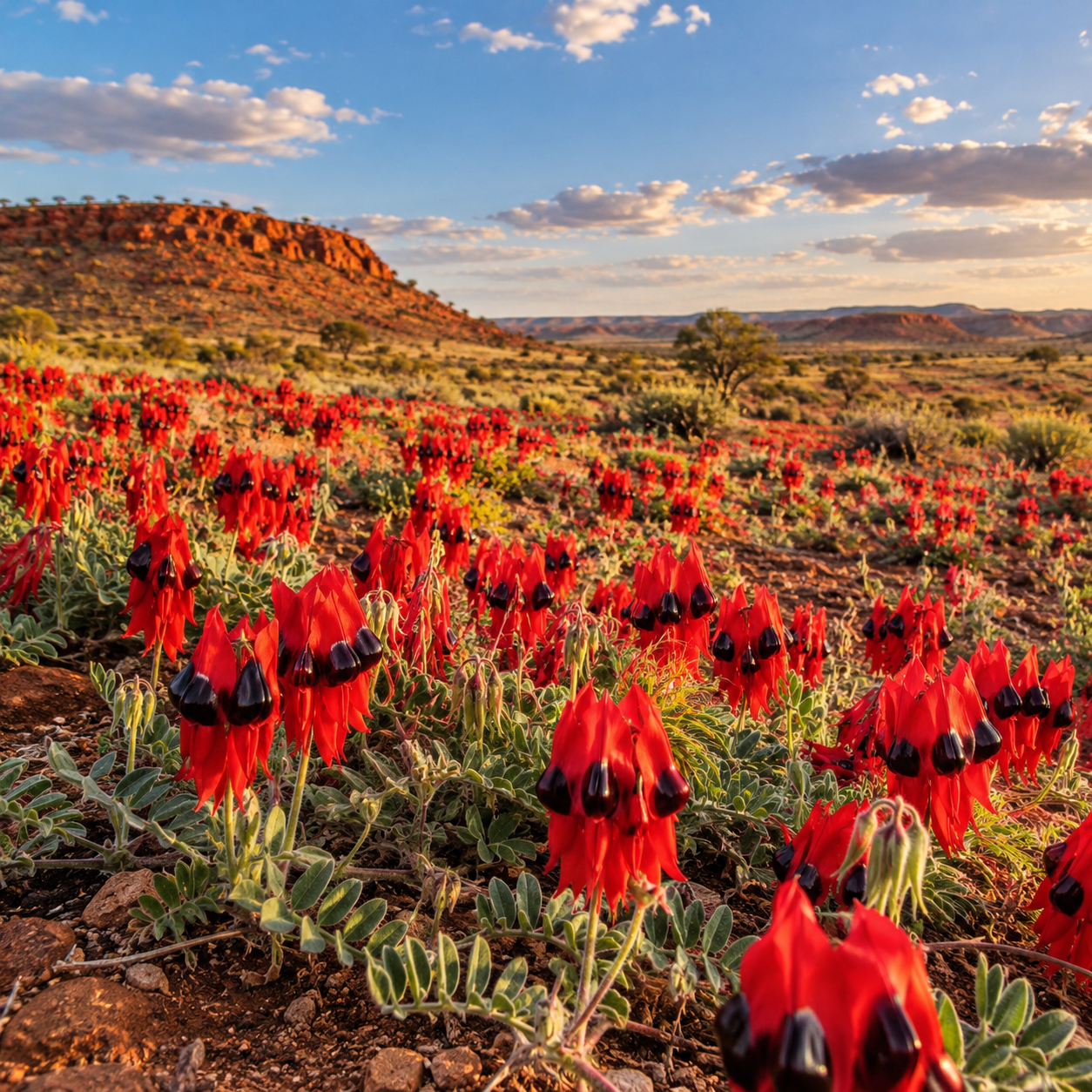
The usually arid landscape across the Flinders Ranges and other parts of northern South Australia has been transformed by mass germination after rainfall totals reached several times the regional average in some areas.
Sturt’s desert peas have also appeared in large numbers farther east near the South Australia–New South Wales border.
For residents and visitors, the result is a rare “super bloom” of one of Australia’s most recognisable native flowers.
Most Sturt’s desert peas have vivid red petals and a glossy dark centre, but this season’s enormous flowering has also revealed unusual pink, white and purple forms.
Those colour variations are normally rare enough that people may see only an occasional plant among a field of red flowers.
When millions of plants germinate at once, uncommon genetic variations become much easier to spot.
The scale of this year’s display is closely tied to the way desert plants survive long dry periods.
Sturt’s desert pea seeds can remain dormant in the soil for years while conditions are too dry for successful growth.
Their hard seed coat helps protect them until moisture, temperature and soil conditions are suitable.
When prolonged or unusually heavy rain arrives, large numbers of seeds can germinate in the same season.
Flinders and Outback Parks and Wildlife manager Phillip Strachan said parts of the region had received three or four times their average rainfall.
Rangers say they have not seen as many Sturt’s desert peas in the area since 1974, another year remembered for exceptional inland rainfall.
The flowers have also arrived relatively early and continued across wide areas rather than appearing as isolated patches.
For people accustomed to the muted reds, browns and greens of the dry interior, the visual change can be dramatic.
Sturt’s desert pea, scientifically known as Swainsona formosa, was adopted as South Australia’s floral emblem in 1961.
It occurs across arid parts of mainland Australia and is especially associated with inland South Australia.
The plant grows low to the ground, spreading across open country with grey-green foliage and distinctive upright flower clusters.
Its flowers are usually scarlet or blood-red with a dark central “boss”, although natural forms can range from white through pink and purple.
The species is adapted to harsh inland conditions but can be surprisingly difficult to grow in gardens.
Adelaide Botanic Gardens staff use scarification — deliberately nicking or weakening the hard seed coat — to help seeds absorb water and germinate reliably.
In the wild, weathering and environmental conditions perform that role over much longer periods.
The plant also needs excellent drainage.
It can respond strongly to moisture, but it does not tolerate water sitting around its roots for long periods and can struggle in humid environments.
That combination helps explain why a desert super bloom can follow heavy rain without meaning the species suddenly prefers permanently wet conditions.
The rain provides the trigger, but the plants still depend on fast-draining arid soils and the return of dry conditions.
This year’s bloom is part of a broader ecological response to exceptional inland rainfall.
After long dry periods, rain can trigger grasses, herbs and wildflowers across areas that may have appeared almost bare.
Insects respond to flowering plants, and birds and other animals can take advantage of temporary increases in food and water.
Those pulses are a normal part of desert ecology, although their timing and scale vary greatly from year to year.
A super bloom should therefore be seen as a temporary event rather than a permanent transformation of the landscape.
As temperatures rise and soil moisture falls, many annual and short-lived plants will complete their life cycle and return seed to the soil.
That seed bank becomes the foundation for the next major flowering event, which may be years away.
The rarity of the display is one reason visitors are travelling to see it.
Tourism can bring valuable spending to remote communities, fuel stations, accommodation providers and local businesses, particularly after difficult dry seasons.
But large visitor numbers can also damage the very plants people have come to photograph.
Sturt’s desert pea is protected in South Australia.
People should not pick wild flowers on public land, and collection rules also apply on other land depending on ownership and permission.
Visitors should avoid driving off designated tracks, trampling flower patches or entering private pastoral land without permission.
Many outback roads also remain vulnerable after heavy rain.
A road that looks dry at one point can still be damaged, closed or impassable farther ahead, so travellers should check current road conditions and park advice before setting out.
Remote travel also requires basic preparation: fuel, water, a suitable vehicle, communications and awareness that mobile coverage may be limited.
The flowering itself does not remove the ordinary risks of travelling in arid country.
The unusual colours have become one of the biggest attractions of the 2026 bloom.
On stations near the South Australia–New South Wales border, residents have photographed white, pink and purple plants among the usual red-and-black forms.
Horticulture specialists say the typical red form accounts for the overwhelming majority of plants, making those variations particularly noticeable during a huge flowering season.
The scale of the bloom also provides scientists and horticulturists with an opportunity to observe natural variation across a much larger population.
That can help improve understanding of seed dormancy, colour genetics and how the species responds to different rainfall patterns.
Sturt’s desert pea has cultural significance beyond botany.
It has been South Australia’s floral emblem for more than six decades and appears in public art, design and state symbolism.
Its common name commemorates explorer Charles Sturt, who recorded the plant during nineteenth-century journeys through inland Australia, although Aboriginal peoples knew and interacted with the plant and its country long before European exploration.
The modern scientific name Swainsona formosa places it in the pea family, Fabaceae.
For many Australians, however, its significance is simpler: few plants are so strongly associated with the red interior of the continent.
That makes a whole hillside covered in the flowers particularly striking.
The bloom will not last indefinitely, and there is no guaranteed date on which every location will be at its best.
Flowering can vary with local rainfall, temperature, grazing pressure and soil conditions.
People planning a trip should use current park and local advice rather than relying on photos taken weeks earlier.
The most important message is to enjoy the event without damaging it.
The 2026 super bloom is the product of seeds waiting through years of difficult conditions until the right combination of rain and temperature arrived.
If visitors stay on tracks, respect private property and leave the flowers where they are growing, the display can be experienced without reducing the seed and plant population that will support future blooms.
The flowering is also a reminder that arid-country ecosystems are driven by pulses rather than steady conditions. Years of low rainfall can be followed by a short period in which dormant plants, insects and animals respond rapidly to water spread across a vast area.
For pastoralists, those seasons can bring both opportunities and challenges. Extra plant growth may improve feed in some areas, but heavy rainfall can also damage roads, isolate properties and change where stock can safely move.
For conservation managers, a mass flowering creates a rare chance to observe plants across a broad geographic area at the same time. It can reveal colour forms and local populations that are almost invisible in dry years.
The Sturt’s desert pea is particularly suited to that cycle. Its hard-coated seed can remain in the soil through long periods of unsuitable weather. Once conditions trigger germination, the plant grows rapidly, flowers and produces the next generation of seed before the landscape dries again.
South Australia’s decision to adopt the species as its floral emblem in 1961 reflects how strongly it is associated with the state’s interior. The plant is protected, and removing flowers from public land can be illegal.
That protection matters most during a spectacular season because social-media images can attract people to fragile patches very quickly. One vehicle driven off-track or repeated trampling around a photogenic cluster can destroy plants that took years of rainfall timing to appear.
The best way to experience the bloom is therefore also the simplest: use designated roads and walking areas, photograph the flowers where they grow and leave them intact to set seed for the future.
For now, outback South Australia is showing what arid landscapes can do after exceptional rain: a place often defined by scarcity has become a broad field of red, black, pink, white and purple, in what rangers say is the most remarkable Sturt’s desert pea season in more than half a century.