NSW public schools will introduce new limits on student screen use from the start of 2027, with younger children facing the tightest caps and high-school students given more flexibility depending on the subject.
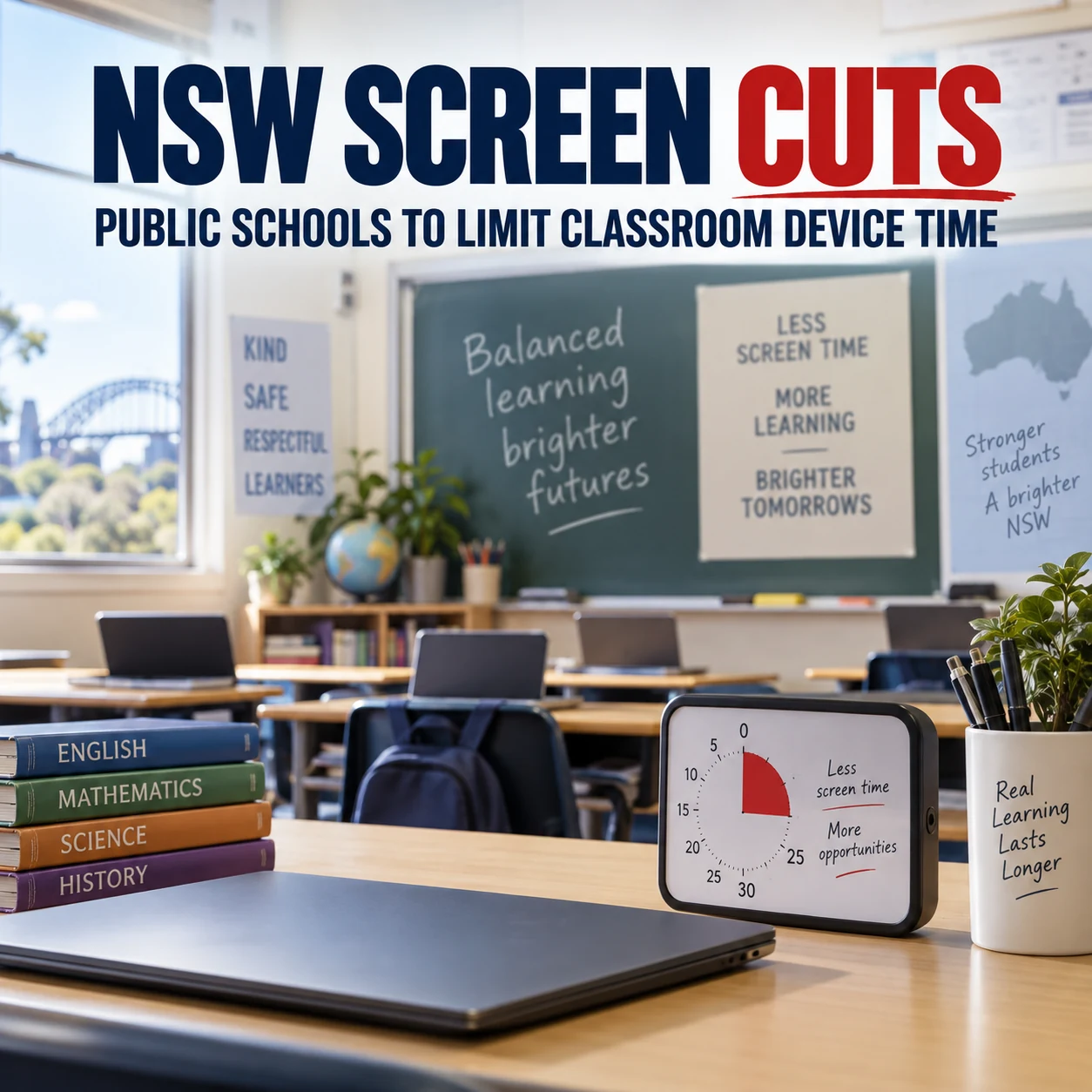
The NSW Government says the change is designed to reduce unnecessary device use, improve attention and make sure technology is used when it adds genuine educational value rather than becoming the default way to teach.
What are the new limits?
From Day 1 of Term 1, 2027, public schools will begin working to recommended maximum times for individual student devices such as laptops, desktop computers and tablets.
Public preschools will have no individual student device use. Kindergarten to Year 2 students will be limited to up to 15 minutes a day, Years 3 and 4 to 30 minutes a day, and Years 5 and 6 to 45 minutes a day.
For Years 7 to 10, device use will be capped at up to 25 per cent of lesson time for each subject. Years 11 and 12 will be able to spend up to 50 per cent of lesson time on individual devices.
The NSW Department of Education says those maximums should be considered as an average across a week, rather than treated as a rigid stopwatch for every lesson.
The guidelines will be introduced in 2027 and become mandatory in 2028, giving schools time to adjust programs, teaching resources and Bring Your Own Device arrangements.
Does this mean laptops are being removed from classrooms?
No. The policy is not a ban on educational technology.
The department says digital literacy will remain a core part of learning and that devices should continue to be used when they are the best tool for a particular task. The aim is to reduce routine or recreational use and build more time for handwriting, reading from paper, discussion and other forms of learning.
The new principles say students should use individual devices when a teacher explicitly directs them to do so. Interactive whiteboards should be used for teacher-led instruction and turned off when they are not needed. Screens should generally not be used as a reward for behaviour or simply to fill transition time.
The department is also recommending at least one hour a day of learning using pen and paper, reflecting research cited by the government on the benefits of handwriting and reading from physical pages.
What about homework?
For students from Kindergarten to Year 4, homework that requires a digital device will not be recommended under the new approach.
For Years 5 to 12, digital homework should only be set when using a device is more effective for learning than the available non-digital alternative.
That could mean fewer routine online worksheets or platform-based tasks for younger children, while still allowing digital work where it is clearly useful.
Are there exemptions?
Yes. The guidelines include exemptions for students who need technology as a reasonable adjustment for disability or specific learning needs, for translation devices, distance education, online support programs and computer-based testing.
Subjects that inherently require significant device use, such as software engineering, can also be exempt from the general maximums.
That means schools will still need to apply judgment. A student using assistive technology is not in the same position as a student watching a video or completing a task that could easily be done on paper.
Why is NSW making the change?
The government says screen use has expanded to the point where it can distract from learning. Research cited in the announcement found that about half of surveyed students reported being distracted by screens in class.
Education Minister Prue Car said the government wanted schools to get back to basics, with pen and paper becoming the default more often instead of devices.
The move builds on the NSW public-school mobile phone ban introduced in 2023. Under that policy, students are generally not allowed to use mobile phones at school, including during recess and lunch, unless an exemption applies.
The new screen-time approach goes further because it deals with school-provided or student-owned learning devices, not just personal phones.
What should parents expect next?
Schools will spend the coming months working with families and communities on how the guidelines will operate locally. Schools with existing Bring Your Own Device programs will need to review those arrangements against the new recommended limits.
Parents may see more printed material, handwriting, paper-based reading and device-free lesson time. They may also see teachers become more selective about when students open a laptop or tablet.
The government’s position is not that screens are inherently bad. It is that technology should have a clear learning purpose every time it is used.
One practical point for families is that the limits are not designed to operate like a stopwatch in every classroom. The department says the maximums should be considered as an average across a week. That gives teachers room to use more device time in a lesson where technology is genuinely useful and less in another lesson where handwriting, discussion, practical work or paper-based reading is more appropriate.
For secondary students, the percentage-based limits also need to be understood in context. A Year 7 to 10 class is not being told that every lesson must stop at exactly one quarter of the scheduled time. The policy sets an average ceiling for individual-device use across the subject, allowing schools to plan sequences of lessons rather than treat every period identically.
The same principle applies to senior students, where up to half of lesson time can involve individual devices. That recognises that Years 11 and 12 can include research, digital assessment, specialist software and subjects where screen-based work is a normal part of the curriculum.
Parents should also expect differences between schools during the transition. A school that already relies heavily on laptops through a Bring Your Own Device program may need larger changes than a school where students already spend substantial time using books, paper and shared classroom resources. The department says schools will work with their communities as they review existing arrangements.
The 2027 start is therefore best understood as an implementation year rather than an overnight ban. Schools will begin applying the guidelines from Term 1, receive support resources and adjust teaching practice, with the limits becoming mandatory in 2028. That staged approach gives teachers and school leaders time to identify where device use is essential and where it has simply become habitual.
The policy may also change purchasing decisions. Families who have been asked to buy laptops or tablets for school may reasonably want to know how often those devices will now be used, while schools will need to explain how BYOD programs fit with the new maximums. The guidelines do not make existing devices useless, but they could reduce the expectation that a student should have a screen open for most of the school day.
There is a broader educational debate behind the announcement. Supporters of tighter limits argue that handwriting, reading on paper, face-to-face discussion and sustained attention can be crowded out when digital platforms become the default. Others point out that students still need strong digital skills and that modern workplaces require confidence with online tools, research and software.
The NSW approach tries to split the difference. It keeps technology in the classroom but asks teachers to justify its educational purpose. A laptop is still appropriate when it enables something meaningfully better — coding, design, research, data analysis, accessibility support or specialised learning — but not simply because a digital worksheet is available.
That distinction is why exemptions matter. Students using assistive technology or translation tools should not lose access because of a general screen-time target, and subjects built around computers cannot realistically be taught under the same limits as a primary-school literacy lesson. The department’s framework recognises those differences rather than applying one number to every student and every subject.
The homework guidance is another significant change for families. For children in Kindergarten to Year 4, schools are being told not to recommend homework that requires a digital device. For older students, digital homework should be used only where the device makes the learning more effective than a non-digital alternative. That could reduce the number of routine online tasks that require families to manage devices at home after a full school day.
The government is also linking the policy to broader efforts to reduce distraction. NSW public schools already restrict student mobile-phone use during the school day. The new guidelines extend the conversation from personal phones to educational screens, recognising that a device can be both a learning tool and a source of distraction depending on how it is used.
For teachers, the challenge will be implementation rather than principle. Many classrooms have spent years building digital systems for assignments, feedback and communication. Moving some activities back to paper or face-to-face instruction will require planning, resources and consistency so that the change does not simply create extra workload without improving learning.
For parents, the most useful question will not be “How many minutes was my child on a screen today?” but “Was the screen being used for something that genuinely improved the lesson?” That is the test the government says it wants schools to apply.
The practical takeaway is simple: from 2027, NSW public schools will begin moving toward less routine screen use, especially in the early years, while still keeping digital tools available where they genuinely improve learning. The guidelines will be introduced with flexibility during the transition and become mandatory in 2028.