Medical retrieval helicopters still cannot use helipads at two major regional South Australian hospitals, forcing crews to land at alternative sites and transfer patients by road ambulance for the final part of urgent journeys.
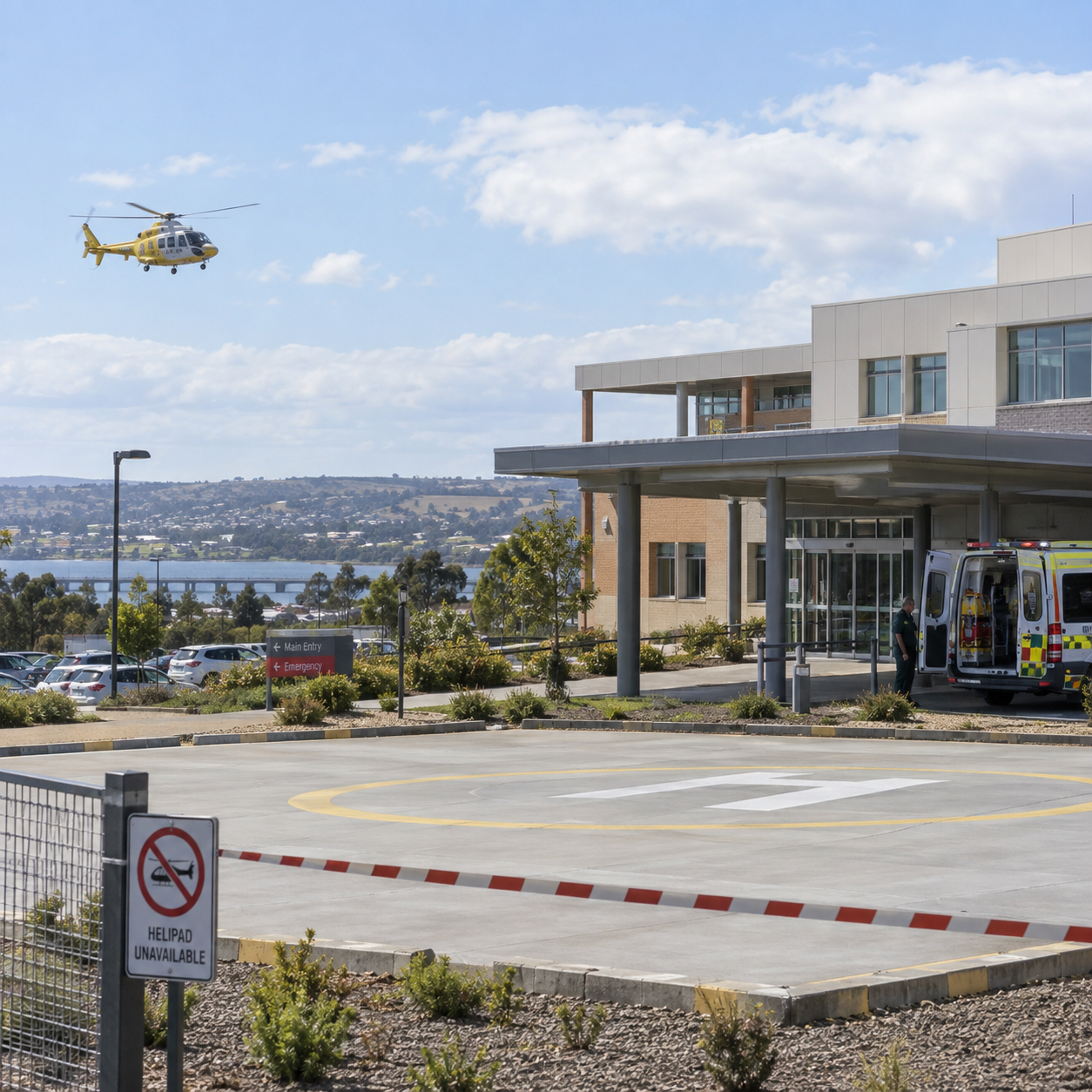
The affected facilities are the Murray Bridge Soldiers’ Memorial Hospital and the Southern Fleurieu Health Service at Victor Harbor.
Both helipads were among regional sites affected by safety and compliance reviews after updated aviation requirements changed the clear space needed around hospital landing areas.
South Australia’s MedSTAR retrieval service remains available to patients in both regions, but helicopters are currently using nearby alternative landing sites rather than landing directly at the hospital.
That means an ambulance must meet the aircraft, move the patient between the temporary landing site and the hospital, and coordinate the transfer with the aeromedical team.
For critically ill or injured patients, every transfer creates additional handling and logistics, although health authorities say the alternative arrangements are operating safely.
The state government says it has invested $23.4 million in upgrading regional helipads to meet updated Civil Aviation Safety Authority requirements.
Thirteen helipads were temporarily closed during the broader review and upgrade program. Most have returned to service, leaving Murray Bridge and Victor Harbor as the two unresolved hospital sites highlighted in the latest reporting.
Health Minister Blair Boyer has indicated that Murray Bridge is closer to reopening.
The government has been working through concerns about the area around the landing site, including homes that may fall within the helicopter downwash zone.
A clear area around a helipad matters because rotor wash can create hazards for people, loose objects, structures and vehicles close to a landing helicopter.
Local representatives have pressed the government for a specific reopening date.
One Nation MP Robert Roylance has told parliament that his Murray Bridge electorate wants to know whether “soon” means weeks, months or longer.
The government has not given a firm public date but says work is continuing to bring the site back into operation.
The Victor Harbor problem is more complicated.
A childcare centre is located close to the hospital helipad, creating a conflict between the aviation safety area required for helicopter operations and the existing use of neighbouring land.
The health minister has described the issue as requiring longer-term planning.
Independent MP Lou Nicholson has said she understands the government is seeking a solution before the childcare centre’s lease expires rather than simply waiting for the lease to run out.
No confirmed reopening date has been announced for Victor Harbor.
The situation shows why hospital helipads are not simply painted landing circles.
A medical helicopter landing area has to account for approach and departure paths, obstacles, lighting, surface strength, emergency access and the high winds generated by rotor blades.
Hospitals can also be difficult sites because they are often surrounded by homes, roads, trees, powerlines, car parks and buildings that have developed over time.
A helipad that operated safely under an older standard may need changes when requirements are updated or when new development appears nearby.
For regional communities, the practical concern is patient transfer time.
MedSTAR is South Australia’s specialist emergency medical retrieval service. It provides advanced medical care and transport for critically ill or injured patients who need treatment that may not be available at a smaller regional hospital.
Helicopters can move specialist teams rapidly over long distances and can transfer patients to major Adelaide hospitals when road transport would take much longer.
Direct landing at a hospital can reduce the number of transfer stages.
When the aircraft has to use a nearby oval or other site, the system relies on local ambulance crews to bridge the gap.
That does not mean retrieval services have stopped. The government has explicitly said medical retrieval remains available in both areas.
It does mean that an additional road leg is built into the operation.
The effect of that extra leg depends on the location of the temporary landing site, traffic conditions, patient condition and how well the transfer is coordinated.
Health systems use contingency arrangements like these when an on-site helipad is unavailable, and clinicians decide the safest transport option based on the individual case.
It would therefore be inaccurate to claim that patients cannot be airlifted from Murray Bridge or Victor Harbor at all.
The issue is that helicopters cannot currently land at the hospital helipads themselves.
The statewide upgrade program reflects a broader safety trade-off.
Keeping a helipad open is useful for access, but aviation authorities and health services also have to ensure that the site meets contemporary safety requirements.
If a landing area is too close to buildings, people or obstacles, continuing normal operations can introduce risk to patients, crews and the surrounding community.
Regional hospitals often face tougher infrastructure constraints than metropolitan sites because they were built decades ago and may have less spare land for relocation.
Murray Bridge is a growing regional centre east of Adelaide, while Victor Harbor serves the Fleurieu Peninsula and a large population of older residents as well as seasonal visitors.
Both hospitals are important transfer points when patients need higher-level care.
That is why delays in restoring the helipads have become a local political issue.
The $23.4 million statewide investment suggests the problem is not simply a matter of repainting the landing surface.
Upgrades can involve engineering assessments, obstacle management, lighting, fencing, access, surface work and changes to surrounding land uses.
At Murray Bridge, the government appears to be working toward a technical and community solution around the downwash area.
At Victor Harbor, the nearby childcare centre creates a land-use problem that may require a different location or a more substantial redesign.
Those differences explain why the two sites may not reopen on the same timetable.
For patients and families, the immediate system remains the same: call emergency services when urgent help is needed, and clinical teams will decide whether road or aeromedical retrieval is appropriate.
Individuals should not attempt to travel to temporary helicopter landing sites themselves.
Emergency transfers are coordinated between hospitals, SA Ambulance Service and MedSTAR.
The public-interest question now is how long temporary arrangements should remain in place.
Alternative landing sites can keep services operating, but they are not a substitute for a direct hospital helipad if a safe permanent solution can be delivered.
Local MPs are therefore seeking clearer milestones from the government.
Murray Bridge may reopen first, but “soon” has not yet been translated into a public date.
Victor Harbor remains the more difficult site, with no confirmed reopening date and a planning problem involving neighbouring childcare use.
Until those issues are resolved, medical helicopters will continue serving both communities through alternative landing sites and ambulance transfers.
The closures also illustrate how aviation standards can interact with land use around hospitals. A site may have enough space for the physical helicopter pad while still failing requirements because houses, fences, trees or other occupied areas sit inside safety or downwash zones.
At Murray Bridge, local discussion has focused on nearby homes. At Victor Harbor, the proximity of the childcare centre makes the issue more sensitive because children and staff regularly occupy land close to the landing area.
Any permanent solution has to work for both emergency medicine and the people living or working beside the hospital. Moving a helipad can require planning approval, new access routes and substantial capital works. Moving another land use, such as a childcare centre, creates a different set of costs and community impacts.
The statewide response also needs consistency. The 13 temporary closures showed that the updated requirements were not a problem unique to one hospital. Most sites have since returned to operation, suggesting upgrades or local solutions were possible, but the remaining two have site-specific obstacles that are harder to resolve.
Regional retrieval planning is designed with redundancy because aircraft can be affected by weather, maintenance and landing-site conditions even when a helipad is fully operational. Road ambulances therefore remain part of the system, and clinicians can choose alternative transport when flying is not appropriate.
That resilience is reassuring, but it does not remove the benefit of direct landing. Every avoided transfer can simplify a time-critical journey and reduce coordination demands on local ambulance crews.
The unresolved question is therefore not whether South Australia still has aeromedical coverage — it does — but when the two hospitals will regain the direct access originally intended by their helipads.
The key point for residents is that retrieval capability remains available, but the two hospitals are still missing the direct helicopter access that regional clinicians and communities want restored.