James Vlassakis, one of the men convicted over the notorious Snowtown murders, will be released on parole after a review upheld the South Australian Parole Board’s decision and rejected the state government’s attempt to overturn it.
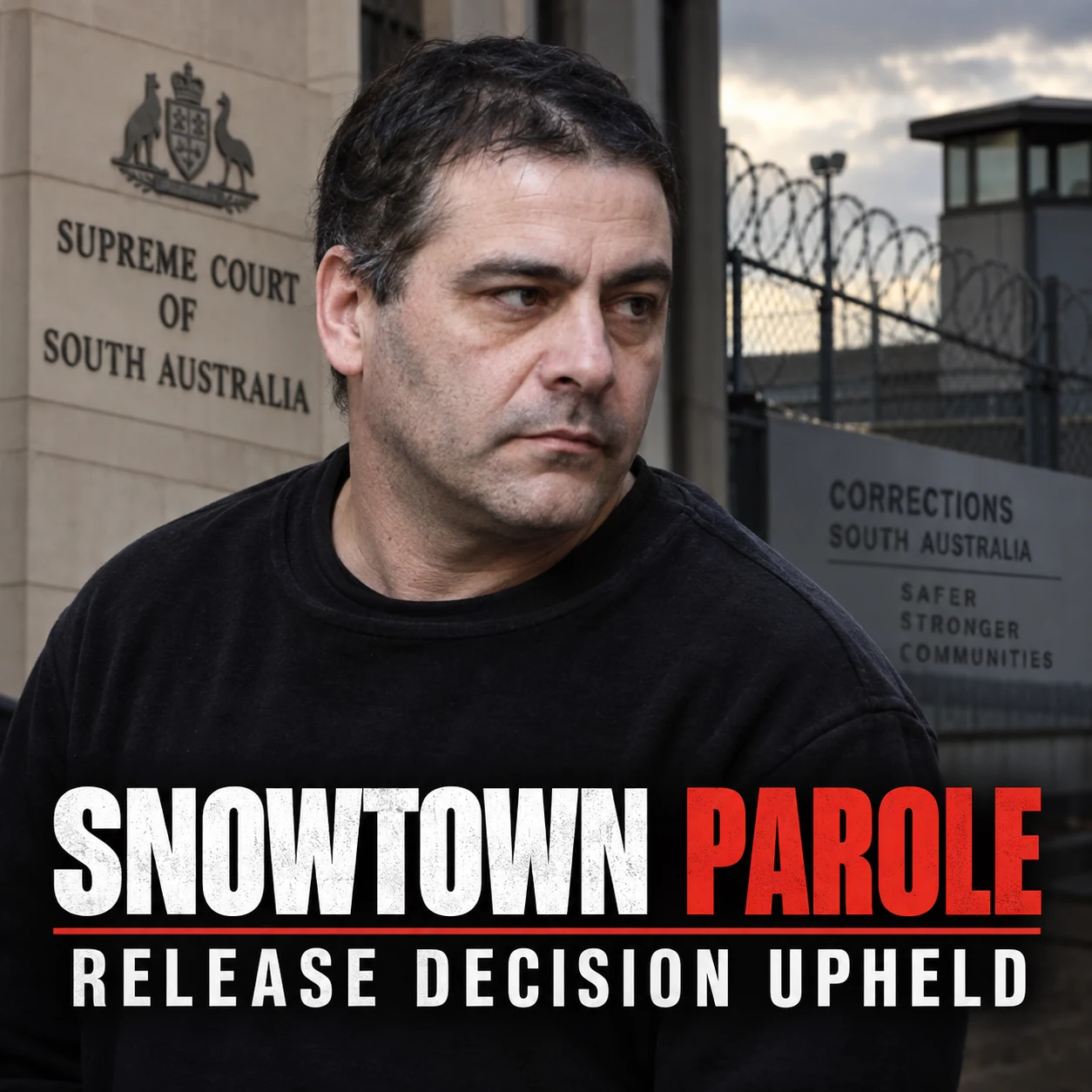
The decision was confirmed on Tuesday after the Parole Administrative Review Commissioner found that the Attorney-General had not established sufficient grounds to set aside the board’s earlier ruling.
Vlassakis was the youngest of the four principal offenders associated with the so-called “bodies in the barrels” killings, a series of murders that shocked South Australia and the country in the 1990s. He pleaded guilty to four murders and later became a prosecution witness against other offenders.
The Parole Board had granted him release last year after he completed the minimum period of his life sentence. The South Australian government then sought a formal review, arguing that the seriousness of the crimes and community safety required the decision to be reconsidered.
That review has now concluded without the parole decision being overturned.
The case is especially sensitive because of the scale and brutality of the Snowtown crimes and the enduring trauma carried by victims’ families. The murders took place between 1992 and 1999. Eight victims were eventually found in barrels stored in a disused bank vault in Snowtown, north of Adelaide, while the wider case involved a larger number of deaths.
Vlassakis was a teenager when he became involved with the group led by John Bunting. He later cooperated with police and gave evidence that helped prosecutors secure convictions against other participants. That cooperation has long been part of the legal context surrounding his sentence and later parole consideration, but it does not diminish the seriousness of the offences to which he pleaded guilty.
The decision to release him has therefore produced two competing concerns. The first is the principle that parole authorities operate independently and assess risk after a prisoner has served the non-parole period set by the courts. The second is the fear and distress experienced by victims’ families when someone involved in an exceptionally notorious crime is allowed to return to the community.
South Australia’s parole system gives the Parole Board responsibility for deciding whether eligible prisoners can be released under supervision. The board can impose strict conditions, and life-sentence prisoners can face significant monitoring and restrictions after release.
Last year, when Vlassakis’ parole application became public, South Australian parliamentary debate focused on public safety, victim consultation and the safeguards applied to life-sentence prisoners. The Attorney-General stressed at the time that the Parole Board is independent of government.
The state nevertheless used its legal avenue to seek review of the decision. According to the latest ABC report, the Parole Administrative Review Commissioner has now found that the Attorney-General failed to establish reasons that justified overturning the board’s ruling.
That finding does not mean the review commissioner endorsed the original crimes, nor does it amount to a judgment that community concerns are unfounded. It means the legal threshold for reversing the parole decision was not met.
For victims’ families, that distinction may offer little comfort. The South Australian Commissioner for Victims’ Rights has previously acknowledged the distress caused when parole is considered for offenders connected to the Snowtown murders, noting the continuing fear and trauma experienced by those affected.
The government has said community safety remains central to the parole framework. Conditions for Vlassakis’ release are expected to govern where he can live, who he can contact and how closely he is supervised. Public reporting has also indicated restrictions may apply to contact with victims’ families and the media.
The exact release arrangements are a matter for the relevant authorities and should not be inferred beyond what is formally confirmed. What is clear is that the legal challenge to the parole decision has run its course at this stage and the original decision stands.
The case is likely to renew debate about whether South Australia’s parole laws strike the right balance for prisoners serving life sentences. Supporters of the current system argue that independent decision-making is essential and that parole is not the same as the end of a sentence: a person remains subject to conditions and supervision in the community.
Critics are likely to focus on the nature of the Snowtown crimes and question whether some offenders should ever be released, regardless of rehabilitation, cooperation with authorities or the length of time already served.
The legal history also helps explain why the latest decision matters. Vlassakis was sentenced to life imprisonment with a non-parole period of 26 years. He was 18 when he became involved in the Snowtown killings and later pleaded guilty to four murders. After his arrest he cooperated with authorities and gave evidence against other offenders, including evidence used in prosecutions that resulted in much harsher sentences for the principal perpetrators.
That cooperation is relevant to the parole process because parole decisions are not a second trial of the original crimes. The board considers whether a prisoner who has reached the end of the court-imposed non-parole period can be managed safely in the community under conditions. The gravity of the offending remains central, but authorities can also consider conduct in custody, rehabilitation, risk assessments, cooperation and the proposed release plan.
The original decision to grant Vlassakis parole was made in August 2025. He did not immediately walk free. The South Australian government challenged the outcome through the review process, and he remained in custody while that challenge was considered. A further review was required this year after changes in the review arrangements, with newly appointed Parole Administrative Review Commissioner David Lovell taking responsibility for the matter.
The commissioner’s latest conclusion was narrow but decisive: the Attorney-General had not established grounds that justified overturning the Parole Board’s decision. In practical terms, that means the government’s review pathway did not displace the board’s original assessment.
That outcome illustrates the separation between political concern and the legal test. Governments can respond to community anxiety, seek reviews and propose changes to parole law, but an individual parole decision must still be made under the legislation and evidence applying to that prisoner. A case can be politically explosive without giving a review body a lawful basis to substitute a different outcome.
For families connected to the Snowtown victims, the process has been prolonged. Every new hearing, review and public announcement can bring the crimes back into the headlines decades after the murders. The South Australian Commissioner for Victims’ Rights has said victims and families must be heard through parole processes, even though their views do not by themselves determine the legal result.
The conditions attached to release will therefore be important. Life-sentence prisoners released on parole remain subject to supervision and can face restrictions on movement, contact, substances, reporting and other behaviour depending on the order made. Breaching parole can have serious consequences, including a return to custody. The exact conditions applying to Vlassakis should be taken from the formal parole arrangements rather than assumed from the notoriety of the case.
That distinction is often lost in public discussion. “Released on parole” does not mean the life sentence disappears. It means the custodial part of the sentence is being served differently, with the person living in the community under a legal supervision framework instead of remaining inside prison.
The Snowtown case inevitably tests public confidence in that framework because of the nature of the offending. Many Australians will regard any release as difficult to accept. Others will point to the purpose of a non-parole period: once a prisoner becomes legally eligible, the parole system is required to assess present risk rather than simply repeat the punishment already imposed by the sentencing court.
That does not mean the law is fixed forever. Parliament can tighten eligibility rules, alter review powers or create special provisions for categories of serious offenders, provided those changes comply with constitutional and legal requirements. South Australia has changed parole laws before in response to high-profile cases, and the Vlassakis decision may renew calls for another debate.
But changing the law prospectively is different from overturning an individual decision under the law that currently applies. The review commissioner’s role was not to decide whether the Snowtown murders were sufficiently horrific — that is beyond dispute — but whether the legal grounds existed to set aside the board’s parole decision.
Those are ultimately questions for parliament and the law. In Vlassakis’ individual case, the operative fact is now settled: after more than a year of reviews and government challenge, the Parole Board’s decision has survived, clearing the way for his conditional release while the life sentence and parole supervision continue.