The Coalition has proposed a major overhaul of Australia’s school curriculum that would remove the three existing cross-curriculum priorities and place greater emphasis on what shadow education minister Julian Leeser describes as “Western values”, civics, literature, philosophy and national pride.
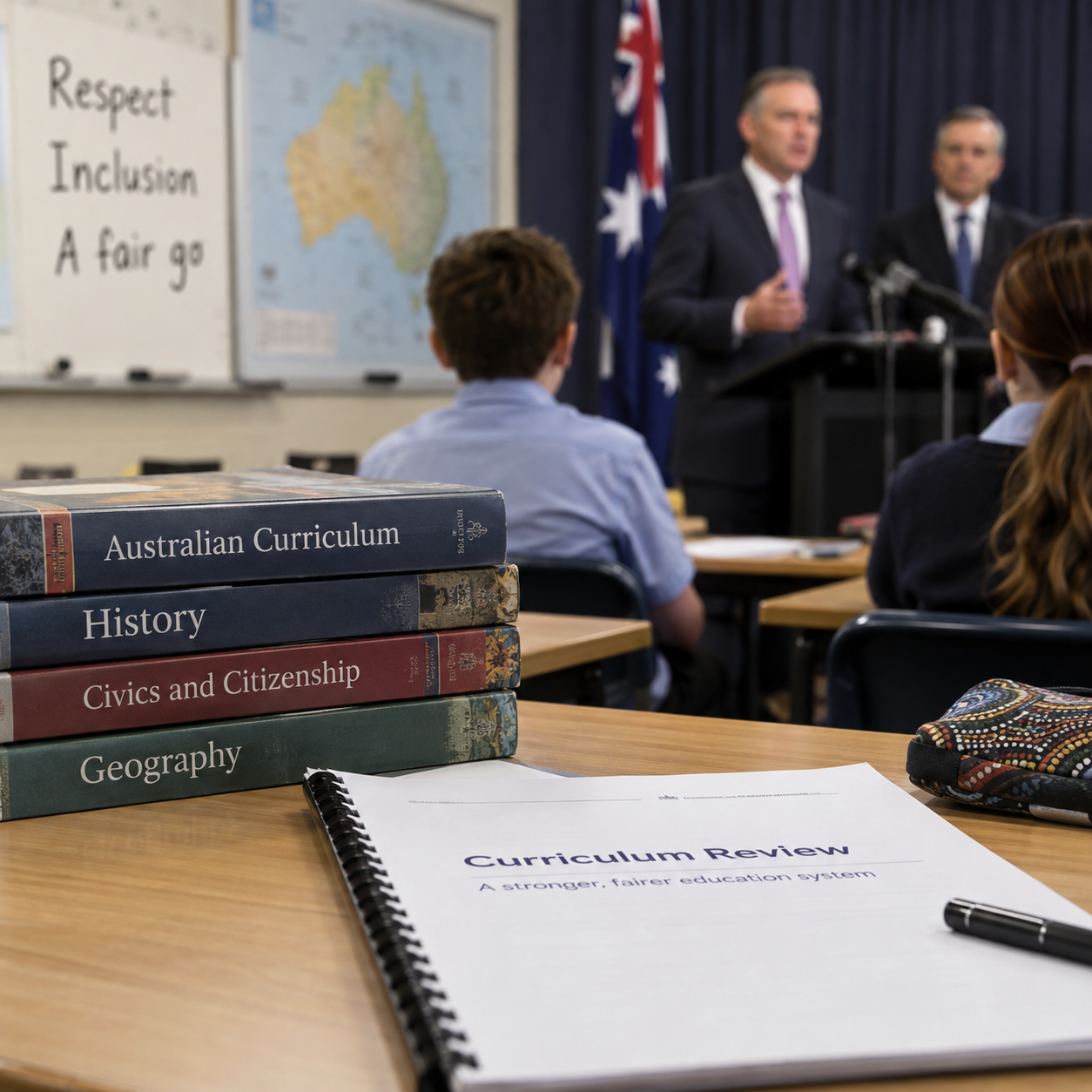
The plan is a political proposal. It has not been enacted, and it would require a Coalition government to work through the national curriculum and education-governance process before changes could take effect in classrooms.
The most contested part of the announcement is its treatment of Aboriginal and Torres Strait Islander Histories and Cultures, one of the three priorities currently embedded across relevant parts of the Australian Curriculum.
The Coalition is not proposing to ban Indigenous history. Leeser says Indigenous heritage should continue to be taught, but as discrete and carefully planned content in subjects such as history rather than as a cross-curriculum priority.
What the Coalition is proposing
Leeser has described the plan as “root and branch” education reform aimed at improving academic results, classroom behaviour and teacher supply.
Under the proposal, the Australian Curriculum would no longer contain its three current cross-curriculum priorities: Aboriginal and Torres Strait Islander Histories and Cultures; Asia and Australia’s Engagement with Asia; and Sustainability.
Instead, the Coalition says those topics should be taught where they fit directly into subjects such as history, geography or science.
Leeser argues that the current approach can spread themes across multiple learning areas and add complexity for teachers. He says the curriculum should be shorter and give teachers more time for core subject knowledge.
The proposal would also give greater prominence to democracy, the rule of law, Australia’s constitutional monarchy and federation, classical literature, art, music and philosophy.
The Coalition also wants schools to display the Australian flag and encourage what it describes as stronger national pride.
What cross-curriculum priorities actually are
The current Australian Curriculum is designed as a three-dimensional framework. It contains learning areas, general capabilities and cross-curriculum priorities.
The priorities are not standalone subjects.
ACARA, the Australian Curriculum, Assessment and Reporting Authority, says they are embedded in learning areas where they are relevant and can add depth to the required content.
The three priorities are Aboriginal and Torres Strait Islander Histories and Cultures, Asia and Australia’s Engagement with Asia, and Sustainability.
Their presence varies between subjects. A priority does not mean every lesson in mathematics, science, English or history must contain the same theme.
ACARA says links are used where the content is appropriate and authentic to the learning area.
The First Nations priority
ACARA says the Aboriginal and Torres Strait Islander Histories and Cultures priority is intended to help students develop knowledge and understanding of the world’s oldest continuous living cultures.
Its framework includes concepts related to Country and Place, Peoples and Cultures, and it is incorporated in different ways depending on the subject.
The Coalition’s proposal would change the structure through which that material is delivered, not remove all Indigenous content from schools.
Leeser has said students should learn Indigenous heritage alongside Australia’s British foundations and multicultural character.
He argues the topics should be taught as planned units rather than threaded through the curriculum as priorities.
That distinction is important because political debate has sometimes compressed the proposal into claims that Indigenous history would be removed altogether. The published policy position does not support that description.
Why the Coalition says change is needed
Leeser has linked the reform to concerns about academic performance, classroom disruption and teacher workload.
He argues Australia should focus more strongly on core knowledge and on cultural foundations he believes have been underemphasised.
He has also pointed to international education results and concerns about boys becoming disengaged from school.
The policy is part of a wider Coalition education platform that includes changes to teacher training, behaviour standards and the use of technology in classrooms.
Leeser has floated faster pathways into teaching, including a return to one-year teacher accreditation routes in some cases, and has suggested that military veterans could be among people recruited into classrooms.
Those ideas are separate from the curriculum proposal but are being presented as part of the same reform agenda.
What “Western values” means in the proposal
Leeser has used the term to refer to ideas including democracy, the rule of law, a “fair go”, constitutional monarchy and federation.
He has also argued students should have greater exposure to classical works of literature, art, music and philosophy that influenced Australian institutions and culture.
Supporters of that approach can argue that students benefit from a clearer understanding of the political and intellectual traditions that shaped modern Australia.
Critics can argue that Australian history and identity cannot be understood through a single civilisational tradition and that First Nations, Asian and multicultural perspectives are also central to the country’s development.
Those are competing educational and political arguments. The factual question is what content is currently required and what the Coalition would change if it gained government and implemented the proposal.
Asia and sustainability would change too
The debate has focused heavily on First Nations content, but the proposal would remove all three cross-curriculum priorities.
ACARA says the Asia and Australia’s Engagement with Asia priority is designed to help students understand the diversity of the region and Australia’s social, cultural, political and economic connections with it.
The Sustainability priority is designed to develop understanding of environmental, social and economic systems and how choices affect the future.
The Coalition says both subjects remain important but should be delivered as discrete content where relevant rather than as priorities that cut across the curriculum.
That means the policy dispute is partly about curriculum architecture: whether important themes are better embedded across subjects or concentrated in clearly defined units.
National curriculum changes are not made by one politician alone
Australia’s education system divides responsibility between the Commonwealth, states and territories, school sectors and curriculum authorities.
The national curriculum is developed through ACARA and agreed through intergovernmental processes.
States and territories then implement it through their own school systems and curriculum arrangements.
A federal government can use funding, national agreements and appointments to pursue reform, but major curriculum changes would still require a process of development, consultation and implementation.
That is why the Coalition announcement should be understood as a policy direction rather than an immediate classroom rule.
The current curriculum was itself the product of review
The Australian Curriculum has been revised over time rather than remaining fixed.
Version 9 was endorsed by education ministers in 2022 after a national review.
Debates about what belongs in a crowded curriculum are therefore not new. Curriculum reviews have repeatedly examined how to balance core disciplinary knowledge, general capabilities and national priorities.
Even ACARA’s own review material has included discussion about clutter, repetition and how cross-curriculum priorities are implemented.
The present political argument is about how far to go: refine the existing model, or remove the priority structure and redesign the material as separate content.
Teacher workload is part of the argument
The Coalition says simplifying the curriculum would return time to teachers.
Whether removing cross-curriculum priorities would materially reduce workload would depend on the replacement curriculum.
If the same knowledge must still be taught as discrete units, teachers would still need resources, professional learning and time to plan those lessons.
First Nations education also involves questions of local context and cultural integrity. ACARA has developed guidance for schools to work with local First Nations communities so content is taught authentically.
Moving material into different subjects would not remove the need for that expertise.
What parents and teachers should watch next
The key details will be in any curriculum documents the Coalition eventually releases.
Important questions include how much Indigenous history would be compulsory, at what year levels, which subjects would carry it, how Asian studies and sustainability would be mapped, and what new “Western values” content would become mandatory.
The implementation timetable would also matter because curriculum change can require new teaching materials, assessment changes and professional development.
Teacher-training proposals would need separate detail about accreditation standards and how alternative pathways maintain classroom quality.
A political choice about structure and emphasis
The Coalition’s plan is best described as a proposal to change the structure and emphasis of the national curriculum.
It would remove the current cross-curriculum priorities, teach their subject matter in more discrete units, increase emphasis on Western political and cultural traditions and pursue additional changes to discipline and teacher pathways.
It is not accurate to say Indigenous history would disappear from Australian schools under the announced policy.
It is also not accurate to treat the current cross-curriculum model as a separate compulsory subject taught identically in every class.
The debate is over how knowledge should be organised, how much emphasis different traditions should receive and what approach would best support student learning.
Those questions will remain politically contested, and voters will ultimately assess the proposal alongside the education policies offered by other parties. The policy itself remains a proposal, not an enacted change to Australian classrooms.