A 95-year-old man has died after a collision involving his mobility scooter and a vehicle in Canberra’s north, bringing the ACT road toll to 12 deaths for the year.
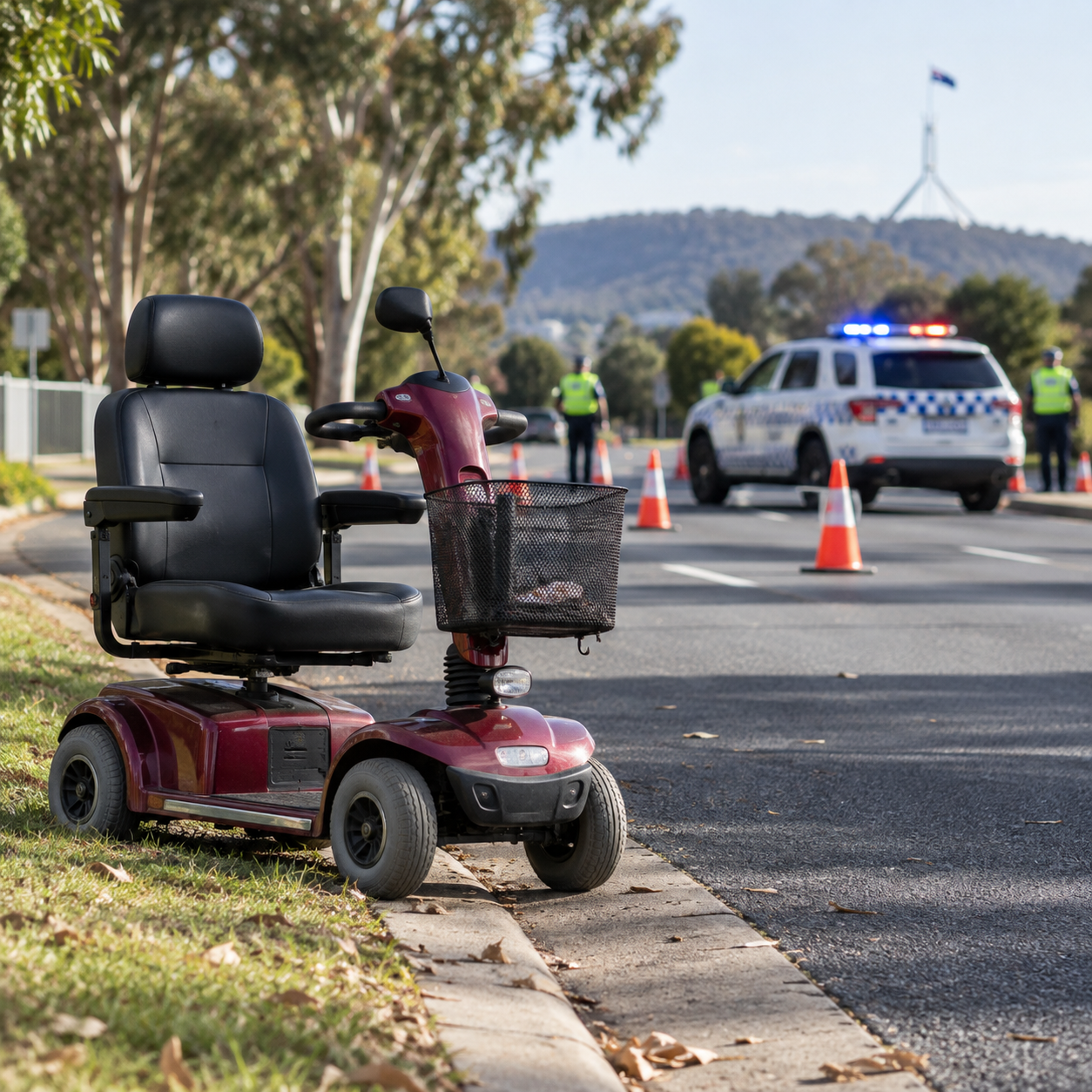
ACT Policing said the collision occurred at about 11:10am on Sunday, 13 September, at the intersection of Ginninderra Drive and Haydon Drive in Bruce.
A white Toyota Alphard van collided with a blue mobility scooter.
The man was assessed at the scene and taken to hospital with what were initially described as minor injuries. His condition later deteriorated and he died on Sunday, 20 September.
The Major Collision Team is investigating and will prepare a report for the Coroner.
The fact that a person has died does not establish which road user was at fault.
Police have not announced a conclusion about responsibility for the collision.
Investigators will examine the circumstances, available witness accounts, road layout, vehicle movements and any relevant video or dash-cam footage.
That process is important because early descriptions of a crash can be incomplete.
A coronial report may ultimately consider both the immediate cause of death and the broader circumstances surrounding the incident.
When ACT Policing first appealed for witnesses, it said a 47-year-old woman and the 95-year-old man had both been taken to hospital with minor injuries following the collision.
The later police update focused on the elderly man’s death after his condition deteriorated.
That chronology shows why road-crash outcomes can change after the initial emergency response.
Injuries that appear minor at the scene can become more serious, particularly for older people whose health can be affected by complications after trauma.
Ginninderra Drive and Haydon Drive are significant roads in Canberra’s north.
Busy intersections bring together cars, buses, cyclists, pedestrians and people using mobility devices.
The mix of road users creates different speeds and visibility challenges.
For someone travelling on a mobility scooter, crossing or moving near a major road can involve exposure to much heavier vehicles and shorter reaction times.
That does not determine what happened in this case, but it explains why investigators examine road design as well as individual behaviour.
For people who cannot comfortably walk long distances or drive, a mobility scooter can provide independence.
It allows access to shops, medical appointments, community activities and public transport connections.
That independence becomes increasingly important as Australia’s population ages.
Road and path networks therefore need to work for people travelling at very different speeds, including pedestrians, mobility-scooter users and cyclists.
The safety challenge is designing intersections and crossings where those users can be seen clearly and have enough time to move through conflict points.
Mobility scooters sit lower than cars and can be harder for drivers to see behind parked vehicles, roadside objects or turning traffic.
Drivers may also misjudge how quickly a scooter is moving.
Conversely, a scooter user may have difficulty judging the speed of approaching traffic, particularly across wide intersections.
Good sightlines, appropriate crossing times and predictable road behaviour can reduce those risks.
Investigators will determine whether any of those factors were relevant in Bruce; they should not be assumed from the location alone.
Age can increase the risk of serious complications after trauma.
Older adults are more likely to have fragile bones, cardiovascular conditions or other health factors that can make recovery harder even when the initial injury does not appear severe.
That is one reason hospitals may monitor elderly crash patients carefully after an incident.
The Bruce case is a reminder that the initial label attached to an injury does not always predict the final outcome.
Police said the man’s death is the 12th death on ACT roads this year.
A road toll counts lives lost, but it does not explain whether crashes share the same causes.
Some involve speeding, alcohol, fatigue or distraction; others may involve road design, medical events, visibility or complex interactions between different road users.
That is why road-safety policy relies on detailed crash investigation rather than treating every fatality as the same type of event.
ACT Policing has asked anyone who witnessed the collision or has relevant dash-cam footage and has not already spoken to investigators to contact Crime Stoppers.
Video can help establish vehicle positions, traffic-light phases, speed, visibility and the sequence of movements before impact.
Even footage that does not capture the collision itself can be useful if it shows a vehicle or scooter approaching the intersection shortly beforehand.
Independent evidence can also help investigators test or reconcile different witness memories.
Major collision investigators may inspect vehicles, photograph the scene, measure road geometry and review mechanical or electronic data where available.
They can also obtain medical information and speak with witnesses.
If there are traffic cameras, business CCTV or nearby residential cameras, that material may be sought as part of the investigation.
The purpose is to reconstruct what happened as accurately as possible rather than assign blame quickly.
Police have said a report will be prepared for the Coroner.
Coronial processes examine deaths that fall within relevant legal categories and can look at cause, circumstances and whether broader safety issues should be addressed.
A coroner can sometimes make recommendations aimed at preventing similar deaths.
That does not mean a recommendation will necessarily arise in this case.
The investigation must first establish the evidence.
Modern road-safety thinking increasingly recognises that people make mistakes and that transport systems should reduce the chance those mistakes become fatal.
That can involve lower speeds in high-conflict areas, protected crossings, better lighting, median refuges and clearer separation between fast and slow road users.
Mobility scooters add another consideration because they may use footpaths and crossings while carrying people whose movement options are limited.
Infrastructure that is easy for a fit pedestrian may be difficult for someone using a powered mobility device.
Beyond the road toll, fatal collisions leave families dealing with hospital care, grief, police contact and coronial processes.
When a person initially survives a crash and later deteriorates, relatives may experience a sudden change from expecting recovery to facing bereavement.
Those personal consequences are one reason police generally avoid speculation until the evidence is clear.
People who believe they saw the collision, the van or the mobility scooter around the time of the crash should provide information directly to police or Crime Stoppers rather than post assumptions about responsibility online.
Investigators can compare a witness account with physical and digital evidence.
Public speculation can create confusion and can unfairly identify people before the facts are established.
The collision occurred on 13 September at the intersection of Ginninderra Drive and Haydon Drive in Bruce.
It involved a white Toyota Alphard and a blue mobility scooter.
A 95-year-old man was taken to hospital and later died after his condition deteriorated.
Police say his death brought the ACT road toll to 12 for the year.
The Major Collision Team is investigating, a report will be prepared for the Coroner and police are still seeking witnesses and dash-cam footage.
Police have not publicly assigned fault, and no conclusion should be drawn from the fact that one vehicle was a van and the other a mobility scooter.
The speed, right of way, visibility and precise movements of the road users remain matters for investigation.
Until that work is complete, the story is a confirmed road fatality and an active investigation — not a proven case against any driver or road user.
If investigators identify a recurring infrastructure issue rather than an isolated driving error, the findings could inform future treatment of busy intersections used by older pedestrians and mobility-device users. Possible responses in comparable locations can include clearer crossing phases, more visible refuge areas, improved lighting or changes to turning movements. No such change has been announced for this intersection, and it would be premature to assume one is required. The value of the investigation is that it can separate speculation from evidence and show whether the crash points to an individual event, a design problem, or a combination of factors.