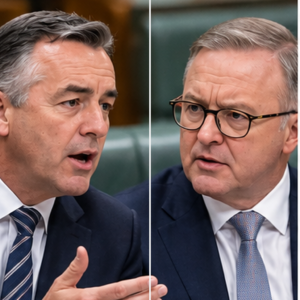
Victorian Opposition Leader Jess Wilson accused Premier Ben Carroll of being sorry only because he had been caught after an auditor-general’s report revealed a previously undisclosed levy on public transport fares. The confrontation put the cost of Melbourne’s Suburban Rail Loop and the transparency of state budget decisions at the centre of an election-year argument.

The revelations emerged on 26 August 2026, with the political dispute intensifying the following day. The Victorian Auditor-General’s Office identified an additional annual one per cent increase in public transport fares on top of ordinary inflation-linked adjustments. The levy had applied from January 2025, yet public statements about fare rises had not disclosed that extra component.
Carroll announced that his government would abolish the levy. He apologised to Victorians and said the process had lacked transparency. Wilson welcomed the decision to scrap the charge but said it did not answer why people had been kept unaware of it. Her reported assessment was blunt: “Ben Carroll isn’t sorry. He’s sorry that he got caught.” That is Wilson’s political judgment, not an independent finding about the premier’s state of mind.
The audit created a particular difficulty for Carroll because he had been public transport minister when the levy was approved in August 2021. He said he was not part of the Budget and Finance Committee process that created it and rejected the suggestion that he personally designed the charge. His ministerial position at the time is a verified historical fact; direct responsibility for a specific cabinet decision must be assessed against the actual decision-making records, not inferred from his title alone.
In Parliament on 27 August, Wilson challenged Carroll over what she described as a concealed $8 billion tax. Carroll rejected the premise and pointed to his decision to abolish the charge. That exchange made clear the parties were arguing about accountability as much as the size of a fare increase. It also showed why an apology, even when unequivocal, does not necessarily end a political controversy.
The numbers require care. The auditor-general said the government expected the levy to produce roughly $8 billion in net present value terms across the period to 2062, of which 60 per cent, or approximately $4.8 billion, was intended for Suburban Rail Loop East. These are long-term modelled values, not a bill suddenly issued to commuters and not an amount already collected. Treating $4.8 billion as cash in the bank would seriously misrepresent the report.
Contemporary reporting put actual receipts in the millions of dollars by early 2026. That difference between collected money and projected revenue is not a technicality: it is central to understanding what the government’s announcement changed. Scrapping a future revenue stream alters forecasts over decades, while the fares already paid raise separate questions about transparency and whether any refund or compensating measure was proposed.
The levy was not a standalone surcharge printed on a ticket. It was incorporated into published annual fare movements. A passenger looking only at the ticket price would know the amount being charged but not necessarily how that amount had been calculated or what portion was linked to the rail project. The audit’s concern was about disclosure of an underlying policy decision, rather than the physical existence of a price people could not see.
That distinction is important for household budgeting. Public transport fares are a recurring cost for commuters, students and families. A one per cent extra annual component can seem small in a single trip, particularly when other fare discounts are operating. Over many years, however, compounding increases can add up. Assessing the burden means considering the fare cap, frequency of travel, discounts and whether the levy would have remained in force as forecast.
The Suburban Rail Loop itself is a substantial long-term infrastructure proposal. Its eastern stage is planned to connect Cheltenham and Box Hill, with the broader concept intended to link suburbs around Melbourne rather than force every trip through the central business district. Advocates argue that rail access can support housing and jobs near stations and create journeys that are difficult on the existing radial network.
Opponents point to the capital cost, uncertainty about future patronage and the opportunity to invest in other services. Those issues are legitimate regardless of party affiliation. A project of this scale needs transparent estimates of construction expenditure, operating costs, passenger demand, borrowing, land-use benefits and the alternatives it displaces. The existence of a secretive funding decision does not by itself establish that every aspect of the railway is uneconomic, but it raises the standard of explanation expected from those defending it.
The fiscal consequences of abolishing the levy are not automatically benign. If the state still intends to deliver the project, it must explain whether money will come from general revenue, different value-capture measures, borrowing, cost reductions or a change in scope. Each option has a distributional effect. General revenue spreads the burden across taxpayers; new charges target particular groups; additional debt creates future repayment obligations; and project cuts may reduce expected benefits.
Borrowing costs are especially relevant because large public works usually involve spending long before all benefits materialise. If forecast revenue falls short, governments still have contractual commitments and interest bills to meet. The public deserves to know what assumptions underlie the project’s financing, including sensitivity to inflation, construction delays and weaker-than-expected economic activity.
There is a housing connection, too, but it should not be overstated. Rail-linked development may make some suburban locations more attractive and support greater density, subject to planning rules, utilities and market demand. Promised new homes are not the same as completed dwellings. The price paid by a commuter today cannot be justified solely by a future development projection unless the costs, benefits and uncertainty have been presented openly.
Regional commuters had reason to examine the decision particularly closely. The undisclosed increase applied to fares in regional Victoria as well as metropolitan Melbourne. That created an obvious fairness question for people who might not routinely use the proposed orbital line. Supporters of statewide funding could argue that transport is a shared system, but the argument must be made publicly before charges are approved, not constructed after they are discovered.
Carroll’s response was to promise a different standard of accountability. He instructed officials to examine whether other similar charges existed and said the levy would end. Such commitments can be tested: the government can publish the decision trail, the financial effect of abolition and any revised budget assumptions. Opposition claims likewise need evidence if they move beyond the undisputed absence of disclosure to allegations of deliberate conduct by named individuals.
The episode illustrates why an auditor-general’s office matters even when a policy attracts little attention at the time it is adopted. Independent scrutiny can reconstruct decisions across successive ministers and budgets, compare internal intentions with public statements and make the consequences understandable for taxpayers. Transparency is not satisfied merely because a final ticket price is visible on an app or station sign.
For Wilson, the row offered a way to frame a broader debate over trust. For Carroll, it offered an early test of whether changing a decision and apologising could mark a credible break with the past. The decisive questions are practical: who authorised the levy, what the government told the public, how much was collected, and how the planned replacement funding will work. In practical terms, the absence of a line item matters because public transport pricing is usually communicated through fare tables and annual changes. When governments announce only the overall increase, commuters may understandably assume it reflects the stated inflation adjustment. A separate policy uplift should be described as such, even when its cost to each passenger is relatively small. Clear labelling would have allowed voters to debate the purpose before the charge took effect.
The numbers also need a careful time horizon. An estimate extending to 2062 assumes particular fare growth, passenger use and collection conditions over decades. Forecasts of that kind are important for financing a long-lived railway but cannot be treated as guaranteed future revenue. Lower usage, policy discounts or a change of government can alter the result. Cancelling the levy makes its original forecast a measure of planned funding, not money lost from a current bank account.
A more transparent response would identify what happened between initial approval, subsequent budget discussions and public fare announcements. The question is not simply whether each official knew that a one per cent component existed. It is whether internal decisions were clearly recorded, who approved the public messaging, whether disclosure concerns were raised and how ministers responded. Those documents help distinguish an administrative failure from a deliberate political strategy.
There is also an accountability issue for future projects. If a government wants to use property-related revenue, transport fares or other value-capture measures to fund infrastructure, residents deserve to know why a particular group is paying and how the expected benefits are distributed. A scheme can be legal and still fail a test of fairness or public explanation. Sounder disclosure at the beginning can prevent that loss of trust later.
Wilson’s criticism won attention because it was attached to a concrete audit finding rather than a general allegation that taxes were too high. Carroll’s response mattered because he could change the policy while serving as premier. The next test is whether voters are given published figures showing how the rail project’s financial plan has been revised, including the effect on debt and on the services competing for the same budget funds.
Those questions remain relevant well after the August confrontation. The levy is a case study in how apparently minor fare adjustments can be tied to multibillion-dollar infrastructure plans and how easily confidence is damaged when a significant policy component is not disclosed. Voters can disagree about the rail project and still expect a clear explanation of every charge on the ticket.