Victoria’s Coalition has promised a $5 billion “war on potholes”, pledging to repair the equivalent of one million road defects and boost road maintenance funding by about 25 per cent over four years if it wins November’s state election.
Opposition Leader Jess Wilson has put the deteriorating condition of Victorian roads at the centre of the Liberal and Nationals’ election campaign, arguing motorists are paying the price for years of inadequate maintenance while the Labor government focuses on major infrastructure projects.
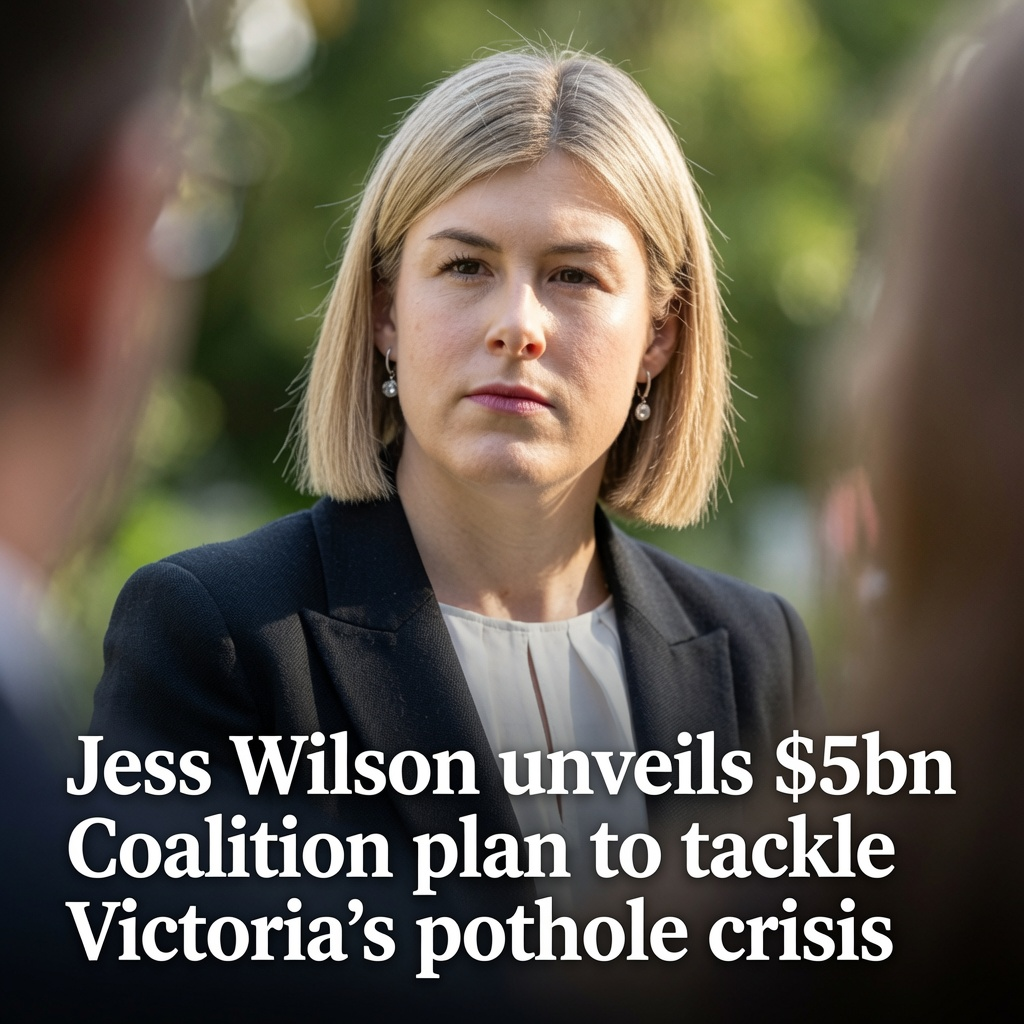
The Coalition says its plan would lift road maintenance and repair spending to $5 billion over the next four years — an increase of roughly 25 per cent on the current government’s funding level.
Its headline promise is to repair the equivalent of one million potholes across Victoria.
But the policy extends beyond simply sending crews to fill holes in bitumen.
The Coalition is also promising more grass slashing, graffiti removal and drain clearing, a review of road construction standards and maintenance contracts, and the creation of a dedicated Better Roads Victoria unit within the Department of Transport and Planning.
Wilson said road conditions had become an everyday cost and safety issue for Victorian families.
“Victorians are sick and tired of driving on crumbling roads, blowing tyres and cracking rims,” she said.
“It is costing families thousands of dollars to repair their cars and putting lives at risk.”
The announcement sets up a major election fight with Premier Jacinta Allan, whose government insists it is already spending record amounts on road maintenance and says recent flooding and heavy traffic have intensified damage across the network.
With road complaints rising sharply and regional communities increasingly angry about deteriorating surfaces, potholes have moved from a routine maintenance frustration to a serious political issue.
Coalition promises $5 billion over four years
Under the Coalition’s plan, a Liberal and Nationals government would spend $5 billion on road maintenance and repairs during its first four-year term.
The Opposition says that represents a 25 per cent increase compared with current funding levels.
The money would be directed towards Victoria’s state-managed road network, with the Coalition promising to focus on both metropolitan and regional roads.
The one-million-pothole target is intended to provide voters with a simple measure of the scale of the proposed repair program.
In practice, road maintenance is more complicated than counting individual holes.
A small surface defect can sometimes be patched quickly. A badly deteriorated section of pavement may require resurfacing or rehabilitation rather than repeated spot repairs.
Drainage failures can allow water to penetrate the road structure and accelerate damage. Road shoulders, vegetation and blocked drains can also affect the safety and durability of a route.
That is why the Coalition’s policy includes broader maintenance work rather than limiting the program to pothole patching.
Wilson said the plan would restore a focus on preventative maintenance.
The Opposition argues that repairing roads earlier can prevent minor damage from developing into more expensive structural failures.
That principle is already recognised as a major road asset management challenge across Australia.
Infrastructure Australia has identified a growing national road maintenance backlog, warning that the cost of maintaining roads is increasing while the overall backlog continues to expand.
For Victoria, the election debate is now about whether existing spending is enough to stop that deterioration.
3,060 road damage issues reported in June alone
The political pressure has intensified as reports of potholes and road damage surge.
Data from community reporting platform Snap Send Solve showed 3,060 road-related issues were reported in Victoria during June 2026.
It was the worst June on record in the available data.
The figure was almost 1,000 higher than the same month a year earlier.
Across the first six months of 2026, 15,514 issues were reported, compared with 11,836 during the same period in 2025.
That is an increase of more than 3,600 reports.
Heavy winter rainfall has contributed to the problem in several regions.
Road complaints have been particularly prominent in areas including the Mornington Peninsula, Latrobe-Gippsland, Ballarat and Hume.
Drivers have also increasingly turned to social media to post images and videos of damaged roads.
Google interest in potholes has surged as public frustration grows.
For the Opposition, those numbers provide an obvious political opportunity.
A pothole is a highly visible government problem.
Motorists do not need an economist or infrastructure expert to explain it to them.
They feel the impact through the steering wheel.
A damaged tyre, cracked rim or suspension repair can turn a routine drive into an unexpected household expense.
For regional Victorians travelling long distances, poor road conditions can also become a safety concern.
Regional roads at the centre of the fight
The Nationals have placed particular emphasis on the condition of Victoria’s regional road network.
Nationals leader Danny O’Brien said the government had allowed country roads to deteriorate while directing too much infrastructure spending towards major metropolitan projects.
The Coalition has separately committed to directing 25 per cent of state infrastructure spending to regional Victoria.
It says the current regional share is about 12 per cent.
The road maintenance promise is therefore part of a broader Coalition strategy to win regional voters who believe Melbourne’s major transport projects have dominated government spending.
Victoria’s Big Build has delivered and funded some of the largest infrastructure projects in the state’s history.
Labor argues those projects are necessary to support population growth and modernise the transport network.
The Coalition says cost overruns on major projects have come at the expense of basic services and infrastructure maintenance.
For a motorist driving over a badly damaged regional highway, that political argument can become highly personal.
The Victorian Farmers Federation has welcomed the Coalition’s road commitment, arguing reliable roads are essential infrastructure for agricultural communities.
Farmers and freight operators depend on regional roads to move livestock, grain, produce and machinery.
Road deterioration can increase vehicle maintenance costs and travel times while creating additional risks for heavy vehicles.
The economic consequences therefore extend beyond individual motorists.
A poorly maintained freight route can affect businesses throughout a regional supply chain.
Labor says it is already spending a record $1.04 billion
The Allan government has rejected the suggestion it has abandoned road maintenance.
Labor points to a record $1.04 billion investment in road rebuilding, repair and resurfacing during the current year.
About 70 per cent of that funding is directed towards regional Victoria.
The government says the program is responding to damage caused by increased traffic and repeated severe weather events.
Victoria’s recent history of floods has placed substantial pressure on road surfaces.
Water is one of the major causes of pavement deterioration.
When moisture enters cracks and reaches the layers beneath a road surface, the pavement can weaken.
Traffic repeatedly passing over the damaged section can then break the surface further and create potholes.
A temporary patch may restore the surface but fail to address deeper structural or drainage problems.
This helps explain why motorists sometimes see the same section of road repaired repeatedly.
The government argues the scale of the network and the damage caused by weather mean road maintenance is an ongoing task rather than a problem that can simply be “fixed” once.
Labor has also exceeded its regional pothole patching target in the 2025–26 financial year, according to state budget papers.
But other maintenance measures have attracted concern.
The government’s planned regional road resurfacing and rehabilitation work has fallen compared with previous years.
Budget material showed a target of 74,000 square metres of regional pothole repairs for 2026–27, compared with 95,000 square metres in the previous financial year.
Road experts and regional advocates have warned that patching potholes is not a substitute for resurfacing and rehabilitating deteriorated roads.
That distinction is likely to become central to the election debate.
Is “one million potholes” a real engineering measure?
The Coalition’s headline is politically powerful, but the one-million figure requires context.
Road agencies do not necessarily manage maintenance programs by counting potholes as identical units.
A pothole can vary dramatically in size, depth and severity.
One defect may require a relatively small amount of asphalt.
Another may be part of a much larger pavement failure requiring extensive reconstruction.
The Coalition describes its target as repairing the “equivalent” of one million potholes.
That wording matters.
The commitment should not necessarily be interpreted as a promise that government crews will physically identify, number and patch exactly 1,000,000 separate holes.
It is a political measure of the proposed scale of road repair activity.
The real test will be the condition of the road network.
If motorists encounter fewer dangerous defects, road surfaces last longer and the maintenance backlog begins to fall, the program will have achieved a meaningful result.
If crews simply increase the number of temporary patches without addressing underlying road failures, the one-million target could become a quantity measure that does little to improve long-term road quality.
This is one reason the Coalition has also promised to review construction standards and maintenance contracts.
The Opposition wants to examine whether current road specifications and contracting arrangements are delivering durable work.
Better Roads Victoria would oversee the program
The Coalition plans to establish Better Roads Victoria as a dedicated unit within the Department of Transport and Planning.
The proposed body would oversee the maintenance initiative and provide a stronger institutional focus on road conditions.
It would not be a separate government department.
Instead, the unit would operate within the existing transport bureaucracy.
The Coalition argues the structure would improve accountability and prevent routine road maintenance from being overshadowed by larger transport projects.
The plan also includes a review of maintenance contracts.
Contract management is a significant issue in road maintenance because governments often rely on private contractors to perform inspections, patching, resurfacing and other work.
The quality of the final road surface can depend on specifications, materials, weather conditions and the standard of the repair.
A poorly executed patch can fail quickly.
A maintenance system that rewards the volume of completed jobs without adequately measuring durability can also create the wrong incentives.
The Coalition says its review would examine departmental and contractor accountability.
Detailed implementation arrangements would still need to be developed if the Opposition wins government.
Allan attacks the Coalition’s debt arithmetic
Premier Jacinta Allan has questioned how the Opposition can afford the $5 billion road promise while simultaneously pledging to reduce Victoria’s debt.
The Coalition has said it wants to cut projected debt by $40 billion.
Allan argues the two commitments are incompatible.
“They are making promises that don’t add up,” Labor has argued as it seeks to challenge the Opposition’s economic credibility.
The government is likely to make funding the central attack on Wilson’s road plan.
A 25 per cent increase in maintenance spending must ultimately be financed through additional revenue, spending reductions elsewhere, borrowing or a combination of those options.
The Coalition says it can redirect money by improving infrastructure project management and reducing waste associated with Labor’s major projects.
It has repeatedly attacked cost overruns across the Big Build.
The Opposition has also promised a royal commission into alleged corruption and mismanagement surrounding major infrastructure spending if it wins government.
Labor rejects the Coalition’s broader financial argument and says the Opposition has not demonstrated how its debt and spending promises can be delivered together.
That dispute means the pothole policy will become part of a much larger election argument about Victoria’s finances.
Voters are not simply being asked whether roads need repair.
Few would argue against better roads.
They are being asked which party has a credible plan to pay for the work.
Why preventative maintenance matters
The Coalition’s emphasis on preventative maintenance addresses a longstanding problem in road asset management.
Delaying maintenance can make eventual repairs more expensive.
A small crack in a road surface can allow water to penetrate.
If the crack is sealed early, the cost may be relatively low.
If water damages the underlying pavement and heavy vehicles continue using the road, the failure can spread.
Eventually, the road may require resurfacing or rehabilitation.
Governments facing budget pressure can be tempted to delay preventative work because the immediate consequences are less visible.
A road that has not yet developed a large pothole does not generate the same political complaints as a damaged highway.
But maintenance backlogs accumulate.
Infrastructure Australia has identified growing road maintenance costs and backlogs as a national problem.
Local government faces similar pressure.
Australian councils collectively manage about three-quarters of the nation’s road network by length while raising less than four per cent of national taxation revenue, according to the Australian Local Government Association.
Victoria’s state road system is separate from council-managed local roads, but motorists rarely care which level of government owns a damaged surface.
They see a pothole and expect someone to repair it.
This creates another challenge for the Coalition’s promise.
A one-million-pothole campaign must clearly explain which roads are covered.
State governments are responsible for major arterial and state-managed roads, while councils maintain extensive local networks.
A voter may hear the headline and assume every pothole in their suburb falls under the program.
The practical delivery will depend on road ownership and the scope of the final policy.
Roads are becoming a genuine election issue
Victoria is due to vote in November.
The Coalition believes road conditions provide it with an issue that cuts across traditional political divisions.
A damaged road affects Labor voters, Liberal voters and people with no strong political affiliation.
It affects metropolitan commuters and regional freight operators.
It creates immediate and visible frustration.
The Opposition has already used potholes as a campaigning tool.
Liberal MP Anthony Marsh recently launched a community reporting website called “Labor’s Road to Ruin” in the Nepean district, allowing residents to identify potholes and upload photographs.
The website distinguishes between state and council roads and places verified reports on a public map.
The initiative followed growing complaints from motorists and an earlier political stunt in which Coalition figures were filmed attempting to repair a pothole.
The Department of Transport and Planning did not take action over the incident.
Those campaign tactics demonstrate how strongly the Coalition believes road maintenance can damage Labor.
The Allan government, meanwhile, will argue its record $1.04 billion maintenance investment shows it is already responding to the problem.
Labor can also point to the impact of floods and extreme weather on a vast road network.
The political danger for the government is that voters judge roads by what they experience rather than the amount printed in a budget.
A motorist who has just destroyed a tyre in a pothole may not be persuaded by a record spending announcement.
Similarly, the Coalition’s one-million-pothole promise will mean little if voters do not believe the $5 billion funding commitment is financially credible.
The election test is now simple
Victoria’s road debate has reached the point where both major political sides agree more maintenance is necessary.
The disagreement is over scale, delivery and money.
Labor says it is already spending a record $1.04 billion this year, with 70 per cent directed to regional roads.
The Coalition says the network has deteriorated so badly that existing funding is not enough.
Wilson is promising $5 billion over four years, a 25 per cent maintenance funding increase and repairs equivalent to one million potholes.
She also wants Better Roads Victoria, a review of construction standards and greater scrutiny of maintenance contractors.
Allan says the promise cannot be separated from the Coalition’s commitment to cut projected debt by $40 billion.
Motorists will ultimately judge both arguments against the roads beneath their cars.
The latest complaint data shows the scale of public frustration is growing: 3,060 road issues reported in June and more than 15,500 in the first half of 2026.
For the Coalition, every pothole is now a campaign advertisement against Labor.
For the Allan government, every repaired road is evidence that its record maintenance program is working.
And for Victorian drivers facing blown tyres, cracked rims and damaged suspension, the political promise is easier to measure than most.
They simply want the holes fixed.






