Victoria's machete surrender-bin program cost $6.55 million, approximately half its previously projected $13 million budget, with newly released records offering a clearer picture of what was collected and how the bins were made. The figures are important to the debate about the state's knife laws, but they do not by themselves reveal whether the program reduced offending or by how much.
Documents obtained by ABC News under freedom-of-information laws show that 12,357 machetes and other knives were put into the secure bins, including items such as butter knives. Retailers surrendered an additional 5,674 machetes after sales restrictions, bringing the combined total to 18,031 items. Those categories should not be merged into a claim that 18,031 prohibited machetes were collected from members of the public.
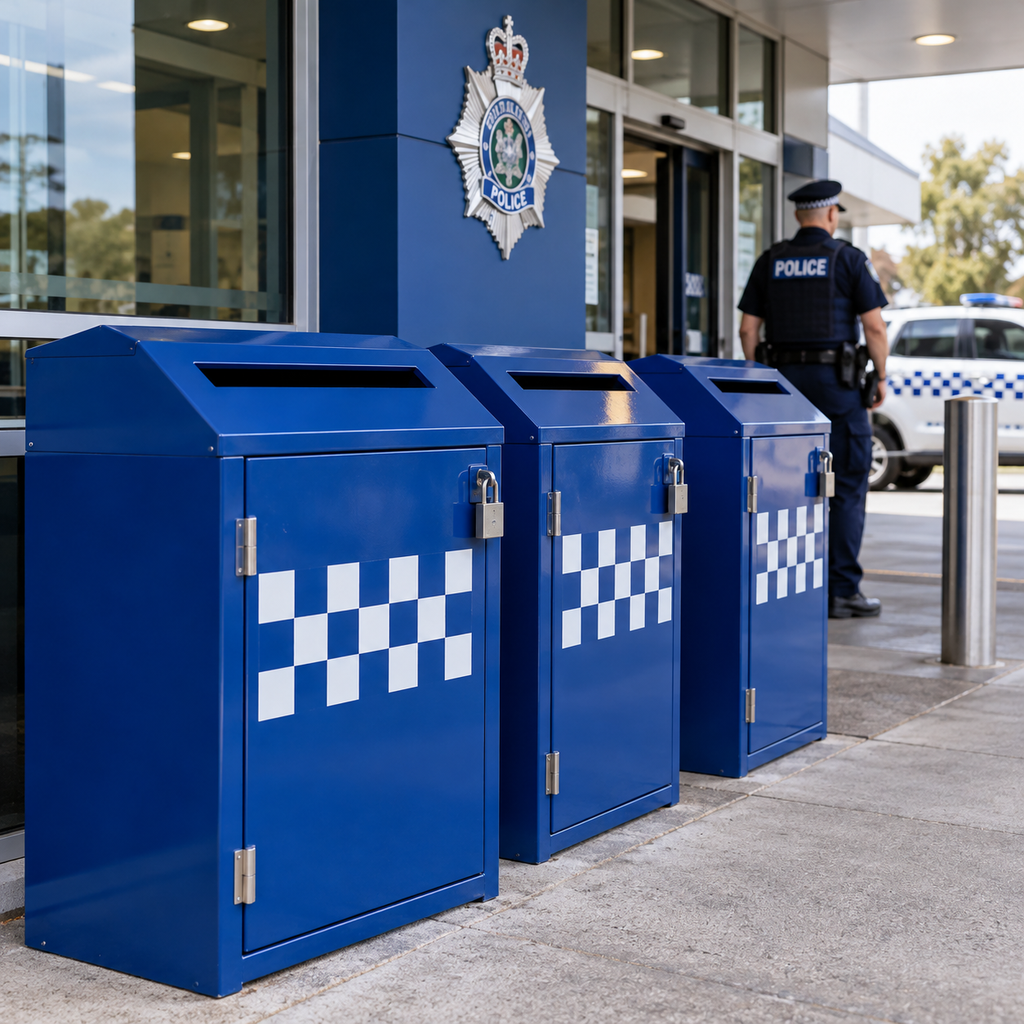
The 75 blue bins were manufactured at the privately operated Mount Gambier Prison in South Australia before being distributed to Victoria. The government paid contractor G4S $925,000 under an arrangement covering manufacture, installation and associated collection, transport, cataloguing and destruction work. That contracted amount is not the same as the entire $6.55 million program cost.
Victoria classified machetes as prohibited weapons from 1 September 2025, with exceptions for people holding appropriate approval or falling within particular exemption categories. The law restricts possession, carrying, use, transport, sale and purchase without a valid legal basis. Victoria Police states that unlawful possession can attract up to two years imprisonment or a substantial fine.
The government introduced the surrender program alongside the ban so people could hand over machetes and other dangerous knives at designated locations. Secure bins were placed outside selected police stations during an amnesty period running from 1 September to 30 November 2025. They were intended to provide a way to surrender weapons safely without requiring every person to approach an officer while carrying a blade.
Officials initially described a statewide rollout to more than 40 police locations. Subsequent records examined by ABC show the government ultimately operated bins at 45 stations. The manufacture of 75 bins did not mean 75 police stations had a permanent installation: some were surplus units used to replace bins that were damaged or full.
The original rollout was heavily promoted by the Allan government as part of a wider response to public concern about machetes and youth violence. Government statements framed the prohibition as a public-safety measure. That policy purpose can be reported without claiming the actual impact has already been scientifically measured or proven by the surrender total.
Critics raised questions about cost and how the program was administered. The newly disclosed documents help answer some of those questions, although gaps remain about the breakdown of expenditure. Reporting the $6.55 million figure accurately matters because public arguments based on the full $13 million projection would overstate the amount the government now says was actually spent.
According to the Department of Justice and Community Safety information reported by ABC, 12,357 machetes and 'other knives' were surrendered through the bins. Sample catalogues include butter knives and kitchen scissors, as well as more dangerous items. Records also show that axes and firearms appeared among items handed over.
The mixed contents matter. If every surrendered object is casually described as a machete, readers may assume that the headline number consists entirely of banned large blades. It does not. Likewise, the presence of a butter knife in a collection catalogue does not establish that possession of a butter knife was prohibited under the machete ban.
A surrender scheme is often designed to accept items with minimal friction, because requiring people to classify a blade at a collection point may complicate safe disposal. That general policy logic does not explain every object handed over in this particular scheme. The records illustrate how public participation can produce a collection broader than the specific class of weapon that prompted the policy.
Retailer surrenders are a separate part of the total. ABC reported that retailers handed over 5,674 machetes after restrictions on selling them. Retailer stock returned through a commercial channel should not be treated as the same thing as a weapon carried by someone on the street. Both are relevant to the overall withdrawal of machetes from circulation, but they measure different routes into the program.
The combined figure of 18,031 is therefore best understood as a total across public bins and retailer returns. It does not tell readers how many items would otherwise have been used in crime, how many were already being stored harmlessly, or how many people might have kept weapons without the program. Those questions require evidence beyond collection counts.
The ABC's freedom-of-information records show prisoners at Mount Gambier Prison made the heavy-duty blue bins in three batches during a 30-day production period. The bins were then moved across the state border and installed at Victorian police stations. That detail is notable but should be reported precisely: manufacture took place in a South Australian prison workshop, not in a Victorian police facility.
The $925,000 contract paid to G4S included more than construction. It also covered tasks connected with putting bins in place and handling their contents. Dividing the entire contract amount by the number of bins and calling that a 'cost per bin' would misrepresent the scope of the agreement, because services beyond the metal units themselves were included.
The original proposal envisaged installations at 58 stations, ABC reported, but the scheme ultimately used 45 police locations. Extra bins were available to replace units when necessary. A change in the number of host sites does not mean the uninstalled bins were necessarily wasted; the records would need to show how many were used as replacements and what remained at the end.
Victorian government material from 2025 described the bins as secure steel units designed with a concrete base, placed at police stations where people could hand in blades safely. Their placement reflected concerns about transporting weapons and the need to separate public disposal from other police interactions. Not all those general design features can be assumed visible in a particular illustrative photograph.
The most direct finding is that actual program expenditure, as reported by ABC, was $6.55 million rather than the $13 million amount initially projected. That is a material difference in a debate about public spending. But a lower spend than forecast is not automatically proof of efficiency, just as a significant total cost is not proof of waste.
Victoria Police's current guidance makes clear that the machete prohibition contains defined exemptions and an approval process. People who require a machete for a legitimate purpose may need to show that a specific exemption applies or hold formal permission. That is distinct from the 2025 time-limited amnesty, which provided a route for surrendering items after the ban took effect. Neither the existence of an exemption nor the presence of ordinary kitchen utensils in bins proves the legal position of any person who surrendered an object.
Judging value for money requires understanding what was purchased and whether the program achieved its intended objectives. Some costs relate to manufacturing and security; others relate to transporting, logging and destroying surrendered items. Without a complete audited breakdown and assessment of outcomes, simple comparisons can mislead.
The headline surrender number is similarly limited. A count of items placed into bins is an output: it shows what the scheme collected. A reduction in violence or weapon-related harm would be an outcome, requiring separate crime and public-safety data, a defined timeframe and an analysis that accounts for changes unrelated to the ban.
It would also be misleading to imply that the government paid $6.55 million solely for 75 empty containers. The available material describes a program, with a bin supply contract forming one component. The public may reasonably ask for more detailed expenditure categories, but the question should be grounded in what the documents actually contain.
Supporters of the ban argue that restricting large blades and offering an amnesty is a practical way to reduce access to dangerous weapons. Critics have questioned the cost, effectiveness and implementation. Both positions involve claims that should be assessed against confirmed collection data and eventual safety outcomes, rather than treated as conclusively established by political statements.
There are also important legal exceptions. Victoria Police guidance explains that some people may be allowed to possess or use machetes for legitimate purposes under exemption or approval arrangements. The law is not accurately summarised by saying every machete, everywhere in Victoria, is illegal in every circumstance.
That legal framework also changes how the collection figures should be interpreted. A broad surrender system may attract items not covered by the core ban, while retailers returning stock represent a different pathway from individual residents using police-station bins. Counting all those items together is useful for an operational total only if the categories remain visible. Assessing whether the scheme was good value requires a separate examination of expenditure, collection administration and any demonstrable effect on public safety, not a single cost divided by a mixed pile of knives.
Changes to the law do not establish whether a person who surrendered a kitchen tool had previously committed an offence. The inclusion of unexpected items illustrates the complexity of the collection figures, not the criminal status of each person who visited a bin. Names, identities and motives of participants have not been reported in the records cited here.
The broader lesson from the new documents is the need to separate projected spending, actual spending, contracts and collected-item categories. Failing to make those distinctions can turn a serious debate about weapons and public safety into an argument based on figures that mean different things.
As of Sunday's reporting, the verified details are a $6.55 million actual cost, 75 manufactured bins, 45 host stations, 12,357 surrendered machetes and other knives in bins, and 5,674 additional retailer returns. Those numbers clarify the scale of the scheme while leaving room for a more thorough evaluation of its results.
The public-interest test for the released records is whether they allow a reader to understand what taxpayers paid for. A contract that covers manufacture, installation, secure transport and destruction cannot be translated into the cost of a bare metal container. Equally, an original budget of $13 million should not be quoted as actual spending once records show $6.55 million was spent. An evaluation of procurement and results would need a breakdown of those services and a clear account of what was achieved against the stated safety objective.
The next useful disclosure would be a detailed accounting of remaining program expenditure and evidence of the scheme's effects on weapon access and harm. Until then, the figures offer a firmer basis for public scrutiny than competing claims based on the original budget alone.