Australian Greens leader David Shoebridge is facing criticism from an unexpected direction after his position on military support for Ukraine prompted a response from Greens figures in the country confronting Russia’s invasion. The disagreement centres on whether Australian military assistance should depend on authorisation by the United Nations Security Council, where Russia holds a veto. Ukrainian Greens representatives argue that such a condition offers no workable path for supporting a country under attack. Shoebridge has opposed Russia’s invasion and supports civilian and humanitarian aid, making it important to distinguish his position from claims that he supports Moscow’s actions.
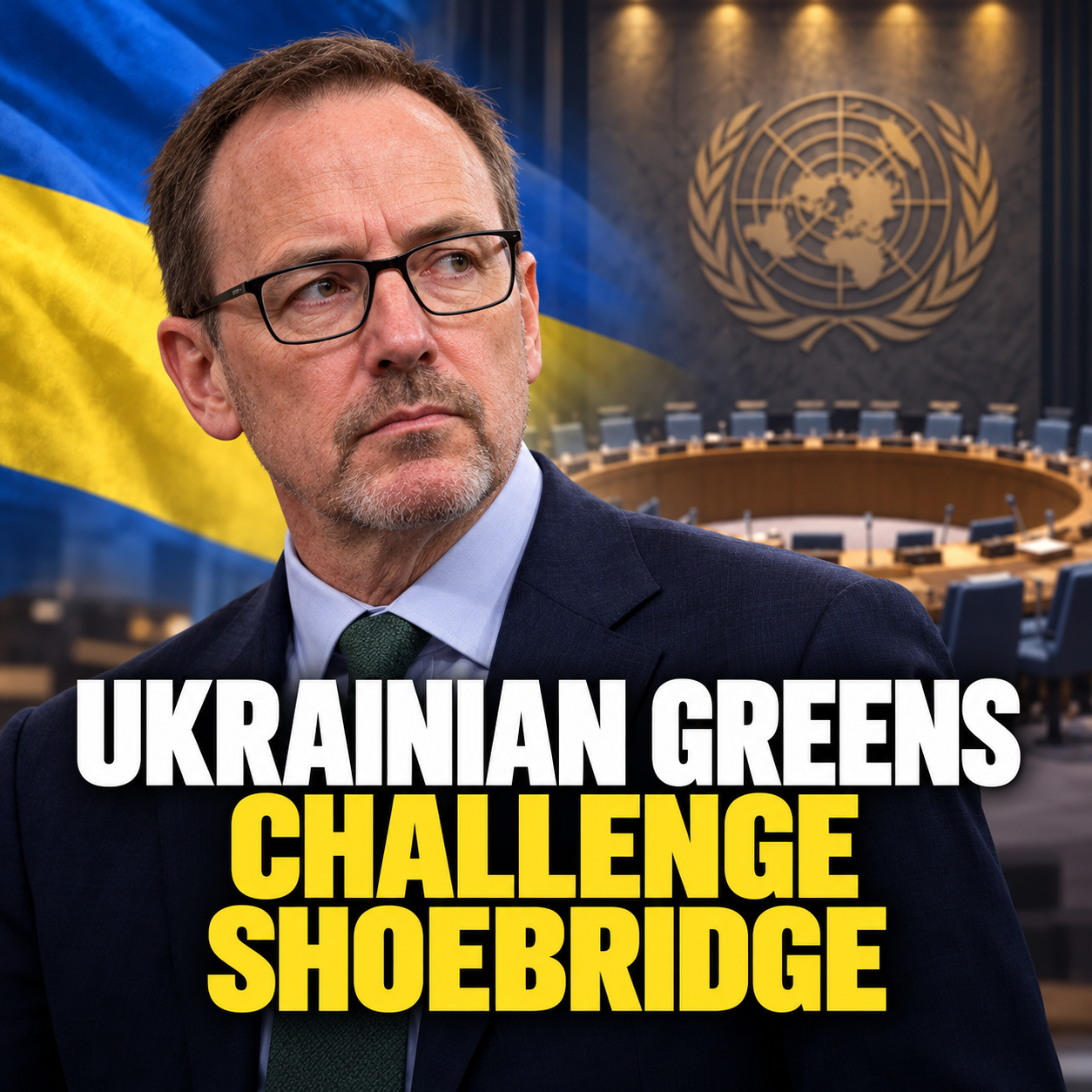
The dispute began with comments attributed to Shoebridge as he outlined his approach to defence and foreign policy. Reporting has described him as opposing direct military assistance to Ukraine without the backing of the UN Security Council. He has also emphasised support for humanitarian and civilian assistance to Ukraine and criticised Russia’s unlawful invasion. Those positions need to be presented together. Describing the disagreement simply as a refusal to help Ukraine would obscure the distinction he draws between forms of assistance. Equally, it would be inaccurate to suggest he endorses military support on the same terms as the Australian government.
The central problem identified by his critics is how the Security Council operates. Its five permanent members hold veto powers over substantive resolutions, meaning Russia can prevent a resolution it opposes even if other countries favour it. The Ukrainian Greens argue that conditioning military assistance on that body’s authorisation effectively makes support contingent on a decision by the invading power. That is their reasoning and their criticism of Shoebridge’s policy. It is not proof of his motives or an indication that he wishes Russia to prevail. The disagreement is about the consequences of a proposed condition, not an established agreement with Moscow.
Ukrainian Greens figures have used stark language in their response, warning that an idealised approach to preventing war can be dangerous when a country is already defending itself. Their perspective is shaped by the reality of a prolonged invasion and the need for external assistance. The comments have been reported as a direct challenge to the position of an overseas political leader who shares the Greens label. That makes the exchange more unusual than an ordinary dispute between Australian parties: it exposes different priorities within a broad international political tradition, rather than a disagreement that can be reduced to government against opposition.
There is also a distinction between supporting diplomacy and determining how a state should defend itself. Calls for negotiation, humanitarian relief and international institutions are familiar parts of Greens political language. Ukraine’s representatives have argued that those approaches do not remove the need for military support while attacks continue. Someone may support negotiations and still view military aid as necessary for a country’s defence. Conversely, opposition to particular weapons transfers does not automatically mean opposition to humanitarian assistance. These are competing policy judgments with real consequences, but they should be examined on their stated terms rather than through accusations about personal loyalty.
The debate has not been limited to exchanges between the Australian and Ukrainian Greens. Ukrainian ambassador Vasyl Myroshnychenko has discussed the issue publicly and met with Shoebridge to explain Ukraine’s situation. In comments reported by the ABC, the ambassador said the ideal of a peaceful world does not match his country’s immediate circumstances. The meeting is significant because it shows the debate moving beyond political sound bites to diplomatic engagement. It does not establish that the Greens leader changed his position, nor should a meeting alone be described as an agreement. Its verified significance lies in the opportunity for direct explanation.
Disagreement has also been reported inside the Australian Greens. Senator Sarah Hanson-Young expressed support for military assistance when required for Ukraine’s defence, marking a different emphasis from Shoebridge’s public stance. She argued that people facing invasion should not be left without the means to protect themselves. Reports of those comments show that the party’s position is being debated among its own representatives, but they do not establish the result of any formal internal policy decision. Readers should distinguish an individual senator’s public view from an adopted party platform or a binding vote of the parliamentary party.
Coalition defence spokesman James Paterson has attacked Shoebridge’s approach, arguing that requiring Security Council approval would give Russia unacceptable influence over Australian decisions. That accusation is a political interpretation of the veto problem, and should be attributed to Paterson rather than reported as an independently established intention of the Greens. Shoebridge has rejected the suggestion that his position hands Australian foreign policy to Moscow, while maintaining his opposition to military assistance outside his stated conditions. The dispute can be reported forcefully without presenting either side’s rhetoric as a judicial or factual verdict.
Australia’s existing support for Ukraine provides essential context. Canberra has supplied military equipment, training and other assistance alongside civilian and humanitarian measures. A bilateral security agreement with Ukraine has reinforced cooperation between the governments. These commitments form part of the policy from which Shoebridge’s position differs. They also mean the debate is not about an entirely hypothetical form of support. Australia’s decisions have involved concrete resources and diplomatic relationships, so a proposal to change the terms of military assistance would be a substantive departure rather than a symbolic adjustment.
The Security Council argument has wider implications for how countries balance their commitment to international institutions with the capacity of those institutions to act. The United Nations remains central to international law and diplomacy, yet its procedures can prevent decisive action when a permanent member is directly involved in a conflict. Critics of a Council-authorisation requirement say the mechanism could allow an aggressor to block outside help. Supporters of strict multilateral conditions may argue that limits on weapons transfers are important to avoid escalation and ensure accountability. The disagreement therefore concerns both Ukraine’s immediate defence and a broader conception of responsible foreign policy.
None of that debate changes the basic description of Russia’s invasion. Australia and other governments have condemned it as unlawful. Shoebridge himself has voiced opposition to the invasion. It is possible for public figures to agree about the illegality of an attack and disagree strongly about which assistance should follow. An accurate report needs to avoid turning disagreement about military aid into a false claim that everyone involved sees the invasion differently. The harder policy question is what practical measures follow from the shared condemnation and whether the measures proposed can achieve their stated aims.
The response from Ukraine also illustrates why international political labels do not guarantee identical positions. Parties and activists associated with environmental or progressive movements operate in very different security conditions. A group confronting the daily consequences of war may prioritise defence against invasion, even while supporting a wider philosophy of peace and restraint. An Australian politician may focus more closely on limiting military exports and relying on multilateral authorisation. Both positions can be explained without suggesting one group has sole ownership of a political tradition. The disagreement itself is newsworthy because the perspectives have come into direct public conflict.
For Australian voters, a useful question is exactly what the Greens would support under each category of aid. Humanitarian relief, civilian assistance, sanctions, military training, defensive equipment and weapons transfers are not interchangeable. A headline referring simply to support for Ukraine risks concealing the most consequential distinctions. Shoebridge’s public response and any future clarification need to be assessed against those categories. The views of other Greens senators should also be represented accurately, without assuming private agreement or a formal party split where none has been verified.
The debate is likely to be scrutinised because it touches on a conflict with profound human consequences and on Australia’s relationship with a partner facing invasion. But the strongest criticism should still be reported as criticism. Ukrainian Greens figures are arguing that a Security Council requirement is unworkable because of Russia’s veto, while Shoebridge maintains an approach centred on opposing the invasion and supporting non-military forms of aid. The question is not whether a dramatic political label can be attached to either side. It is whether the policy being defended can operate in the circumstances the Ukrainian representatives describe.
The verified record shows a public challenge from Ukrainian Greens to an Australian Greens leader over the conditions for military assistance, accompanied by criticism from Australian politicians and discussion with Ukraine’s ambassador. No vote by the Australian Greens or final diplomatic outcome should be invented to complete the narrative. Shoebridge’s intentions, the stated concerns of his critics and the practical consequences of the UN veto need to remain distinct. Those facts are enough to explain why a disagreement within a familiar political movement has become a consequential debate about Ukraine, international institutions and Australia’s role in supporting a country under attack.






