Do Alliances Survive When The Leaders Who Built Them Leave?
Political leaders come and go.
Elections happen.
Governments change.
Prime ministers resign.
Presidents lose office.
Cabinets are reshuffled.
Yet the relationships between nations are expected to endure long after individual politicians leave the stage.
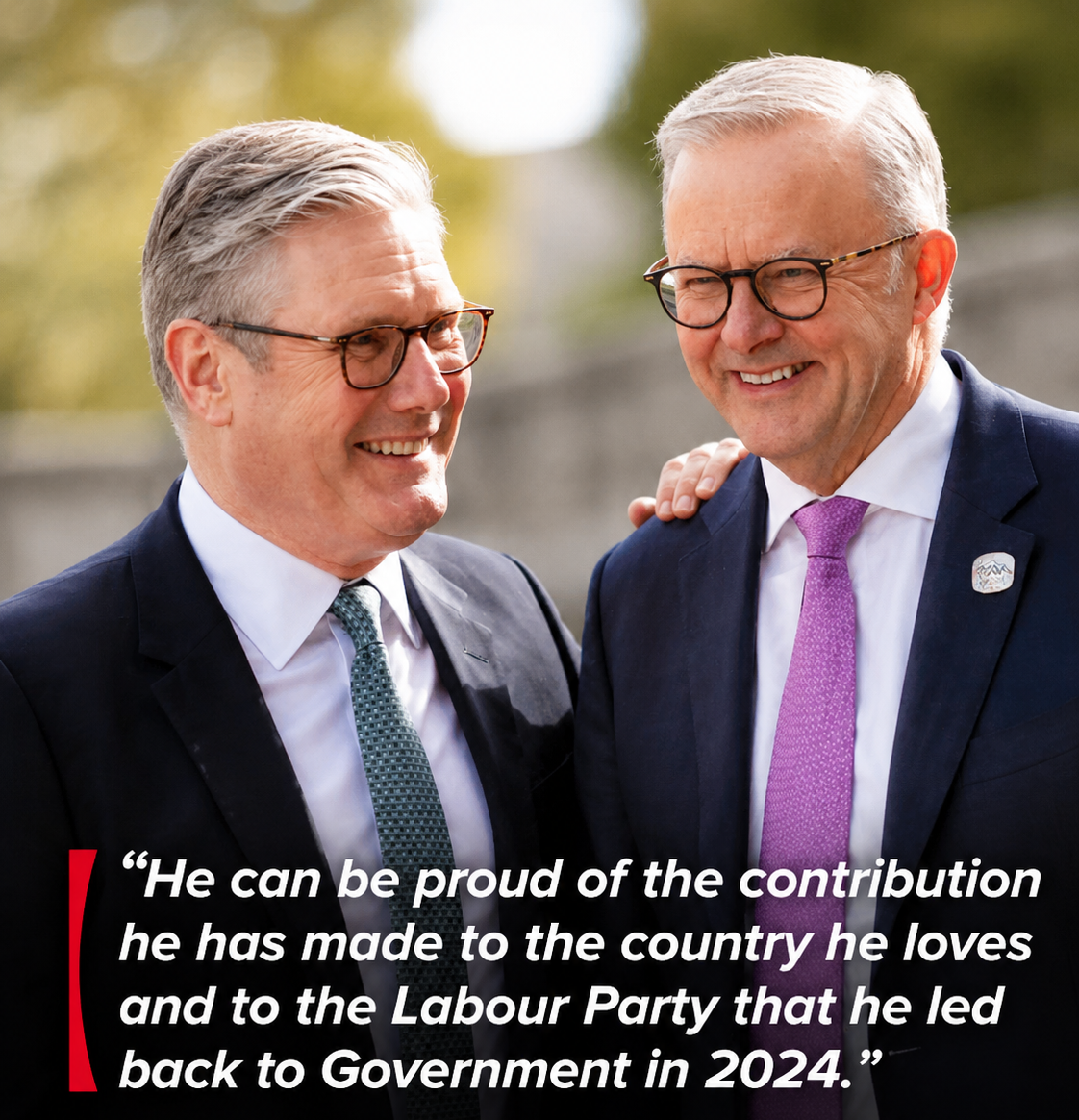
That expectation is currently being tested following the resignation of UK Prime Minister Keir Starmer and the reaction from leaders across the democratic world.
Australian Prime Minister Anthony Albanese responded to the news by describing Starmer as a friend and reflecting on their work together across several major international initiatives. Among the areas highlighted were AUKUS, support for Ukraine and efforts aimed at improving online safety for children.
At one level, such statements are expected.
Political leaders often exchange public messages following major events involving allies.
But beneath the diplomatic language lies a more important question.
What happens to international partnerships when the leaders who helped shape them leave office?
It is a question that has become increasingly relevant in an era of rapid political change.
Across Europe, North America and the Asia-Pacific region, governments are experiencing growing electoral volatility.
Leaders who once appeared politically secure can find themselves replaced within a relatively short period of time.
That reality places greater importance on the strength of institutions rather than the popularity of individuals.
International alliances are designed with this challenge in mind.
The most successful partnerships do not depend entirely on personal friendships between leaders.
Instead, they rely on shared interests, long-term agreements and cooperation between government agencies, defence organisations and diplomatic networks.
When those foundations are strong, alliances can survive multiple leadership transitions.
The AUKUS agreement provides a useful example.
The partnership between Australia, the United Kingdom and the United States was established to strengthen defence cooperation and enhance long-term strategic capabilities.
Although individual leaders have played important roles in advancing the initiative, the agreement itself extends far beyond any single political career.
Its implementation is expected to span decades.
During that period, numerous prime ministers, presidents and government ministers are likely to come and go.
The same principle applies to many other international commitments.
Support for Ukraine.
Intelligence cooperation.
Trade relationships.
Security partnerships.
Research collaboration.
These arrangements often involve years of planning and significant institutional investment.
As a result, governments generally seek continuity even when political leadership changes.
That does not mean leadership transitions are irrelevant.
Far from it.
New leaders can bring different priorities.
Different political philosophies.
Different approaches to diplomacy.
Different domestic pressures.
Those factors can influence the pace and direction of cooperation.
However, they rarely erase strategic interests overnight.
This is particularly true when nations face shared challenges.
Security concerns.
Economic competition.
Technological change.
Cyber threats.
Regional stability.
These issues do not disappear when governments change.
Consequently, many alliances prove more durable than individual political careers.
History offers numerous examples.
Governments from different parties have often maintained the same broad alliances while disagreeing on specific policies.
Political competition occurs domestically.
Strategic interests often remain remarkably consistent.
That consistency is one reason diplomatic relationships receive so much attention during leadership transitions.
Observers are not simply interested in who leaves office.
They want to understand what will happen next.
Will existing commitments continue?
Will priorities shift?
Will cooperation deepen or weaken?
These questions become especially important when the departing leader played a visible role in major international initiatives.
The public reaction to Starmer’s resignation reflects that broader uncertainty.
Although domestic political issues may have driven events in Britain, the consequences are being discussed far beyond the UK’s borders.
Allies, investors and strategic partners all have an interest in understanding how the transition may affect future policy.
For Australia, maintaining strong international partnerships remains a central objective regardless of who occupies leadership positions abroad.
That approach reflects a broader reality of modern diplomacy.
Nations cannot build long-term security and economic strategies around individual personalities alone.
They require institutions capable of enduring political change.
In that sense, the true test of any alliance is not how it performs when leaders agree.
It is how well it survives when those leaders move on.
Political careers are temporary.
National interests are not.
And the strength of an alliance is often measured by its ability to bridge the gap between the two.






