A teenager has been arrested after a woman was struck by an allegedly stolen car near Melbourne's Flinders Street Station on Sunday morning, as thousands of runners and spectators were in the city for the Melbourne Marathon. Police say the incident was neither a terrorist act nor a targeted attack, an important distinction amid the alarm caused by the vehicle's movements through one of the city's busiest transport precincts.
Victoria Police said a 16-year-old boy from the Greater Dandenong area was arrested without incident in Albert Park. Investigators allege a Ford Escape had been stolen from business premises in Cranbourne South earlier that morning and was driven through the central business district. The allegations remain under investigation and should not be treated as findings of guilt.
The injured woman, who police said was from Southbank, was taken to hospital with injuries described as non-life-threatening. That is the confirmed medical position publicly released by authorities; reports of frightening near misses elsewhere along the route should not be confused with additional confirmed injuries.
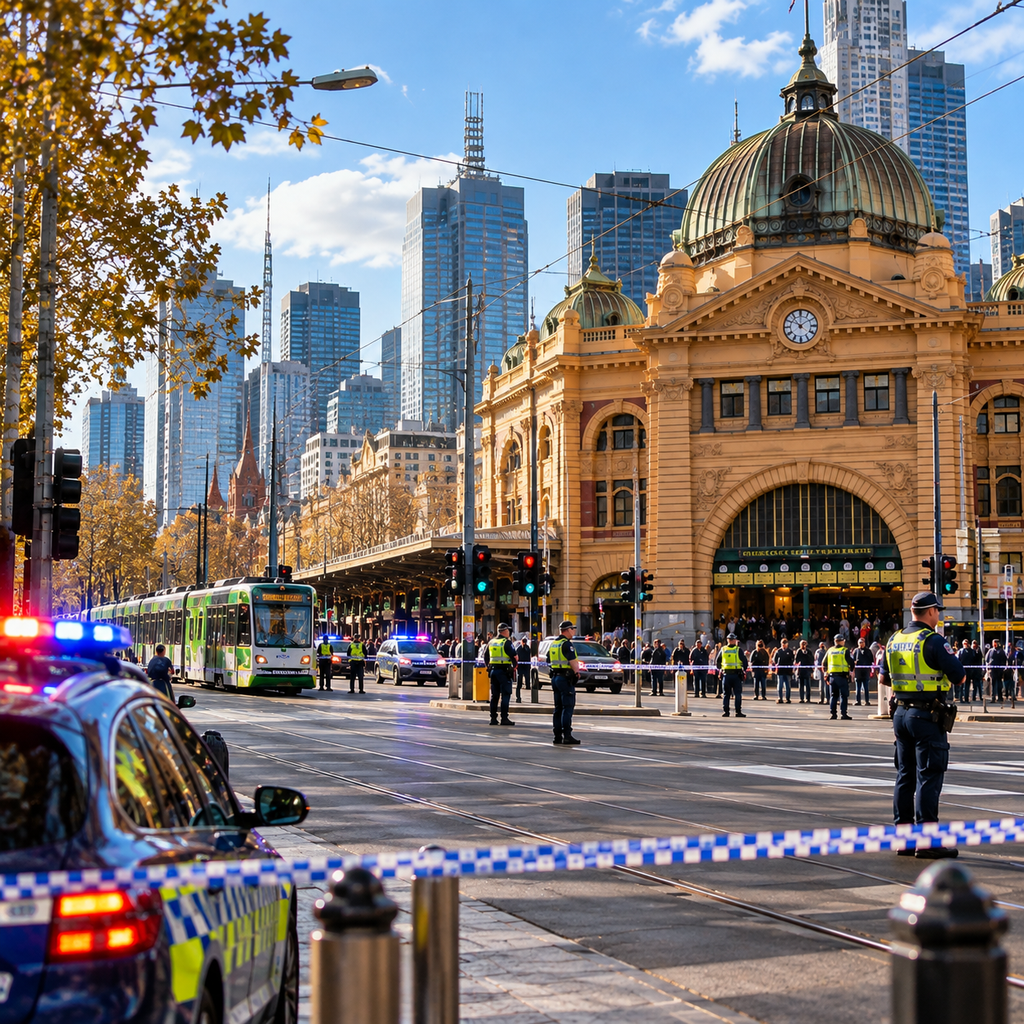
According to Victoria Police, the Ford Escape was travelling east along the tram tracks on Flinders Street at about 10.45am when it struck the pedestrian at the Elizabeth Street intersection. The driver allegedly made a U-turn outside Flinders Street Station and continued into Flinders Lane, where police believe the vehicle struck several unoccupied parked cars.
The sequence matters because the incident was not confined to a single collision point. Flinders Street is a heavily used route for pedestrians, trams, commuters and visitors, and the surrounding lanes connect several busy parts of the city. Police were called to assess what had occurred at multiple locations rather than simply attend a conventional one-vehicle crash.
Police subsequently located and arrested the teenager on Beaconsfield Parade in Albert Park. Their first public statement said he would be interviewed. Arrest and interview are investigative steps, not a conviction, and authorities had not announced a court outcome in the material available on Sunday. It would therefore be inaccurate to describe the boy as having been found responsible for any alleged offences.
Victoria Police said the vehicle had allegedly been stolen from a business on Luster Circuit in Cranbourne South at about 2am. The time of the reported theft and the later activity near Flinders Street are separate claims within the ongoing investigation. Whether other people were involved, how the driver came to possess the vehicle and the precise offences eventually alleged are matters for police and, if charges are laid, the courts.
The police statement also expressly ruled out terrorism and a targeted attack. Neither finding diminishes the danger described by witnesses, but it prevents an incident of alleged dangerous driving from being recast as an ideological assault without evidence. In rapidly developing public-safety stories, the difference between fear at the scene and a substantiated motive is especially important.
Witnesses speaking to ABC News described a white car moving quickly and erratically near Flinders Street, Flinders Lane and Elizabeth Street from around 10.30am. Several reported pedestrians moving out of its path. Such observations help explain the scale of the emergency response, but they remain accounts by people at the scene rather than a complete, independently established reconstruction of the driver's intentions.
The Melbourne Marathon was under way at the same time, with a route passing near Flinders Street Station. That overlap intensified concern because large numbers of participants and supporters were nearby. ABC reporting said witnesses believed the vehicle came within metres of the event route; neither that description nor the station's proximity establishes that runners were deliberately targeted. Police have specifically said they do not consider it a targeted attack.
For those using the area, the station is more than a familiar Melbourne landmark. It is a central interchange between rail, trams and pedestrian corridors, with crowd movements shaped by crossings, signals and event conditions. A vehicle behaving unpredictably in that environment can generate significant disruption even when the number of verified casualties is limited.
Ambulance Victoria confirmed paramedics were called shortly before 11am and transported one patient to Royal Melbourne Hospital. Police and other emergency personnel attended the city-centre scene. The emergency response can be described from their official statements and ABC's reporting without assuming every vehicle photographed at the site was attending the precise moment of the collision.
The strong presence of police vehicles and officers understandably drew attention as images circulated. Photographs and footage from different points in a developing incident, however, can show different stages of a response. A later view of a cordon should not be used to infer details about the vehicle's original speed, the identity of its driver or what a particular witness saw.
For injured pedestrians in Victoria, the aftermath of a road crash may involve medical care and rehabilitation long after the road is reopened. The Transport Accident Commission operates the state's no-fault transport injury scheme. Its published guidance says pedestrians injured by the driving of a motor vehicle may be eligible to claim support, subject to the scheme's rules and assessment of the incident. No public statement has established whether the woman injured on Flinders Street has made a claim or what assistance she might receive.
The public information about the woman is limited. Victoria Police said she was from Southbank and sustained non-life-threatening injuries. Officials had not given a detailed diagnosis or an extended account of her treatment in the first statement. There is no evidentiary basis to speculate about long-term health effects, further surgery or a particular medical condition.
That scheme also draws a useful distinction between injury-related assistance and damage to property. TAC information describes potential help with accident-related treatment, ambulance expenses and recovery services once a claim is accepted, while ordinary vehicle repair and most non-medical property losses are outside its injury scheme. Those are general provisions, not a finding about liability for Sunday's alleged theft or collisions with parked vehicles. The separate questions of criminal responsibility, treatment costs and damaged property cannot be answered from the arrest alone.
It is natural for witnesses and readers to be concerned about a person struck by a car in a busy street, but maintaining that boundary is part of accurate reporting. The fact that the injuries were not considered life-threatening does not mean the collision was minor or that the experience was not frightening. It simply reflects the medical assessment reported at that stage.
The woman's identity has not been supplied in the official material being relied upon for this report. Publishing an imagined identity or details circulating without confirmation would contribute little to public understanding of the case and could interfere with the privacy of someone recovering from an unexpected incident.
This story contains several types of information which should not be blended together. The arrest, the hospital transport, the location and the police decision to exclude terrorism are matters confirmed by authorities. The vehicle theft and details of its movements are police allegations under investigation. The reported proximity to runners and pedestrians' reactions come from witness accounts carried by ABC News.
Treating those categories separately allows readers to understand both the incident's seriousness and the limits of what is known. In particular, a teenager being arrested does not establish a criminal conviction. Nor does eyewitness fear prove that the alleged driver intended to injure people. Police investigation and the legal process must determine what can be sustained by evidence.
Victoria Police have called for witnesses and anyone with dashcam or CCTV footage to come forward through Crime Stoppers. That request indicates the investigative record may still be incomplete. Accounts from commuters, nearby businesses and motorists may help detectives test the sequence and timing of events, but their usefulness depends on verification rather than online speculation.
Major events add another layer of complexity for first responders. Race participants, commuters, tram passengers and spectators may use the same central streets at different times of day, making accurate route and road-closure information important during an unexpected incident. The Melbourne Marathon's presence explains why so many people were nearby, but the fact of an organised event does not alter the police finding that this was not a targeted attack. Any later review of access and crowd movements would be a separate exercise from determining the alleged driver's conduct.
The incident also occurred during a major day of sport in Melbourne. Kenyan distance-running great Eliud Kipchoge won the marathon in a race-record time, a separate development that underlines how many people had come into the central city on Sunday. It should not be used to imply the race itself was attacked or that the runner's performance had a causal connection with what happened on Flinders Street.
The immediate unanswered questions concern the circumstances of the alleged theft, the route followed by the vehicle, the collision with the pedestrian and the possible damage to parked cars. Police will assess evidence and determine what charges, if any, are appropriate. Those are matters for the investigators, not for the public to conclude from a headline, video clip or photograph.
An incident involving a young suspect also poses a particular reporting responsibility. The teenager's age does not diminish the seriousness of a woman being struck, but it does mean his identity and any untested allegation should not be amplified through online identification campaigns. Witnesses can assist through evidence such as their own footage and observations rather than sharing guesses about a person seen near the scene. Those safeguards matter because a criminal investigation can change as new material is obtained and assessed.
For the woman who was injured, the priority is her recovery. For others who encountered the vehicle, the incident was a disturbing interruption to an otherwise busy Sunday in Melbourne. The authorities' clarification that terrorism and targeted violence have been ruled out provides important context, without changing the fact that a pedestrian was injured and a serious investigation remains active.
The most reliable next update will be an official police account of any charges and verified developments in the woman's condition. Until then, the established picture is specific: one confirmed injured woman, a teenager arrested, an allegedly stolen vehicle, reported collisions and an investigation still under way.