“Stop mass immigration. Put Australians first.”
The message is blunt, politically charged and increasingly central to one of Australia’s fiercest national debates as voters confront expensive housing, tight rental markets and growing pressure on infrastructure and public services.
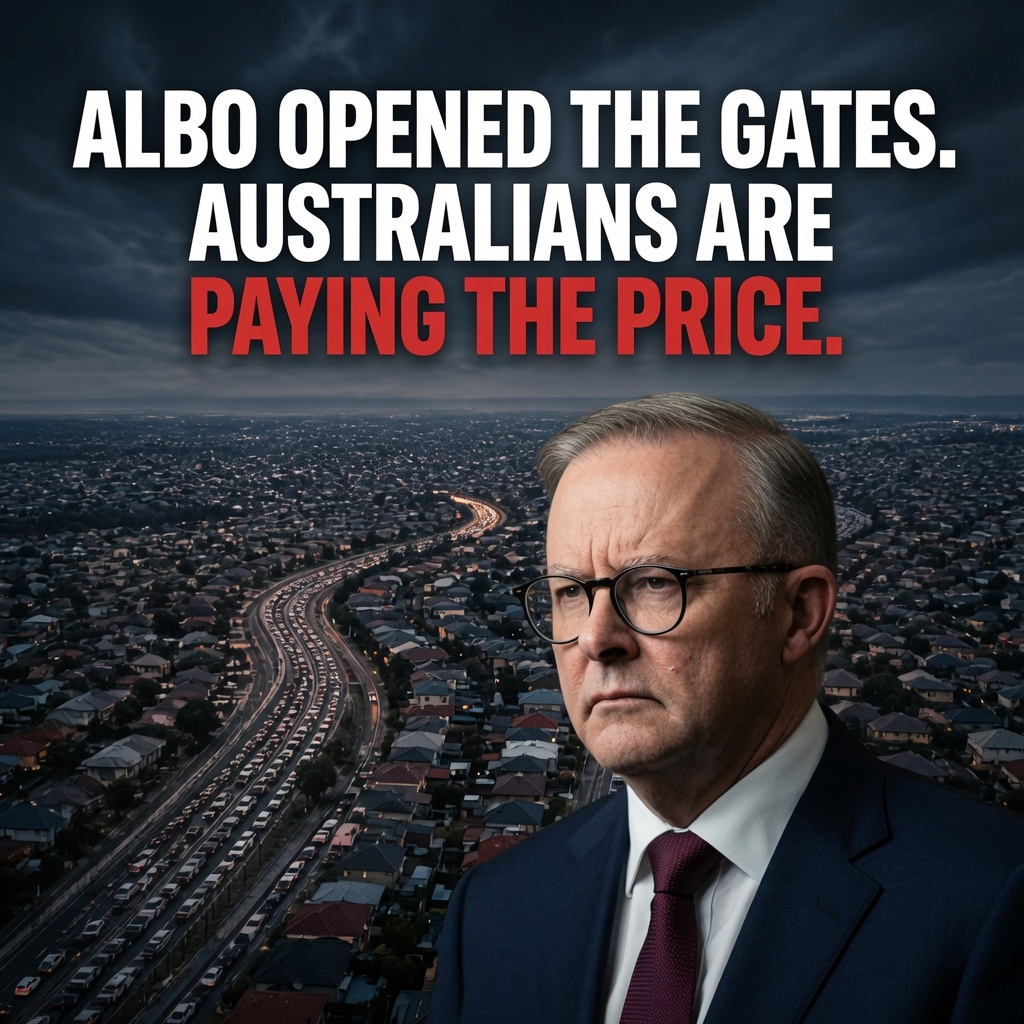
Australia’s migration intake has fallen from the extraordinary post-pandemic surge, but the latest official figures show net overseas migration remains at about 301,000 people a year.
That is enough to ensure immigration remains a major political issue, particularly as population growth collides with a housing system already struggling to build enough homes.
The Albanese government argues migration is moving in the right direction and says changes to the system have brought net overseas migration down substantially from its recent peak.
Its critics say the reduction is nowhere near enough.
One Nation has placed immigration at the centre of its political pitch, arguing Australians should receive priority in housing, employment and access to strained services before governments continue allowing rapid population growth.
The Coalition has also attacked Labor over migration levels and linked future intake more closely to housing and infrastructure capacity.
The argument is no longer simply about whether Australia should have immigration.
Australia is a migrant nation and successive governments of both major political parties have supported permanent migration.
The increasingly urgent question is how many people the country can absorb at one time without making existing shortages worse.
Australia is still adding about 301,000 people a year through net overseas migration
Australian Bureau of Statistics data released in June showed annual net overseas migration was approximately 301,000 in the year to December 2025.
Australia’s population reached 27.8 million at the end of 2025 after increasing by 412,500 people over the year.
Net overseas migration accounted for 301,000 of that growth.
Natural increase — the difference between births and deaths — contributed about 111,500.
Those figures explain why immigration has become inseparable from Australia’s population debate.
Migration was responsible for almost three-quarters of annual population growth.
However, the current rate is significantly below the post-pandemic peak.
Net overseas migration reached extraordinary levels after Australia’s international borders reopened and temporary migrants, students and workers returned.
The ABS recorded net overseas migration of 429,000 in the 2023–24 financial year.
It fell to 306,000 in 2024–25.
The latest annual figure to December 2025 was about 301,000.
Home Affairs Minister Tony Burke has pointed to that decline as evidence the government’s measures are working.
Critics look at the same data and reach a different conclusion.
They argue that remaining above 300,000 is still historically high and that a reduction from an exceptional peak does not automatically mean the current intake is sustainable.
That disagreement sits at the centre of the political fight.
Migration numbers are often confused in the public debate
One reason the argument becomes confusing is that Australian politicians and commentators frequently discuss several different migration figures at the same time.
Net overseas migration is not the same as the permanent Migration Program.
Net overseas migration measures the net change in population caused by people arriving in and departing Australia under the ABS 12/16-month rule.
It can include international students, temporary workers, working holiday makers and other temporary visa holders, as well as permanent migrants.
The permanent Migration Program is a government planning level for permanent visa places.
The Albanese government has set the 2026–27 permanent Migration Program at 185,000 places.
The program maintains an approximate 70:30 split between the skilled and family streams.
That does not mean Australia’s population will grow by only 185,000 migrants.
Temporary migration and the movement of people in and out of Australia can push net overseas migration above the permanent program figure.
The ABS has specifically warned against using permanent and long-term arrival data as a substitute for net overseas migration.
In June, the bureau said doing so would have overstated migration by about 60 per cent for the latest annual period.
The distinction matters because exaggerated or incorrectly compared numbers can distort an already heated debate.
But using the correct figure does not make the political question disappear.
Official net overseas migration is still about 301,000.
The argument is whether Australia has built the homes and infrastructure needed for population growth at that speed.
Housing is driving much of the anger
For many Australians, immigration policy is no longer an abstract argument about population projections.
It is connected directly to the search for a home.
Renters have faced intense competition in major cities and regional centres.
Would-be first-home buyers are attempting to enter markets where prices remain beyond the reach of many ordinary incomes.
Governments have promised ambitious housing construction targets, but planning delays, construction costs, business failures and shortages of skilled trades have made rapid expansion difficult.
Every additional household needs somewhere to live.
Migration is not the sole cause of Australia’s housing crisis.
The shortage has been shaped by decades of planning decisions, insufficient construction, infrastructure constraints, tax settings, high land costs and the concentration of jobs and population in major cities.
But rapid population growth increases demand immediately.
New housing takes years to plan and build.
That timing mismatch is politically explosive.
A migrant can arrive in Australia today.
An apartment project may require years to move from planning to completion.
A new suburb needs roads, water, electricity, schools and health services.
If population growth runs ahead of construction, existing residents and new arrivals compete for a limited supply of housing.
That is why critics of current migration levels argue intake should be tied more closely to housing completions.
Their position is not necessarily that Australia should permanently close its borders.
It is that population growth should slow until supply catches up.
One Nation has made immigration a defining political issue
Pauline Hanson’s One Nation has been the most aggressive major political force campaigning for a dramatic reduction in immigration.
The party’s official immigration policy says Australia’s system is “broken” and argues rapid population growth is overwhelming housing, infrastructure and essential services.
One Nation has proposed capping visas at no more than 130,000 a year.
The party also wants tougher rules around citizenship and welfare access and has advocated a stronger focus on migrants it considers genuinely skilled and capable of integrating into Australian society.
Hanson has repeatedly connected high migration with housing pressure, stagnant wages and congestion.
Her message has gained political traction as economic pessimism has grown.
Recent polling has shown One Nation reaching levels of support far above its historical results, although a July Resolve Political Monitor poll recorded a three-point fall in the party’s primary vote to 26 per cent.
Labor was on 28 per cent and the Coalition recovered to 23 per cent in that poll.
The result was a setback for Hanson after One Nation briefly moved ahead of both major political blocs in the previous survey.
But analysts have warned against assuming the party’s surge has ended.
Immigration remains one of the issues where One Nation’s message resonates with voters who believe the major parties have ignored the consequences of rapid population growth.
Even Australians who reject Hanson’s broader politics may still believe migration is running too high.
That creates a difficult problem for Labor and the Coalition.
If they dismiss concerns about immigration, they risk pushing frustrated voters towards One Nation.
If they adopt Hanson’s language and policies, they risk validating the party they are trying to defeat.
Labor says migration is falling
The Albanese government’s defence is built around the direction of the numbers.
Net overseas migration has fallen sharply from the post-COVID peak.
Burke said in June that the latest ABS figures showed migration continuing to decline.
The government has tightened parts of the international education and visa system and argues it inherited significant integrity problems.
Labor also says Australia still needs skilled migration.
Hospitals require health workers.
Construction needs tradespeople.
Businesses in some industries struggle to find staff.
Australia’s ageing population creates longer-term workforce and budget pressures.
A carefully targeted migration system can help fill genuine skills gaps and expand the tax-paying workforce.
The problem is whether the system is targeted carefully enough.
Recent scrutiny of the skilled migration program has intensified after figures showed large numbers of visas in the skilled stream were granted to secondary applicants, including family members of primary skilled migrants.
That has fuelled criticism that headline descriptions of “skilled migration” can give voters an incomplete picture of who is actually entering under the program.
Employment Minister Amanda Rishworth has acknowledged Australia needs more skilled tradespeople, particularly as the construction sector faces workforce shortages.
This exposes one of the contradictions in the immigration debate.
Australia needs more homes.
Building more homes requires more workers.
Some politicians argue migration should be cut because housing supply is inadequate.
Industry groups argue skilled migrants are needed to build the additional housing.
The real policy challenge is ensuring migration adds the workers Australia needs without increasing population demand faster than those workers can expand supply.
“Australians first” is a powerful slogan — but policy requires difficult choices
The demand to “put Australians first” has obvious political force.
A government is elected by Australian voters and is expected to protect the interests of the people it represents.
When young Australians cannot buy a home, renters compete at crowded inspections and families wait for services, it is reasonable for voters to ask whether population policy is making those problems harder.
But turning the slogan into government policy requires decisions about who should be allowed to come and who should be excluded.
Should Australia cut international student numbers?
Universities argue overseas students support jobs and contribute billions of dollars to the economy.
Critics say the education system has become too dependent on migration and that some courses function as pathways to work rights rather than genuine education.
Should temporary workers be reduced?
Businesses may then face labour shortages.
Should skilled migration be protected?
Governments must decide which occupations are genuinely in shortage and prevent the visa system from being manipulated.
Should family migration be cut?
That would separate some Australians and permanent residents from partners and relatives for longer periods.
Every migration reduction creates consequences.
So does maintaining a high intake.
The political argument is about which consequences Australians are prepared to accept.
Australia’s population has passed 27.8 million
The speed of recent population growth has changed the context of the debate.
Australia’s population reached 27,801,023 at December 31, 2025.
The country added more than 400,000 people in one year.
Population growth can support economic expansion.
More people create demand, enter the workforce and pay taxes.
But headline economic growth does not automatically mean individuals are becoming better off.
Australia has experienced periods in which total economic output increased while GDP per person weakened.
That distinction has contributed to public scepticism about migration-led economic growth.
If the economy becomes larger because the population is larger, but housing becomes less affordable and infrastructure more congested, voters may not feel richer.
They may feel they are competing harder for the same resources.
This is one reason immigration has become tied to the broader cost-of-living debate.
For a household struggling with rent, the argument that population growth increases aggregate GDP may offer little comfort.
For a business unable to hire a qualified worker, a drastic migration cut may sound equally detached from reality.
Both experiences can be true at the same time.
The debate is shifting from whether migration should fall to how far it should fall
The federal government already accepts that the post-pandemic migration surge needed to decline.
Labor points to falling net overseas migration as evidence of progress.
The Coalition says current levels remain too high.
One Nation wants a far more dramatic reduction.
The political distance between the parties is increasingly about scale, speed and the design of the migration system.
Australia’s next phase of the immigration debate will therefore be shaped by measurable outcomes.
Do rents ease?
Does housing construction increase?
Can hospitals and schools keep pace with population growth?
Are skilled migrants actually filling occupations Australia cannot fill domestically?
Do wages improve?
Can infrastructure catch up?
If Australians see conditions improving, the political pressure for drastic migration cuts may weaken.
If housing remains unaffordable and services remain stretched while net overseas migration stays above 300,000, demands for a much harder approach are likely to grow.
That is why the words “Stop mass immigration. Put Australians first” are more than a protest slogan.
They capture a political challenge the major parties can no longer easily avoid.
Australia must decide not only how many people it wants to welcome, but how quickly the country can build the homes, services and infrastructure required to accommodate them.
The latest figures show migration is falling from its peak.
For a growing number of Australians, the question is whether it has fallen nearly far enough.






