Robert Irwin has marked 20 years since the death of his father Steve Irwin with a simple four-word tribute that captured a relationship largely remembered through photographs, family stories and the conservation mission his dad left behind.
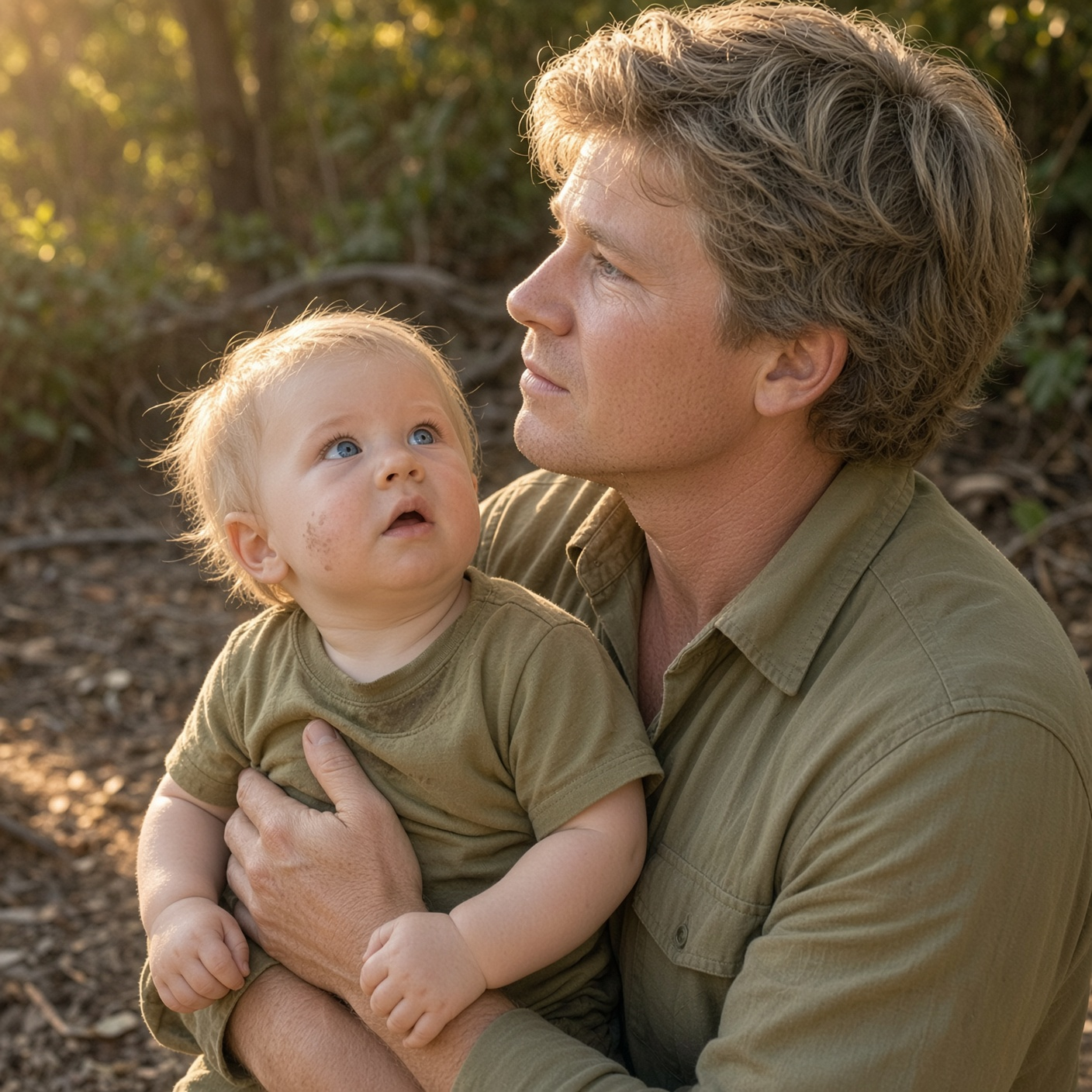
On September 4, Robert shared a photograph of himself as a khaki-clad baby sitting with his mud-covered father in the bush.
His caption was brief.
“Your legacy is forever.”
For millions of Australians who remember the Crocodile Hunter racing enthusiastically towards crocodiles, snakes and almost every other animal placed in front of him, the anniversary was a reminder of just how much time has passed.
Steve Irwin died on September 4, 2006, aged 44, after being fatally struck by a stingray barb while filming off the Queensland coast.
Bindi was eight at the time.
Robert was only two.
Twenty years later, both children have built lives deeply connected to the work their father began.
Robert, now 22, is a wildlife conservationist, photographer and television personality who continues to work at Australia Zoo.
But his anniversary post stripped away the television career, international profile and public image.
It was simply a son remembering his dad.
A photograph from a childhood Robert barely had time to share with Steve
The image Robert selected carries particular weight because he was so young when his father died.
Unlike older relatives and colleagues who worked alongside Steve for decades, Robert’s own direct memories come from a very short period at the beginning of his life.
Yet Steve’s presence has remained central to almost everything Robert has done publicly.
He grew up at Australia Zoo, wore the same familiar khaki and developed the same fascination with reptiles and wildlife.
He became an accomplished photographer and increasingly took on public conservation work, eventually building an international media profile of his own.
Robert has repeatedly resisted the idea that continuing Steve’s work means trying to become an imitation of him.
Instead, the family has treated conservation as the inheritance.
That distinction helps explain why a decades-old photograph can still feel current.
The physical relationship between father and son ended in 2006, but the work Steve wanted his children to understand has continued every day since.
Bindi also remembers the father behind the Crocodile Hunter
Robert was not alone in marking the anniversary.
His sister Bindi shared footage of their father talking emotionally about the day she was born.
In the video, Steve described becoming a father with the same intensity he normally reserved for wildlife, making clear that his family ranked alongside conservation as the defining passion of his life.
Bindi wrote about the grief that has accompanied the family for two decades and described Steve not just as a famous wildlife conservationist but as their family’s superhero.
Now a mother herself, Bindi has another generation through which to understand her father’s legacy.
Her daughter Grace never met Steve, yet watches his documentaries and knows him as the grandfather whose image, voice and enthusiasm remain everywhere around the Irwin family.
That may be one of the most unusual aspects of Steve Irwin’s legacy.
He died before smartphones and social media became the dominant forces they are today, yet hundreds of hours of television preserved his personality for children who were not even born when he was alive.
For Grace, Steve is both a family member she never met and a television figure she can still watch every morning.
September 4, 2006 shocked Australia
Steve was filming in the Great Barrier Reef region when the accident occurred.
His death was sudden, unusual and almost immediately became international news.
He had spent years handling animals that most people would never willingly approach, yet his death came during an encounter with a stingray while filming underwater.
The loss produced a level of public mourning rarely seen for an Australian television personality.
Flowers, messages and makeshift memorials accumulated outside Australia Zoo.
A public memorial was later held at the zoo’s Crocoseum, where a young Bindi stood before the crowd and spoke about the father she had lost.
The scale of the grief reflected how unusual Steve’s public relationship with his audience had become.
He was a wildlife presenter, but he rarely behaved like a conventional television host.
His excitement seemed uncontrolled, his language unmistakably Australian and his enthusiasm for animals almost impossible to fake.
That made him easy to imitate.
It also made him difficult to replace.
The television star was only one part of the mission
Steve’s international fame was built largely through The Crocodile Hunter, the documentary series he made with wife Terri.
Australia Zoo says the Irwins eventually produced more than 300 episodes across programs including The Crocodile Hunter, Croc Diaries and Croc Files, reaching audiences around the world.
But television was never supposed to be the final product.
For Steve and Terri, fame generated money and attention that could be redirected towards wildlife.
The family expanded the small Queensland wildlife park that eventually became Australia Zoo and invested in conservation properties, rescue programs and veterinary care.
Steve’s central formula was what the zoo still describes as “Conservation Through Exciting Education”.
The idea was simple: make people fascinated by an animal first, then persuade them that the animal and its habitat were worth protecting.
Twenty years after his death, much of the infrastructure built around that idea remains in operation.
Australia Zoo has become physically larger than the place Steve left behind
Australia Zoo says it now covers more than 700 acres on Queensland’s Sunshine Coast and employs more than 500 people.
The property bears little resemblance in scale to the small reptile park Steve’s parents established in Beerwah in 1970.
The Wildlife Hospital, inspired by the animal rehabilitation work of Steve’s mother Lyn, has become one of the family’s most tangible conservation projects.
Wildlife Warriors says between 9,000 and 10,000 animals can arrive at the hospital for treatment during a 12-month period.
Its records put total admissions since the facility’s early years well above 100,000.
Those patients include koalas, birds, reptiles, possums, gliders and other Australian native wildlife injured by road vehicles, domestic animals, habitat destruction and other threats.
It is practical conservation work rather than television symbolism.
An animal arrives injured.
Veterinarians and nurses treat it.
Where possible, it returns to the wild.
Steve’s name also protects land far from the zoo
The Steve Irwin Wildlife Reserve in Cape York is another part of that continuing legacy.
Wildlife Warriors describes the reserve as roughly 330,000 acres, or about 130,000 hectares, spanning dozens of ecosystems and providing habitat for a wide range of Australian species.
The reserve was established after Steve’s death as a tribute to his conservation work.
Australia Zoo and Wildlife Warriors now say their protected conservation properties across Queensland cover more than 450,000 acres in total.
That matters because Steve’s message was never simply that people should enjoy seeing animals in captivity.
His wider argument was that wildlife needed habitat in which to survive.
The reserve gives that argument a physical footprint stretching far beyond Beerwah.
Robert has inherited the platform as well as the responsibility
Steve became internationally famous at a time when global celebrity usually required television networks.
Robert operates in a very different media world.
He can reach millions through television, photography and social media without copying the exact career his father had.
Yet the family resemblance in public life is impossible to miss.
Robert brings wildlife onto television programs, photographs animals in the field, feeds crocodiles at Australia Zoo and talks about conservation to audiences who may know Steve only from old clips.
For younger viewers, Robert may increasingly be their first introduction to the Irwin family rather than an extension of somebody they remember from the 1990s.
That is how a legacy changes from memory into continuity.
It stops depending entirely on people who personally remember the original figure.
A new generation begins carrying the message independently.
Twenty years has not turned grief into a museum piece
The Irwin family’s tributes this year have been striking because they have not presented September 4 merely as an anniversary of Australian celebrity history.
For Terri, Bindi and Robert, the public icon was also a husband and father.
That distinction can disappear when a person becomes as famous as Steve.
The Crocodile Hunter belonged, in some emotional sense, to millions of viewers.
Steve belonged to a much smaller family.
Robert’s photograph quietly restores that distinction.
There is no crocodile being wrestled, no television audience and no conservation speech.
There is a muddy father with his baby son on his lap.
And there are four words written by that son two decades later.
The public legacy Steve left is measurable in land protected, animals treated, a zoo expanded and television programs still being watched.
The private legacy is harder to quantify.
It appears in a daughter showing her own child old footage of the grandfather she never met.
It appears in a son who was two years old when his father died but chose a career surrounded by the animals his father loved.
And it appears every September when millions of Australians remember a man in khaki who somehow made wildlife conservation feel like the most exciting job in the world.
Twenty years is enough time for an entire generation to grow up.
It has not been enough time for Steve Irwin to disappear.






