Perth’s taxi industry is facing explosive allegations of organised fare manipulation, cash-job networks and student visa work breaches, with veteran drivers warning that compliant operators are being pushed towards financial ruin.
An investigation into the city’s on-demand transport industry has alleged that groups of temporary migrants, including some Pakistani and Indian student visa holders, are being coached on how to enter the passenger transport sector before using WhatsApp networks and off-meter fares to maximise earnings.
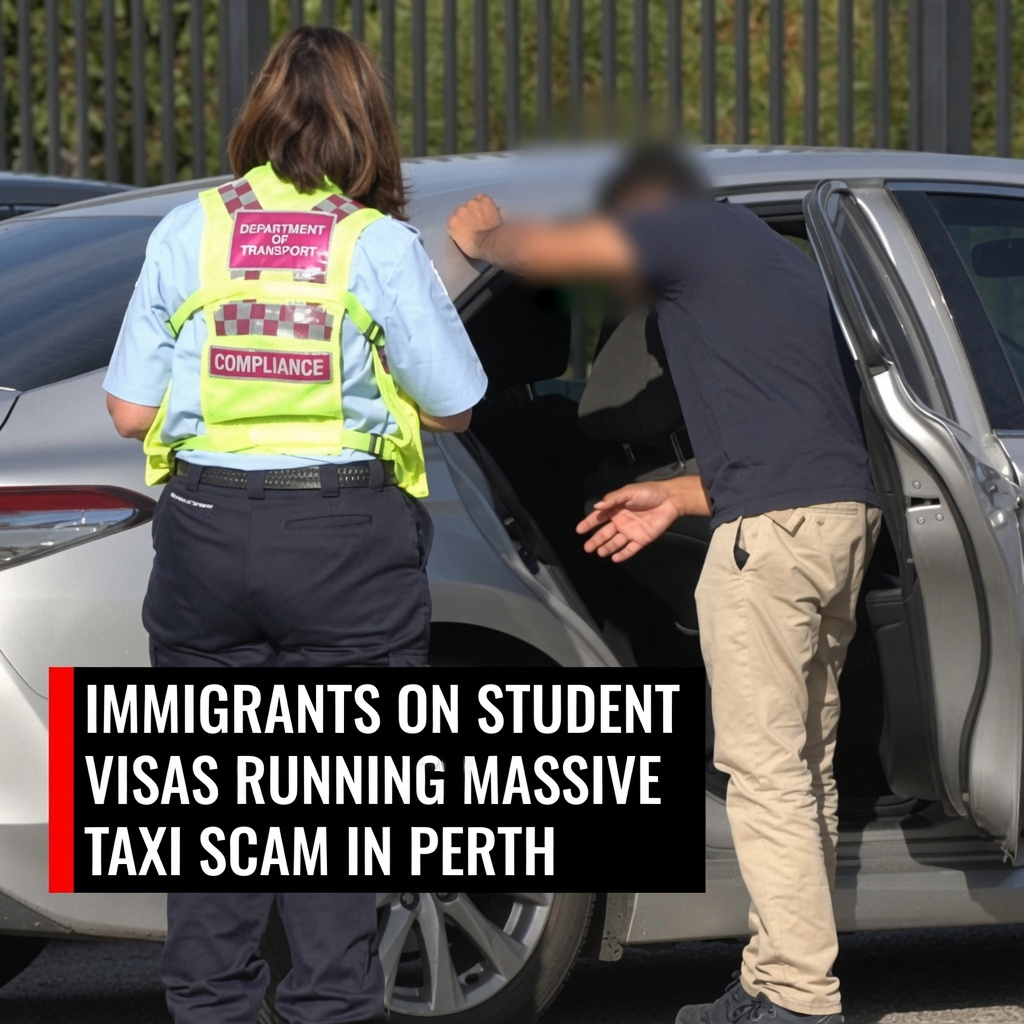
The allegations include drivers pretending EFTPOS terminals or taxi meters are not working, using higher meter settings intended for particular trips or times, sharing cash fares through private messaging groups and warning each other about government inspectors.
Industry whistleblowers have also alleged some drivers are working far beyond the hours permitted under student visa conditions while failing to regularly attend their courses.
The claims have triggered fresh questions about a regulatory system in which transport authorities police passenger services while the Federal Government controls immigration and visa compliance.
For legitimate Perth taxi drivers, the argument is no longer simply about competition.
They say an underground system has emerged in which operators willing to ignore transport, tax or visa rules can work longer, avoid commissions and extract inflated fares from passengers.
“This is the wild west, these are cowboys, not taxi drivers,” one cabbie told 10 News.
Veteran driver Jonathan Masih said the financial position facing compliant drivers had become “dire”.
“We cannot earn enough to support ourselves or our families caused by unlimited oversupply of vehicles, and an estimated 60 to 70% of drivers being international students working unrestricted hours,” he said.
“Rule-breakers and unregulated operators have taken over, making life in this country unbearable for compliant drivers.”
“If authorities did their job and stopped these practices, honest drivers could earn a fair, respectable income again.”
How the alleged Perth taxi network operates
The allegations describe something more organised than individual drivers occasionally overcharging a passenger.
According to industry sources and whistleblowers, prospective drivers can receive advice before arriving in Australia about obtaining the licences and documentation needed to enter passenger transport work.
Once in Western Australia, drivers can apply online for passenger transport driver authorisation through the state’s DoTDirect system.
A Passenger Transport Driver authorisation, commonly known as a PTD authorisation, is required for people driving vehicles for hire or reward in Western Australia.
Drivers can then sign up with an authorised on-demand booking service and begin operating in the taxi or passenger transport industry.
The West Australian investigation alleged some newly arrived drivers were placed into overcrowded shared accommodation under “hot bedding” arrangements, where sleeping spaces may be used by different people at different times.
Vehicles were allegedly made available for about $425 a week.
From there, drivers were reportedly taught methods of increasing fares and finding work outside conventional booking and payment systems.
One alleged technique involves telling a passenger that an EFTPOS machine is broken.
Another involves claiming the meter is not functioning.
The passenger may then be asked to pay a cash amount determined by the driver rather than the regulated or properly calculated fare.
Whistleblowers also allege drivers can activate more expensive meter settings intended for particular late-night, special or higher-tariff journeys.
A passenger unfamiliar with Perth taxi tariffs may have little idea that the meter has been placed on an incorrect setting.
The result, according to the allegations, can be a fare substantially higher than the amount charged by established taxi operators for the same journey.
Some passengers are reportedly paying as much as three times the usual fare.
WhatsApp groups allegedly distribute cash jobs
Private WhatsApp groups are alleged to play a central role in the system.
Industry sources claim dozens of groups exist, some with hundreds of members.
Jobs can allegedly be distributed through the groups outside normal taxi booking channels.
The booking network reportedly takes a 10 per cent commission for connecting a driver with a passenger.
Cash and off-meter work can be particularly attractive to a driver because it may avoid the standard systems used by larger taxi companies to allocate and record jobs.
But whistleblowers claim the messaging groups are also used for another purpose.
Drivers allegedly warn each other when government transport inspectors or compliance officers are operating in a particular location.
If accurate, that would create a significant challenge for regulators conducting visible roadside operations.
A message posted to a large group can potentially alert hundreds of drivers within seconds.
Drivers who believe they may be non-compliant can simply avoid the area until inspectors leave.
The alleged system demonstrates how private encrypted messaging platforms can complicate traditional transport enforcement.
A roadside compliance operation may be effective against drivers who happen to enter the inspection area.
It is far less effective if the operators most likely to breach the rules receive advance warnings and stay away.
Drivers allegedly coordinate repeat overcharging
One of the more sophisticated allegations involves drivers sharing information about passengers who have already accepted an inflated fare.
A whistleblower claimed drivers can collude to charge the same excessive amount on a return journey.
For example, a passenger travelling to a destination may be overcharged by the first driver.
Information about the passenger or journey can then allegedly be passed through the network.
When the passenger requires a return trip, another driver charges the same inflated amount.
The customer may assume the price is normal because two separate drivers have quoted or charged a similar fare.
The arrangement can also allegedly allow drivers to avoid paying a booking commission on the return journey.
If proven, such conduct would be fundamentally different from a simple meter mistake.
It would suggest deliberate coordination designed to create a false impression of consistent market pricing.
Passengers unfamiliar with Perth, including tourists and recent arrivals, could be particularly vulnerable because they may not know what a normal journey should cost.
WA Government has already acknowledged growing non-compliance reports
The broader concern about taxi and rideshare compliance is not based solely on the latest whistleblower allegations.
Western Australia’s Cook Government publicly acknowledged “increasing reports of industry non-compliance” when it announced a joint operation at Perth Airport in April.
The multi-agency compliance action involved the Department of Transport and Major Infrastructure, Western Australia Police and Perth Airport.
More than 100 taxi and rideshare drivers and vehicles were checked.
Authorities specifically identified concerns including drivers refusing to use meters and failing to appropriately display required authorisations.
The government said compliance operations would continue without advance warning about when or where they would occur.
Transport Minister Rita Saffioti said the government wanted to ensure passenger transport services were safe and operating within the rules.
The official operation does not prove the existence of every network or scam alleged by industry whistleblowers.
It does, however, confirm that Western Australian authorities have been receiving enough reports of non-compliance to justify coordinated enforcement activity.
The state’s own On-demand Transport Industry Reference Group has also continued discussing taxi fare settings and broader industry issues during 2026.
Perth taxi fares are regulated under the Transport (Road Passenger Services) Regulations 2020, with maximum metered fares subject to government review.
That regulated system is undermined if a driver deliberately uses an incorrect tariff or abandons the meter to demand an inflated cash payment.
The student visa work limit is still 48 hours a fortnight
The allegations have also drawn the Federal Government’s student visa system into the controversy.
Under current Australian visa conditions, most Student visa subclass 500 holders are limited to 48 hours of work per fortnight while their course is in session.
They can generally work unrestricted hours during scheduled course breaks.
There are exceptions, including different arrangements for some postgraduate research students, but the basic 48-hour limit remains the rule for most international students.
Home Affairs explains that a fortnight for the relevant student work condition is a 14-day period beginning on a Monday.
Working beyond the permitted hours can place a student in breach of visa condition 8105.
Visa breaches can have serious immigration consequences, including potential visa cancellation.
The Perth taxi allegations claim some student drivers are working up to 90 hours.
Those claims have not been established against every international student working in the industry and should not be used to characterise all foreign-born taxi drivers.
Many international students lawfully work in Australia and comply with both visa and workplace rules.
The allegation is narrower but serious: industry sources say a section of Perth’s passenger transport workforce is using student visas while routinely working hours that would appear incompatible with the conditions applying during study periods.
The nature of taxi work can make monitoring particularly difficult.
A person working for a conventional employer may have rosters, payslips and electronic time records.
An on-demand driver may move between booking systems, accept direct jobs and receive cash payments.
If some journeys are deliberately kept off-meter or outside formal booking platforms, reconstructing total working hours becomes more complicated.
Transport authorities cannot police visa status
The case exposes a fundamental division of government responsibility.
Western Australia’s transport authorities regulate passenger transport drivers, vehicles and booking services.
Student visas are administered by the Commonwealth through the Department of Home Affairs.
The WA Department of Transport and Major Infrastructure has said it does not have authority to investigate the visa status of passenger transport drivers.
That creates a potential enforcement gap.
A transport inspector may identify a meter breach, an authorisation problem or another violation of passenger transport legislation.
The same inspector is not necessarily responsible for determining whether the driver has exceeded student visa work limits or stopped attending a registered course.
Conversely, federal immigration authorities are not routinely stationed at taxi ranks monitoring meter settings and passenger complaints.
Effective enforcement therefore depends on information sharing and coordination between agencies operating under different laws.
The April Perth Airport operation demonstrated that multi-agency enforcement is possible.
But the latest allegations suggest drivers believe the existing level of scrutiny is not enough.
Industry sources have claimed the Australian Border Force is not prioritising searches for people who remain in Australia after losing lawful visa status.
That claim requires careful distinction from official policy.
A student whose enrolment is cancelled does not automatically become an unlawful non-citizen at the exact moment a university or college removes them from a course.
Visa status and cancellation involve Commonwealth immigration processes, individual circumstances and legal requirements.
It is therefore inaccurate to assume every person with a cancelled enrolment must simply leave Australia within a universal 30-day period.
However, failure to remain enrolled, comply with course requirements or meet visa conditions can create serious risks to a person’s student visa.
The key question for authorities is whether passenger transport work is being used by people who are no longer genuinely studying or who are systematically breaching work conditions.
Claims of “phantom students” add to existing concerns
The taxi allegations come amid a much broader national debate about the integrity of Australia’s international education system.
Governments, universities and regulators have spent years confronting concerns about non-genuine students, education providers with weak compliance systems and people using study pathways primarily to gain entry and work rights.
The term “ghost student” or “phantom student” has been used to describe people who enrol but rarely attend classes, disengage from study or disappear from their course while remaining focused on employment.
The problem should not be confused with normal student attrition.
International students can leave courses for legitimate reasons including financial hardship, family emergencies, health issues or a decision to transfer institutions.
A university dropout rate is not proof of immigration fraud.
But unusually low attendance or systematic non-engagement can become a compliance concern where a person is supposed to be in Australia primarily for education.
The Perth allegations claim some taxi drivers simply stop attending courses after establishing themselves in passenger transport work.
If substantiated, that would raise questions not only for Home Affairs but for education providers responsible for monitoring enrolment and reporting relevant changes through the international student system.
Honest taxi drivers say they cannot compete
For established Perth taxi drivers, the most immediate concern is economic.
They say a compliant operator faces costs and restrictions that an off-the-books driver can avoid.
A legitimate driver must maintain the appropriate authorisations, comply with passenger transport rules and use the correct fare system.
Depending on their work arrangements, they also face vehicle costs, booking service charges, fuel, insurance and tax obligations.
A driver working within student visa conditions may also have a strict limit on working hours during the academic term.
If a competing driver works 80 or 90 hours, takes cash jobs, avoids commissions and manipulates fares, the legitimate operator is placed at an obvious disadvantage.
The alleged rule-breaker can remain on the road for longer and extract more money from each passenger.
Masih said the combination of vehicle oversupply and widespread non-compliance was making it impossible for some drivers to earn a sustainable income.
His estimate that 60 to 70 per cent of drivers are international students working unrestricted hours is an industry claim, not a verified government statistic.
But his frustration reflects a deeper concern among drivers who believe regulators are policing visible technical breaches without dismantling the networks behind systematic misconduct.
They want enforcement focused not only on individual taxis but on booking services, cash-job networks and the people allegedly organising drivers.
The alleged booking networks may be the key
If authorities want to determine whether organised fare scams exist, the drivers themselves may be only one part of the investigation.
The alleged WhatsApp networks and booking intermediaries could provide a clearer picture of how jobs are allocated.
Whistleblowers claim services take a 10 per cent commission from fares distributed through private groups.
That raises obvious questions.
Who administers the groups?
How are passengers recruited?
Are the intermediaries authorised on-demand booking services?
Are fares and commissions properly recorded?
Are drivers being directed to use incorrect meter settings or is the alleged conduct independently adopted by individual drivers?
And are warnings about compliance operations being systematically distributed?
The answers would determine whether Perth is dealing primarily with widespread individual misconduct or a more organised business model built around avoiding normal taxi systems.
Under Western Australian law, on-demand booking services have their own regulatory obligations.
Focusing only on the person behind the steering wheel may therefore fail to identify the wider structure supporting non-compliant work.
Passengers need a practical way to challenge suspicious fares
The controversy also raises a basic consumer protection issue.
Many passengers do not know the maximum taxi tariffs or understand the different meter settings available in Perth.
A customer arriving at Perth Airport after a long flight may simply assume the number displayed on a meter is correct.
If a driver claims an EFTPOS machine is broken, a passenger may agree to pay cash because they need to reach a hotel or home.
Tourists and people with limited English can be especially reluctant to argue with a driver late at night.
Passengers who believe they have been overcharged should preserve whatever evidence is available.
That can include the vehicle registration, taxi identification details, driver’s authorisation information, booking confirmation, receipt, payment record and the approximate route and time of the journey.
Where possible, customers should request a receipt and report suspected misconduct through the relevant booking service or Western Australian transport complaint channels.
A pattern of complaints involving the same driver, vehicle or booking network can provide regulators with more useful intelligence than an isolated allegation lacking identifying details.
This is an enforcement story, not an ethnicity story
The original allegations specifically identify Pakistani and Indian student visa holders as prominent within the networks described by whistleblowers.
That detail is part of the reporting and should not be concealed.
But it also requires precision.
There is no evidence that Pakistani or Indian taxi drivers as a group are involved in fare scams.
There is no basis to treat every international student driving a taxi in Perth as a visa offender.
The conduct under scrutiny is alleged organised rule-breaking by particular drivers and networks.
Nationality does not establish involvement.
This distinction matters for another reason: some of the drivers speaking publicly against the alleged misconduct are themselves from migrant backgrounds.
The divide described by industry whistleblowers is between compliant and non-compliant operators, not simply between Australian-born and foreign-born drivers.
Honest migrant taxi drivers are also financially harmed when passengers lose trust in the industry or when competitors ignore rules.
Effective enforcement protects those drivers as much as anyone else.
Perth authorities now face a much bigger test
The Cook Government has already demonstrated that it recognises compliance problems in the taxi and rideshare sector.
Its April operation at Perth Airport checked more than 100 drivers and vehicles after increasing reports of non-compliance.
The latest investigation, however, alleges a system capable of adapting to conventional enforcement.
Drivers allegedly communicate through large private groups.
They allegedly share cash jobs outside normal booking channels.
They warn each other about inspectors.
Some are accused of manipulating meter settings or claiming payment equipment is broken.
Industry sources also allege student visa holders are working far beyond permitted hours and, in some cases, disengaging from their courses.
Each allegation sits within the responsibility of a different part of government.
Transport regulators oversee drivers and booking services.
Police investigate criminal conduct where relevant.
Home Affairs controls visa compliance.
Education providers monitor student enrolment and engagement under international education requirements.
Tax authorities deal with undeclared income and cash earnings.
A network operating across those boundaries may be difficult for any single agency to see in full.
That is the central challenge exposed by the Perth taxi controversy.
If the whistleblower allegations are accurate, the problem will not be solved by occasionally catching one driver using the wrong meter setting.
Authorities will need to determine whether booking networks, messaging groups and organised intermediaries are enabling systematic misconduct.
They will also need to establish whether student visa work breaches are genuinely widespread within the sector or whether industry estimates have overstated the scale of the problem.
For Perth passengers, the demand is simple: a taxi fare should be calculated under the rules, not according to how much a driver thinks an unsuspecting customer can be persuaded to pay.
For compliant drivers such as Masih, the issue is survival.
“If authorities did their job and stopped these practices, honest drivers could earn a fair, respectable income again,” he said.
Western Australia has already admitted reports of non-compliance are increasing.
The question now is whether its enforcement system — together with federal immigration authorities — can move quickly enough to identify the networks alleged to be operating behind the wheel.






