One Nation has pulled off one of the most striking political upsets in recent Western Australian history, capturing the traditionally Labor-held seat of Secret Harbour and installing Luke Herdegen as the party’s first member of the WA Legislative Assembly.
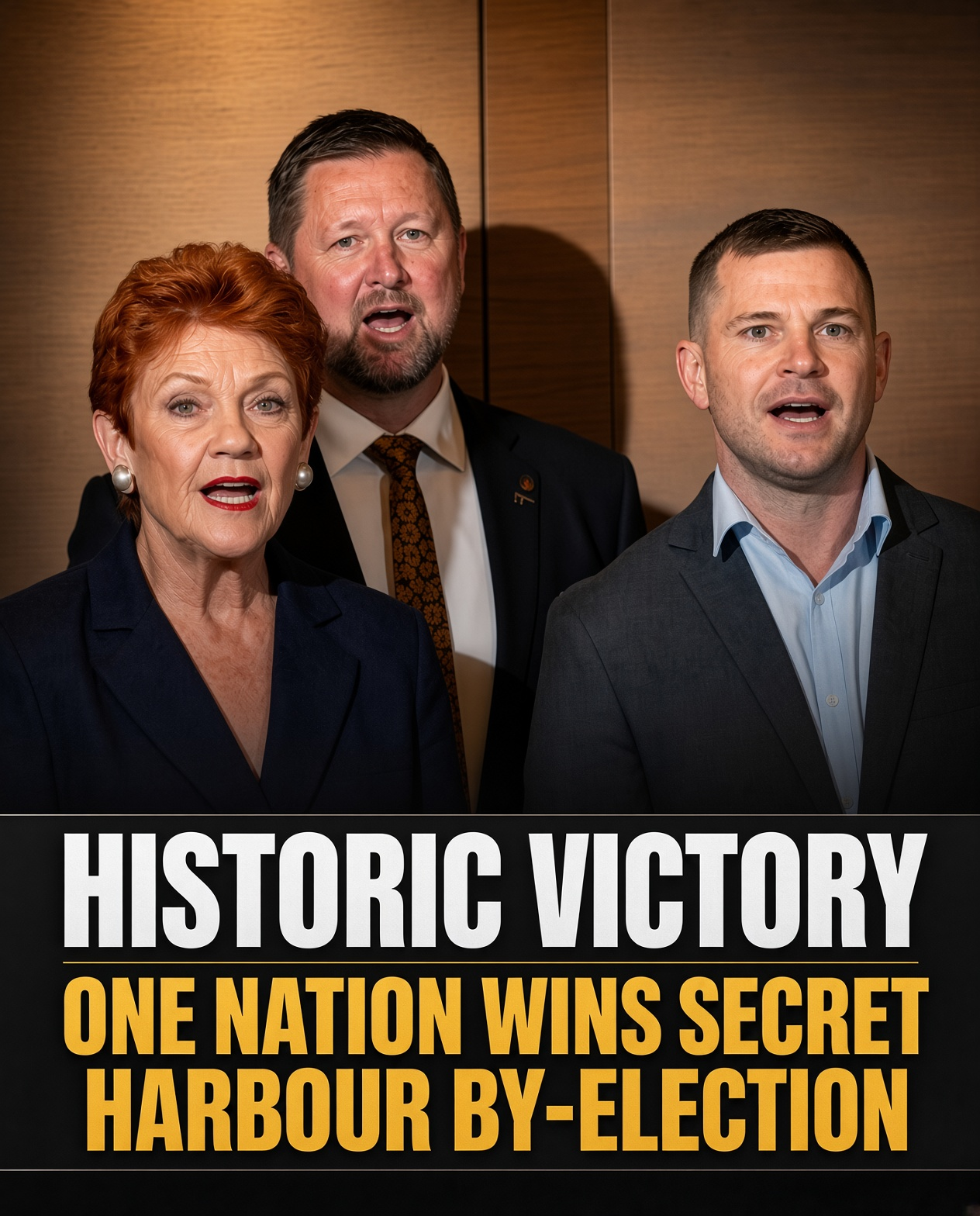
The result has transformed what began as a local by-election south of Perth into a national political warning. A seat that Labor entered the 2025 state election holding comfortably has moved decisively to One Nation, with both the scale of Labor’s primary-vote decline and the surge in support for Pauline Hanson’s party attracting attention well beyond Western Australia.
According to the ABC’s updated count on September 5, with 79 per cent of the vote counted, Herdegen had secured 39.1 per cent of first preferences. Labor candidate Georgia Tree was on 24.1 per cent, while Liberal candidate Ryan Robertson was third on 17.2 per cent.
Those numbers represented a swing of about 30.7 percentage points towards One Nation on the primary vote compared with the 2025 state election and a fall of about 22.4 points for Labor.
After preferences, Herdegen was leading Tree by 57.2 per cent to 42.8 per cent, a margin of 3,999 votes and an 18.8-point swing away from Labor on the two-candidate-preferred count.
The distinction between those figures is important. The roughly 30-point movement is the increase in One Nation’s primary vote rather than the two-candidate swing against Labor. But by any measure, the movement was enormous for an electorate that had previously been regarded as part of Labor’s heartland.
A Labor stronghold changes hands
Secret Harbour was first contested under its current name at the 2025 Western Australian election, after a redistribution largely replaced the former electorate of Warnbro. Labor’s Paul Papalia, who had represented the area and its predecessor seats since 2007, won Secret Harbour with 46.6 per cent of the primary vote.
After preferences in 2025, Labor defeated the Liberals by 61.5 per cent to 38.5 per cent, leaving Papalia with a post-election margin of 11.5 per cent. One Nation, by comparison, received only 8.4 per cent of first preferences at that election.
The transformation in little more than a year is therefore difficult for either major party to dismiss. One Nation has gone from a minor presence in the electorate to the dominant primary-vote party, while Labor’s support has fallen from almost half of all first preferences to less than a quarter.
The broader area has an even longer Labor history. Secret Harbour and the electorates from which it was formed have been held by Labor in various configurations since 1989.
The by-election became necessary after Papalia announced his retirement from politics in July. The long-serving minister said he was leaving parliament because of a serious illness affecting an immediate family member. Polling day was set for August 29.
From the beginning, Labor understood the contest carried unusual danger. Premier Roger Cook publicly described the campaign as a “fight for our lives”, acknowledging that One Nation was capable of taking significant support from his party in an outer-suburban electorate dominated by working families.
One Nation turns voter frustration into a seat
Herdegen, a gym owner who moved to Western Australia several years ago, campaigned on both local and national concerns. His campaign touched on housing pressures, migration and everyday community issues, including local services and rubbish collection.
That mixture appears to have connected with an electorate where frustration extended beyond any single policy dispute.
ABC reporting following the election found cost-of-living pressure, housing affordability, dissatisfaction with politicians and anxiety about voters’ future prospects among the recurring concerns raised in the area. Secret Harbour contains large numbers of young and working families and has a higher proportion of residents with vocational rather than university qualifications.
Those characteristics have made the result especially interesting to political strategists. The electorate resembles a number of outer-metropolitan seats around Australia where voters are dealing simultaneously with mortgage pressure, rent increases, infrastructure demands and rapidly growing communities.
For One Nation, the victory provides something more valuable than a strong opinion poll: a demonstration that rising support can be converted into a lower-house seat in metropolitan Australia.
Herdegen used his victory speech to argue the result had destroyed the assumption that traditional Labor territory could be taken for granted. “There are no safe Labor seats in this state or in this country anymore,” he said.
One Nation’s WA leader Rod Caddies similarly portrayed the outcome as a rejection of the established political order, while Pauline Hanson said voters were looking for representatives who would listen to them and fight for their priorities.
The party’s interpretation is inevitably political, and a single by-election cannot establish how voters across WA or Australia will behave at a general election. By-elections frequently produce larger swings against governments because voters can register dissatisfaction without changing the government itself.
But the scale of the Secret Harbour result makes it harder to dismiss as a routine mid-term protest.
Labor faces questions over both policy and campaign
Labor is now preparing to examine what went wrong. According to ABC reporting, the party mounted a significant campaign, including thousands of voter conversations, extensive door-knocking and a large direct-mail operation.
It was not enough to overcome the broader political mood.
There are also questions about the selection and presentation of Labor candidate Georgia Tree. Tree grew up in the area but was living about 60 kilometres from the electorate during the campaign. She had previously worked as an adviser to federal Labor MP Madeleine King and later in government relations for Woodside Energy.
Labor figures have reportedly acknowledged that her residency and moments during the campaign when she appeared unable to speak freely at media events may have contributed to a perception that she was disconnected from the local community.
Yet focusing entirely on the candidate would risk overlooking the much larger shift evident in the numbers.
Notre Dame University politics professor Martin Drum told the ABC that governments faced underlying pressures that could not simply be solved by campaigning, pointing to housing and cost-of-living problems that could not be made cheaper overnight.
Deputy Premier Rita Saffioti has also argued that one lesson from the result is the importance of direct contact between politicians and voters. In an environment where social media can amplify anger while weakening personal connections, she said people increasingly wanted to know and speak directly with their representatives.
That assessment could have implications across both major parties.
The Liberals have a warning of their own
Although Labor lost the seat, the Liberal result was hardly encouraging. The party’s primary vote fell to 17.2 per cent, down 7.8 points from its 2025 performance in the electorate.
That left the Liberals a distant third behind One Nation and raised a difficult strategic question: whether One Nation should be treated as a potential preference partner against Labor or as a direct competitor for conservative and disaffected voters.
The issue has particular significance because much of Secret Harbour lies within the federal electorate of Canning, held by senior Liberal MP Andrew Hastie. One Nation’s ability to attract voters in this part of Perth therefore matters to the Coalition as much as it does to Labor.
WA Liberal leader Basil Zempilas had argued during the campaign that a Labor defeat would demonstrate falling support for the government, even if the Liberals were not the beneficiaries. That approach drew criticism from Hastie, who warned against conceding ground to One Nation.
The by-election result suggests both sides of that debate now have reason to pay attention. Labor has lost a seat it once regarded as secure, but the Liberals did not replace it. One Nation did.
What the result does — and does not — prove
Secret Harbour does not prove that every safe Labor seat is about to fall, nor does it demonstrate that One Nation would achieve the same result at a statewide or federal general election.
Turnout patterns, candidate profiles, preferences and the opportunity to cast a protest vote can all make by-elections behave differently from ordinary elections.
Labor also remains overwhelmingly dominant in the WA Legislative Assembly, holding 45 of the chamber’s 59 seats after years of electoral success. One by-election does not threaten the Cook government’s parliamentary control.
What the result does show is that traditional electoral loyalty can break down quickly when a large enough group of voters decides an alternative is worth trying.
In 2025, One Nation received 8.4 per cent of the primary vote in Secret Harbour. In the latest by-election count, it has more than quadrupled that share to 39.1 per cent.
For Labor, the fall is equally stark: from 46.6 per cent of first preferences to 24.1 per cent.
Those figures explain why the result is being watched nationally. The political question is no longer simply whether voters are unhappy with the established parties. Secret Harbour has provided evidence that, under the right circumstances, that dissatisfaction can be organised into a winning electoral coalition.
For One Nation, the breakthrough gives the party a foothold in WA’s lower house and a platform from which to target surrounding seats.
For Labor and the Liberals, the message is more uncomfortable. Voters who once appeared predictable are becoming less so, and seats built on decades of political habit may no longer be protected by history alone.
The next test will be whether Secret Harbour proves to be an exceptional by-election revolt or the beginning of a more durable realignment in Australian outer-suburban politics.






