Federal Treasurer Jim Chalmers is facing an extraordinary challenge in his own political heartland, with a new seat-level poll showing One Nation surging to within striking distance of Labor in a Queensland electorate that Chalmers dominated only last year.
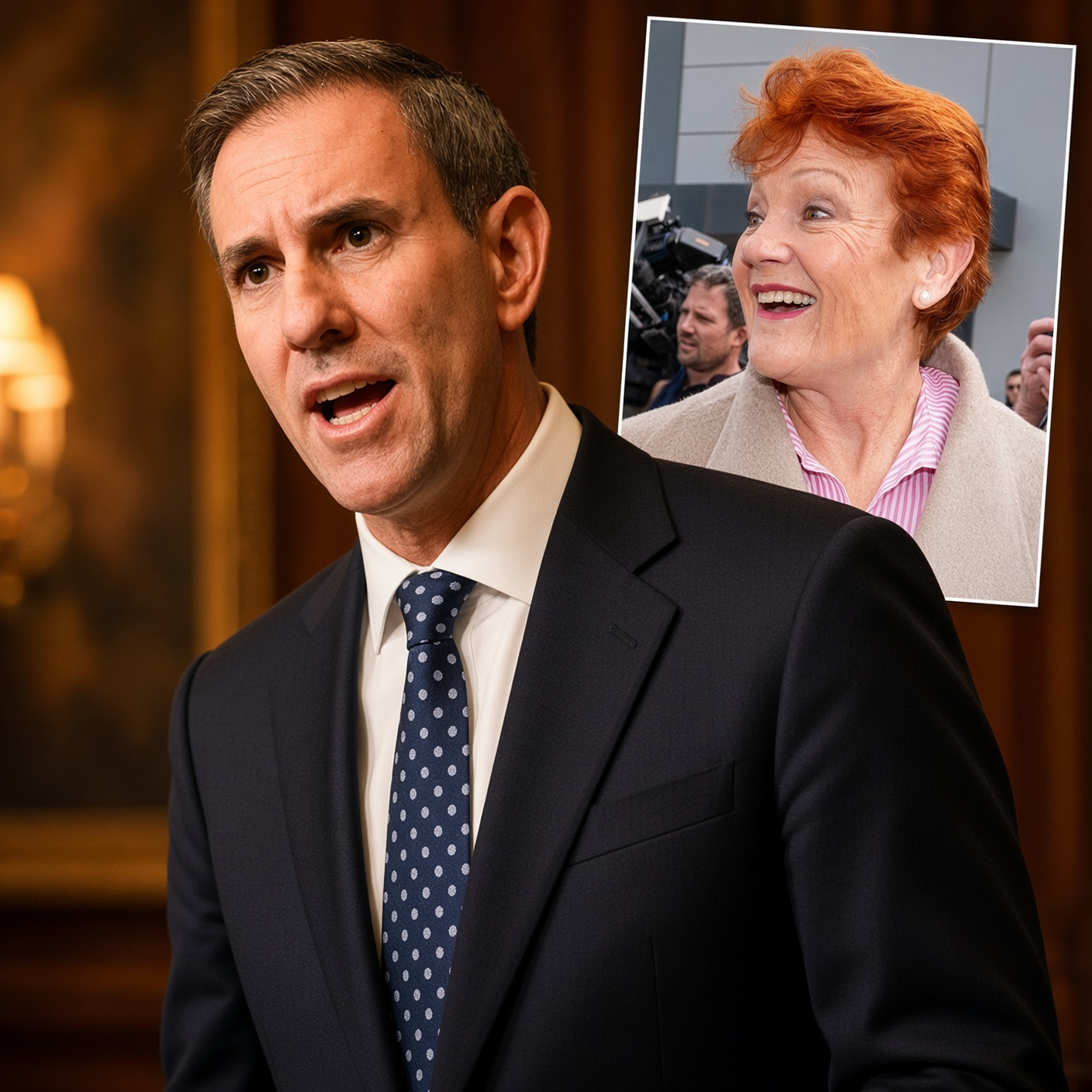
The survey of 501 voters in Rankin puts Labor’s primary vote at just 39.92 per cent, down almost 10 percentage points from the 49.42 per cent Chalmers secured at the 2025 federal election.
The most dramatic movement is towards Pauline Hanson’s One Nation.
Support for the party was measured at 31.54 per cent, compared with just 6.57 per cent at last year’s election — almost five times its previous result.
The Greens were polling at about 11 per cent, while the Liberal National Party had fallen below 12 per cent.
If those numbers were repeated at an election, Rankin would no longer resemble the overwhelmingly safe Labor seat Chalmers carried with 65.55 per cent of the final two-candidate vote in 2025.
Instead, preference assumptions used with the new polling produce a final result of about 50.9 per cent for Labor, leaving the Treasurer potentially dependent on preferences from voters supporting parties such as the Greens to survive.
It is a remarkable hypothetical scenario for one of the most senior figures in the Albanese government.
But there is an equally important qualification: this is a poll, not an election result.
The survey is a snapshot of 501 voters taken well before the next federal election, and preference flows at that election will depend on candidates, campaign circumstances, voter decisions and how-to-vote recommendations that do not yet exist.
There is therefore no basis to say Chalmers is certain to lose Rankin, or that Greens voters will determine his political future.
What the poll does show is that Labor’s previously enormous advantage in the electorate could no longer be taken for granted if the current political environment persists.
That matters well beyond one Queensland seat.
Chalmers is not simply a backbench MP defending a marginal electorate. He is Treasurer of Australia, one of Labor’s most prominent national figures and a politician whose economic management is central to the government’s pitch to voters.
Rankin is also deeply connected to his political identity.
He has represented the electorate since 2013 and maintains his principal electorate office in Logan Central. The division covers parts of Logan City and Brisbane’s southern suburbs and is classified by the Australian Electoral Commission as an outer-metropolitan electorate.
It contains communities including Woodridge, Browns Plains, Springwood and surrounding suburbs where household budgets, housing affordability and employment have long been central political issues.
That makes a major swing against the Treasurer in Rankin especially politically sensitive.
If voters in his own electorate are becoming dissatisfied with Labor’s economic management, opponents will inevitably argue that the result represents a verdict on the Treasurer himself as well as the government.
The 2025 election result demonstrates the scale of the change suggested by the new poll.
Last year, Chalmers won 45,303 first-preference votes, or 49.42 per cent of the formal vote.
The LNP’s Paul Darwen finished a distant second on 19.75 per cent.
The Greens received 10.94 per cent and One Nation candidate Kyle Lentz only 6.57 per cent.
After preferences, Chalmers defeated the LNP by 65.55 per cent to 34.45 per cent.
In raw vote terms, Labor finished with 60,092 votes in the final count against 31,577 for the LNP.
It was a crushing victory.
Only a little more than a year later, the new polling presents a radically different contest in which the LNP has been pushed into a minor role and One Nation has emerged as Labor’s principal challenger.
That shift is potentially as important for the Coalition as it is for Labor.
A conventional anti-Labor swing in Rankin would normally be expected to benefit the LNP.
Instead, the poll suggests dissatisfied voters are bypassing the Coalition and moving directly to Hanson.
That pattern reflects a broader national problem facing Opposition Leader Angus Taylor.
Several recent national polls have placed One Nation ahead of the Coalition on primary support, with Newspoll conducted from August 24 to 28 recording One Nation at 30 per cent, Labor at 29 per cent and the Coalition at just 19 per cent.
Other pollsters have produced different figures, but the overall trend is clear: Hanson is competing for voters who previously belonged to both major political blocs.
Queensland is particularly important to that strategy.
One Nation has deep historical roots in the state, Hanson herself is a Queensland senator, and outer-suburban and regional electorates contain many of the voters the party believes are most receptive to its message on cost of living, migration, energy and distrust of established political institutions.
Rankin fits that political profile in several ways.
The electorate is outer metropolitan, younger than Australia as a whole and contains large numbers of working households exposed to housing and cost-of-living pressures.
At the 2021 Census, Rankin had a median age of 34, compared with 38 nationally.
Median household income was $1,610 a week at that time, while median monthly mortgage repayments were $1,650 and median weekly rent was $350.
Those figures predate the sharp rise in housing and household costs of the following years, but they illustrate why economic pressure can resonate strongly in the area.
DemosAU researcher George Hasanakos has linked the polling movement to growing frustration among working-class and outer-suburban voters over cost of living, housing affordability and perceptions that governments have failed to deliver on their promises.
Those issues place Chalmers in an unusual position.
As Treasurer, he is one of the ministers most closely associated with Labor’s response to inflation, housing affordability, taxation and household finances.
As the local MP, he must convince voters experiencing those pressures that the government’s economic strategy is working for their community.
One Nation’s opportunity is to make the opposite case.
Hanson’s party has increasingly presented itself not merely as a protest option but as an alternative to both Labor and the Coalition.
Its recent policy announcements have targeted cost-of-living pressure directly, while immigration, energy prices and opposition to aspects of Labor’s economic agenda remain central to its campaign.
That approach appears to be finding an audience among voters who do not necessarily identify with the traditional political right.
The Rankin poll is particularly striking because Labor itself appears to have lost far more support than the Greens have gained.
If the figures are accurate, a substantial share of the movement has gone directly towards One Nation.
The preference mathematics then becomes crucial.
Australian federal elections use full preferential voting in the House of Representatives.
A candidate does not need to lead on primary votes to win. If nobody receives more than 50 per cent initially, lower-ranked candidates are progressively eliminated and their ballots transferred according to voters’ next preferences.
That system strongly benefited Chalmers in 2025.
AEC figures show that when Greens candidate Joshua Riethmuller was eliminated in the final stages of the count, 71.29 per cent of his remaining preferences went to Chalmers.
Looking specifically at the official two-candidate-preferred preference-flow calculation, 84.87 per cent of Greens voters ultimately preferred Chalmers over the LNP.
One Nation preferences moved strongly in the other direction: 69.39 per cent ultimately preferred the LNP to Labor.
A future Labor–One Nation contest would be different.
The LNP could be eliminated before One Nation if the new poll were replicated, creating a flow of conservative preferences towards Hanson that has not previously determined the final result in Rankin.
Greens preferences would then become particularly important to Labor.
That is the basis for suggestions Chalmers could find himself relying on Greens voters to remain in Parliament.
But it remains a hypothetical calculation.
No future One Nation candidate has yet received 31.54 per cent of Rankin’s vote at a federal election, and voter preferences between Labor and One Nation cannot simply be assumed from the Labor–LNP contest of 2025.
A seat poll of 501 respondents also carries substantially more uncertainty than a national survey involving thousands of voters.
Individual electorate polls can be useful warning signs, but Australian political history contains many examples of seat polls that failed to predict the final result accurately.
Local candidate recognition, campaign spending, national events and turnout can all produce significant movement before polling day.
Chalmers also possesses advantages that should not be understated.
He has represented Rankin for more than 13 years, has extensive local recognition and currently holds one of the most senior offices in the federal government.
His 2025 result was not merely a narrow victory. Labor increased its primary vote by 5.47 percentage points and its two-candidate-preferred vote by 6.46 points at that election.
In some individual booths, the result was overwhelming.
At Woodridge, Labor won more than three-quarters of the final two-candidate vote. In Stretton and several other booths, Chalmers also recorded commanding majorities.
Those numbers illustrate how large the task would be for One Nation to convert current polling momentum into an actual victory.
Yet that is also why the latest figures are politically explosive.
A party that received only 6.57 per cent in Rankin last year is now being measured above 30 per cent.
Even if that number ultimately overstates One Nation’s election-day support, a substantial increase could permanently reshape the contest.
It could push the LNP into third place, force Labor to devote campaign resources to a seat it previously regarded as secure and transform the local contest into a national test of Hanson’s ability to penetrate working-class Labor territory.
The wider electoral implications are significant.
Labor’s route to majority government depends heavily on retaining outer-suburban electorates across Brisbane, Sydney, Melbourne and other major cities.
Those communities have historically been fertile territory for Labor because of their large working-class populations and dependence on public services.
But they are also among the areas most exposed to mortgage repayments, rents, fuel costs, population growth and pressure on local infrastructure.
If One Nation can convert dissatisfaction on those issues into durable voting blocs, the party could challenge Labor in places where the Coalition has struggled to make progress.
At the same time, the Coalition risks losing its traditional position as the default destination for voters abandoning Labor.
Rankin therefore captures the three-way political contest increasingly visible nationally.
Labor must defend voters who once appeared reliably attached to it.
The Coalition must persuade anti-Labor voters that it, rather than One Nation, remains the credible alternative government.
And Hanson must demonstrate that extraordinary polling numbers can survive an election campaign and convert into seats under Australia’s preferential system.
For Chalmers personally, the new poll is best regarded as a warning rather than a prediction.
His official 2025 margin remains enormous, and no election is imminent.
But a Treasurer who won almost half the primary vote only last year is now being polled below 40 per cent, while a party that previously attracted fewer than seven voters in every hundred is suddenly above 30.
If anything close to that shift persists until the next federal election, Rankin will no longer be watched simply as Jim Chalmers’ safe Labor stronghold.
It could become one of the clearest tests of whether One Nation’s national surge is capable of breaking into the heartland of Australia’s governing party.






