Hundreds of mourners gathered in Gaza City for one of the largest funeral processions since the war began, as the remains of 112 Palestinians recovered from beneath collapsed buildings were finally laid to rest almost three years after a devastating Israeli air strike destroyed their neighbourhood.
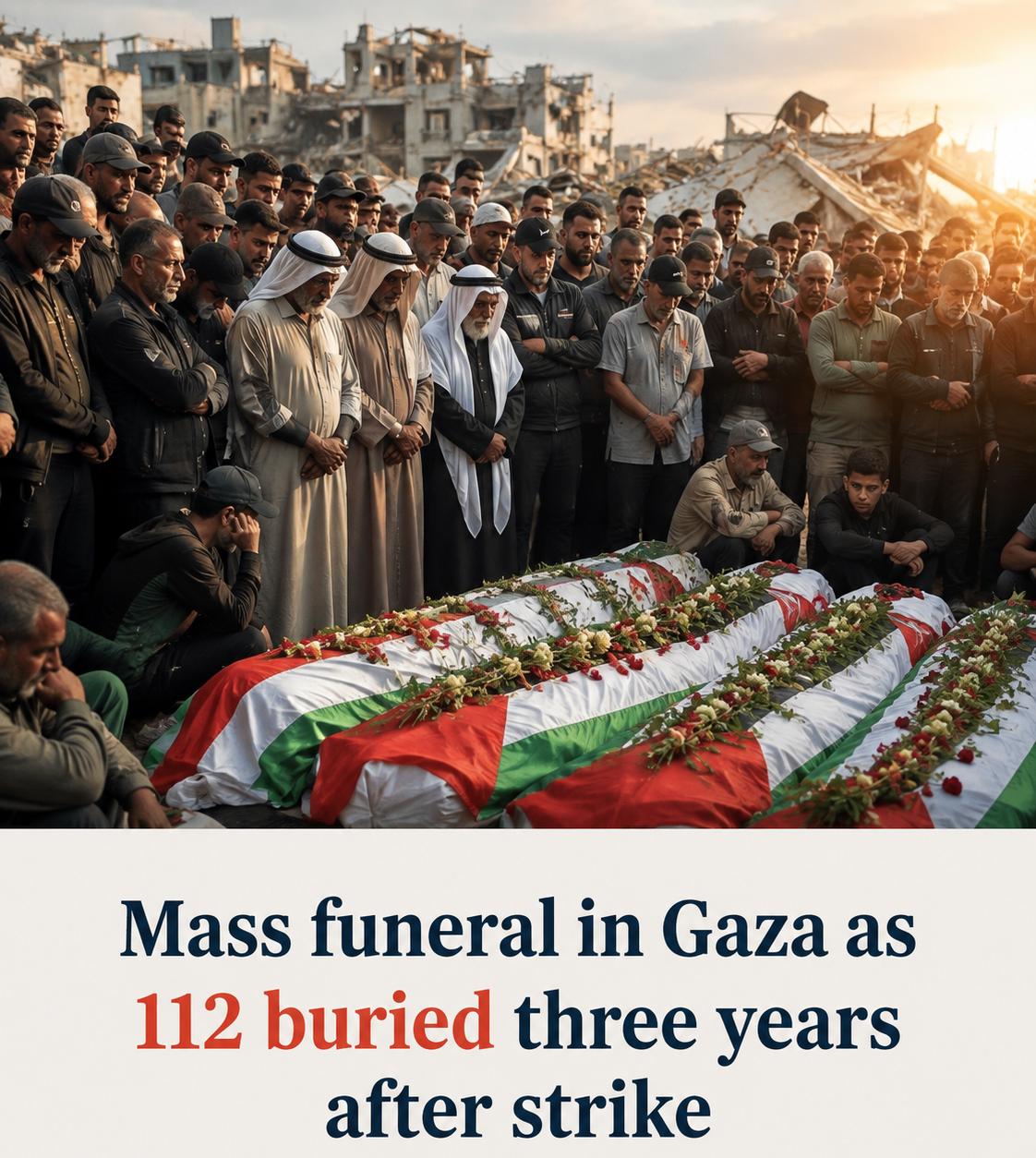
The funeral followed an intensive recovery operation by Gaza’s Civil Defence teams, which spent more than two weeks excavating the rubble of apartment buildings destroyed in the Sabra neighbourhood during an Israeli air strike in November 2023. Authorities said the operation recovered the remains of 112 people, including at least 40 children, many of whom belonged to the extended Abu Sharia and Al-Hassayna families.
Bodies wrapped in Palestinian flags were carried through the streets before funeral prayers were held and the victims were buried together. Relatives described the ceremony as reopening wounds that had never fully healed after years of uncertainty over the fate of loved ones whose bodies had remained trapped beneath collapsed buildings.
According to Gaza’s Civil Defence, the residential complex struck in November 2023 consisted of several apartment buildings sheltering multiple generations of the same extended family. Palestinian officials say approximately 308 people were killed in the attack. While dozens of bodies were recovered shortly after the strike, ongoing fighting, repeated bombardments and limited access prevented emergency crews from reaching many others until recently.
The recovery itself proved exceptionally difficult.
Emergency workers said they used heavy machinery where available, but much of the excavation relied on manual labour because specialised equipment remained scarce after years of conflict. Teams also faced the challenge of identifying heavily decomposed remains using personal belongings, jewellery, clothing and available forensic methods before the victims could be returned to surviving relatives.
Many family members said the funeral marked the end of an agonising wait.
Some survivors had spent nearly three years hoping additional bodies would eventually be found, while others had continued searching despite the destruction surrounding their former neighbourhood. Several mourners described finally recovering relatives as both a moment of relief and renewed grief.
Palestinian authorities estimate that thousands more people remain buried beneath collapsed buildings across Gaza.
Civil Defence officials have previously said the lack of equipment, fuel, heavy machinery and secure access to many damaged areas has significantly slowed recovery efforts. They estimate that at least 7,000 people are still believed to be trapped beneath rubble throughout the territory, although the precise number cannot be independently verified.
The mass funeral has once again drawn attention to the long-term humanitarian consequences of urban warfare.
Even after active fighting subsides in particular areas, recovery teams often require months or years to locate victims buried beneath destroyed residential buildings. Humanitarian organisations have repeatedly warned that damaged infrastructure, unexploded ordnance and continuing insecurity make search operations both dangerous and time-consuming.
The strike that devastated the Sabra neighbourhood occurred during the early months of the Gaza war, which began after Hamas launched an unprecedented attack on southern Israel on 7 October 2023, killing about 1,200 people and taking hundreds of hostages, according to Israeli authorities.
Israel subsequently launched a large-scale military campaign in Gaza aimed at dismantling Hamas. The conflict has caused extensive destruction across the territory and resulted in very high casualties, although casualty figures and responsibility for particular incidents remain the subject of international scrutiny and differing claims.
International humanitarian organisations have continued calling for greater protection of civilians, improved humanitarian access and expanded recovery operations for missing persons. Several organisations argue that families should be able to recover and identify relatives as quickly as conditions permit, both for humanitarian reasons and to provide certainty for surviving family members.
The funeral also highlighted the broader challenge facing Gaza’s emergency services.
Years of conflict have left large parts of the territory heavily damaged, with collapsed buildings, destroyed roads and shortages of specialist recovery equipment complicating rescue and excavation efforts. Civil Defence officials have repeatedly appealed for additional machinery capable of safely removing large volumes of concrete and debris without causing further damage to human remains.
Israel has not publicly commented specifically on the strike that destroyed the Sabra residential block. Throughout the conflict, Israeli authorities have maintained that military operations target Hamas and other armed groups while accusing those organisations of operating within densely populated civilian areas. Hamas has denied using civilians as human shields. The competing claims remain central to ongoing international legal and diplomatic debate surrounding the conflict.
The humanitarian situation across Gaza remains severe despite periods of reduced fighting in some areas.
Many displaced families continue living in temporary shelters or damaged buildings while reconstruction has progressed slowly. Recovery operations remain dependent on security conditions, available funding and access to equipment, meaning thousands of families are still waiting for news of relatives believed to be missing beneath the rubble.
For those gathered in Gaza City, however, the day’s focus was not on politics but remembrance.
After nearly three years of uncertainty, the recovered victims were finally given individual burials, allowing relatives to perform funeral rites that had long been delayed. Yet the ceremony also served as a stark reminder that many more families across Gaza continue waiting for the chance to recover loved ones still believed to lie beneath the ruins of the war.