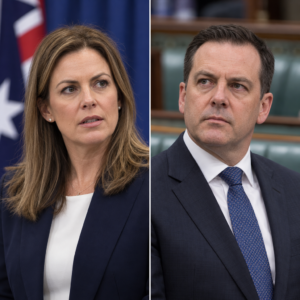
Nationals MP Darren Chester became the second politician ordered out of Question Time during a turbulent sitting, with Speaker Milton Dick warning that passionate disagreement did not excuse disorder in the House of Representatives.
The Guardian’s parliamentary live blog identified Chester as the second member ejected that day. The Speaker responded to the member’s conduct while emphasising that political feeling does not override the House’s standards.
Chester’s removal followed a separate incident involving Nationals MP Llew O’Brien. The two are distinct parliamentary events, with different politicians and immediate circumstances, despite sharing the same sitting and presiding officer.

That distinction matters for accurate reporting. The account of Chester’s removal records the Speaker’s rebuke. The swearing reported earlier concerned O’Brien, not an established remark by Chester.
Question Time was also consumed by disagreements over inflation, the cost of living and a contested grant for a Marrickville golf club. These issues provided the political temperature but do not replace the specific facts behind each disciplinary decision.
A Speaker’s ejection operates under parliamentary procedure. It is not a legal conviction, a suspension from the party or evidence that the member’s electoral position has changed.
An argument can be politically forceful without being procedurally disorderly. The Speaker has to draw that line in real time, sometimes while members from both sides challenge the ruling.
Reporting the incident fairly means recording Chester’s removal and Dick’s response without treating a routine procedural sanction as proof of a broader allegation of wrongdoing.
The incident matters because the chamber is a key place for public scrutiny of ministers. When disorder interrupts the proceedings, taxpayers lose some visibility of policy answers, even as the short confrontation can attract far more attention than the substantive questions.
A formal response, new documents or a policy decision could clarify the remaining disagreements. At present, the opposing statements leave significant questions unresolved.
The evidence establishes the public disagreement, but not every claim made by the participants has been independently resolved. Official statements, allegations and formal findings remain distinct.
Chester’s removal must be treated as its own event. The Guardian’s live coverage identified the Nationals member for Gippsland as the second politician ordered out of Question Time that day. Speaker Milton Dick rebuked his behaviour and said that strong feelings about political issues did not justify the way a member behaved inside the chamber.
The distinction from the earlier removal of Llew O’Brien is essential. O’Brien was reported swearing at the prime minister, and Dick cited that language when directing him out for three hours. The account of Chester’s removal records a rebuke about conduct, not a verified repeat of those exact words. Chester’s intervention is distinct from the earlier swearing allegation involving O’Brien.
Two ejections in a single sitting suggest a particularly difficult period for the Speaker, but they do not establish that the entire House had become ungovernable. Parliamentary proceedings continued and substantive questions were still asked. It is fair to describe disorder; it would be excessive to claim a constitutional breakdown or emergency.
Political disagreement sometimes becomes most intense when members believe a minister is avoiding a direct answer. That does not establish what motivated Chester’s particular conduct. The confirmed facts are the removal and the Speaker’s criticism. Any subsequent explanation from Chester would be a separate development.
The Speaker’s decisions serve an institutional purpose. A House in which one side can drown out the other would become less useful to the public. Temporary removal offers a means of restoring order without treating every interruption as a question for the courts. Its legitimacy depends on the published rules and consistent exercise of discretion.
The broader day’s debates included inflation, a disputed Marrickville golf-club grant and questions about online regulation. Their presence helps explain why the chamber was noisy, but the report does not prove Chester was ejected because of any one of those policies. Care is needed not to turn background topics into unverified descriptions of his conduct.
Accountability cuts in both directions. Ministers should answer substantive questions as clearly as possible; opposition members should be able to ask them with force. Both responsibilities can be undermined when proceedings devolve into repeated procedural confrontation. Different voters may assign blame differently without disputing the fact of the ejection.
Chester’s status as an elected MP did not end when he was ordered out of the chamber. Nor is the ruling a finding of criminal misconduct. A procedural direction belongs to a different category from party discipline, suspension for a lengthy period or removal from elected office. Clear terminology protects the audience from false impressions.
At this stage, the verified outcome is narrow: Chester was removed, Dick criticised the conduct, and the House had already experienced a separate ejection. Any subsequent apology, defence or disciplinary escalation would need a separate source. The sequence itself is newsworthy without creating a confrontation that the record does not describe.
The procedural issue is not whether a member feels strongly about a policy. Representatives are expected to feel strongly about matters on which people elected them. Dick’s rebuke drew a line between having a strong position and engaging in conduct that the Chair would not accept. Dick’s criticism concerned parliamentary conduct, not the mere expression of a strong political view.
Question Time is structured around limited opportunities to put questions to ministers. Interruptions can consume that time and make it harder for the public to assess answers. They can also obscure whether the government has addressed the subject of the question. Discipline is therefore not only a matter of decorum; it affects how visible accountability is to the people watching.
A removal order can seem dramatic when isolated in a video clip. Inside the House it is part of the procedural tools available to the Speaker, who must manage government, opposition and crossbench members. The importance of a single intervention should not be inflated into a claim that the House could no longer function or that the member had been removed from elected office.
The parliamentary record distinguishes the earlier O’Brien incident from Chester’s later removal. The two ejections happened at different moments during the same sitting and followed different exchanges. Because both men belong to the Nationals, there is an additional risk that a rushed caption will assign the wrong action to the wrong politician.
Members can object to a Speaker’s approach through parliamentary and political channels, but a later objection should not be invented. If Chester issues a statement defending his behaviour, that would be relevant additional evidence. Without it, the fairest presentation is the Speaker’s reported words and the confirmed fact of the removal, with no invented exchange of insults.
The day’s other conflicts included economic policy and criticism of a government grant. They formed the backdrop to a noisy sitting but do not establish a direct causal link to this particular decision. The immediate reason for the rebuke must remain separate from whatever larger political battles were being fought in adjacent questions.
Public trust depends on consistency. Voters may be more tolerant of disruptive conduct by politicians they favour, but the rules are meant to apply across parties. Whether the Chair succeeds at that is a broader matter for the parliamentary record, not something that can be established from one isolated clip of one member being removed.
The lasting public-interest question is how Parliament can protect robust scrutiny while keeping debate usable. The strongest test may be what happens after the headlines fade: whether later questions receive clear answers, whether members respond to rulings and whether the Chair maintains the same standards for all sides.
There is a difference between a headline describing Parliament as fiery and a claim that every participant engaged in the same conduct. Some members may be frustrated by questions, others by answers and others by the Speaker’s management of proceedings. The record of this particular ruling does not establish each person’s motive. Focusing on the words that were actually reported is more useful than inventing what Chester might have shouted or implying that he made the remarks attributed to another MP.
A useful follow-up would examine the chamber’s official record and any statement Chester chooses to make. That could clarify whether he disputes the ruling or accepts the Chair’s decision. No subsequent apology or detailed defence from Chester is established in the cited account. Fairness to the politician and to the Speaker both require restraint. The ejection is a reportable procedural event, but its seriousness should be judged against what actually happened, not the most dramatic possible interpretation.
For people watching Parliament to understand policy, orderly proceedings have value beyond appearances. Time spent on procedural confrontations can crowd out questions about spending decisions, services and the national economy. Conversely, an institution that discouraged tough challenges altogether would also fail its purpose. The Speaker must try to maintain space for both vigorous criticism and comprehensible answers. The exchange with Chester illustrates that daily balancing act without proving anything broader about the motives of the members involved.