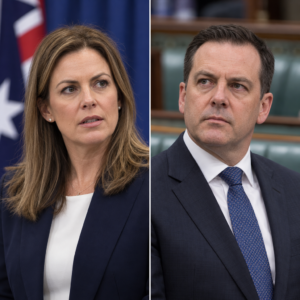
Victorian Labor is facing an unusually public dispute with trade unions as the state election approaches. Australian Services Union secretary Tash Wark has criticised Premier Ben Carroll while her organisation withdraws its customary campaigning support and runs advertising against Labor.
The immediate dispute concerns council rate caps and the ability of local governments to fund services and pay workers. The union argues that the government’s position threatens the financial capacity of councils and undermines an earlier understanding about their revenue arrangements.

The Australian Services Union says it will not undertake its usual door-knocking campaign for Labor. The decision matters because political campaigning draws on volunteer time, organisation and relationships built over successive elections, not just donations.
The Electrical Trades Union has also decided against a statewide Labor campaign, choosing instead to direct attention to the construction royal commission and its members. The Guardian reported that the union spent more than $1.6 million supporting Labor in 2022; that historical figure does not prove a comparable loss of cash in this election.
The ASU has indicated that a different response to workers’ concerns could change its campaign position. That leaves room for a political settlement, although no such agreement is established here.
The argument raises two genuine public-interest issues: how councils should balance rates and service delivery, and how employees can obtain sustainable wages. Raising council rates may improve fiscal capacity but can also place costs on households already under pressure.
Carroll’s government faces the political challenge of answering those criticisms while maintaining its position on household affordability. It would be misleading to treat union complaints as proof that all union members have withdrawn support from Labor.
In an election campaign, the loss of an ally can attract more attention than the underlying policy. The more meaningful test is what specific council-funding change the government proposes and whether it addresses the reasons behind the union’s action.
The reporting establishes an organised campaign dispute, not an election outcome. Claims about inevitable defeat, the size of electoral effects or future council pay rises would require evidence that does not yet exist.
The union’s dispute is rooted in a practical tension between council finances and household affordability. A cap on rates can protect some residents from sharper bills, especially when everyday costs are rising. But councils also need sufficient revenue to maintain roads, libraries, waste services, community programs and employee pay. Both the short-term bill and the longer-term quality of services matter to voters.
According to Guardian reporting, Wark’s organisation argues that the government retreated from an understanding reached with former premier Jacinta Allan about changing the rate-cap arrangements. The attack on Carroll therefore concerns a specific policy decision, not simply general dissatisfaction with the premier’s leadership. It would be inaccurate to suggest every union agrees with the ASU’s position.
The ASU’s withdrawal of door-knocking assistance is a concrete campaign decision. Door-knocking uses volunteers’ time to speak with voters, identify local concerns and support candidates. Without that assistance, a party may have to find other campaign resources. Nevertheless, no independently measured vote loss can yet be assigned to the decision.
An advertising campaign is a second, separate form of pressure. A union can criticise a government publicly while continuing to negotiate with it over workplace issues. Wark’s organisation has not framed its disagreement as necessarily permanent: its stated position leaves open the possibility of reconsidering support if the government addresses its concerns.
The Electrical Trades Union’s action should not be mistaken for the same dispute. Its reasons include the Victorian construction royal commission and legal or political support for members potentially affected. Combining the ETU and ASU decisions into a single set of demands would erase significant differences. They are separate organisations whose actions both create pressure on Labor.
The Guardian reported that the ETU spent more than $1.6 million backing Labor in 2022. The figure provides historical context for the scale of union campaigning, but it is not a current unpaid invoice, government loss or established prediction of spending in 2026. The amount the union might otherwise have spent this election is not verified by that historical comparison.
Carroll faces an unusually difficult balance. If the government agrees to a change that increases local-government revenue, it may be asked how ratepayers will be protected. If it maintains a tight cap, workers and councils may demand an explanation of how services and wages can be funded. A clear answer needs numbers and policy details rather than accusations alone.
Election advertising encourages exaggerated predictions about the political consequences of losing an ally. The reported union decisions are significant, but they do not establish how every member will vote or whether Labor will lose the election. Union officials, rank-and-file members and the wider electorate can hold differing views.
The practical questions for Victorian families include the cost of council services, the availability of maintenance and local amenities, and whether public-sector pay remains competitive. Those issues will continue after the campaign ends. A policy settlement may be more enduring than the immediate contest over attack advertisements.
The next evidence to examine is any written agreement or policy statement that clarifies the disputed rate-cap arrangement, followed by whether the ASU changes its campaign position. Until such developments occur, the confirmed story is that the union has taken action and explained its objections; a wider political outcome remains uncertain.
Rate caps are politically appealing because households can see their council bills. But a capped revenue stream also forces councils to choose between staffing, maintenance and service levels when their operating costs rise. The union’s point is that workers may be asked to absorb pressure created by a decision over which they have little control. Councils, however, still owe residents a credible plan for efficient spending.
A change to a rate cap does not automatically mean every council would raise bills to the maximum permitted. Local decisions, budget obligations and community priorities would still affect what residents pay. Equally, additional revenue would not guarantee a particular pay rise without workplace negotiations. Claims on both sides should explain the path from policy to household or employee outcomes.
Union campaigning can take several forms. Paid advertising reaches broad audiences, while volunteers at doors and community events provide personal contact. The loss of one type of activity may not be replaced easily by the other. That practical distinction helps explain why a dispute about rates can become a national newsworthy story about an election campaign.
Financial support is a different category again. A union’s decision to redirect its own resources towards members or workplace disputes does not necessarily mean a political party must repay anything. Historic spending may suggest a campaign relationship was once significant, but the exact current financial effect needs statements from the parties involved rather than arithmetic based on the last election.
The ETU’s focus on the construction royal commission adds another dimension to the dispute. That investigation and the union’s response are not merely background to Wark’s criticism of council rates. They concern distinct labour issues. The two unions are putting pressure on Labor for distinct reasons, despite both reducing their normal election-campaign support.
Political opponents may use this dispute to argue that Labor is losing its traditional base. That is an interpretation, not a measurable fact about every worker or union voter. Members of any organisation can hold a wide range of political preferences, and organisational decisions do not dictate how individuals cast secret ballots.
Carroll’s immediate test is to explain the government’s position in terms that can withstand scrutiny from both ratepayers and employees. If it believes a cap is necessary, it should address the funding consequences. If it sees room for an adjustment, it should quantify the impact. A response consisting only of campaign slogans would leave the underlying concern unresolved.
The immediate evidence is the withdrawal of campaign activity and the union’s stated reasons. The longer-term consequences depend on negotiations, government policy and what voters decide. For people relying on local-government services, those practical details are more important than whether a union leader or premier wins the loudest exchange in the media.
The election date creates a short window for the government to respond, but an unresolved campaign dispute should not be mistaken for a completed policy breakdown. The union can continue negotiations while publicly campaigning against the government. A concrete announcement on rate caps, an agreed wage framework or a withdrawal of advertising would each be a distinct development. Voters should be told which has actually happened rather than encouraged to assume a settlement or permanent rupture.
For local-government employees, any proposal has to connect revenue decisions to wage negotiations and service delivery. For ratepayers, the relevant comparison is between near-term bills and the condition of local services over time. That is a more useful measure of success than the intensity of the union’s advertisement. The political fight will end at the ballot box, but council finance and workers’ conditions will remain practical questions after the campaign.