Hundreds of masked anti-immigration protesters brought roads around Britain’s busiest international ferry port to a standstill after blockading access to Dover in a disruptive “stop the boats” demonstration.
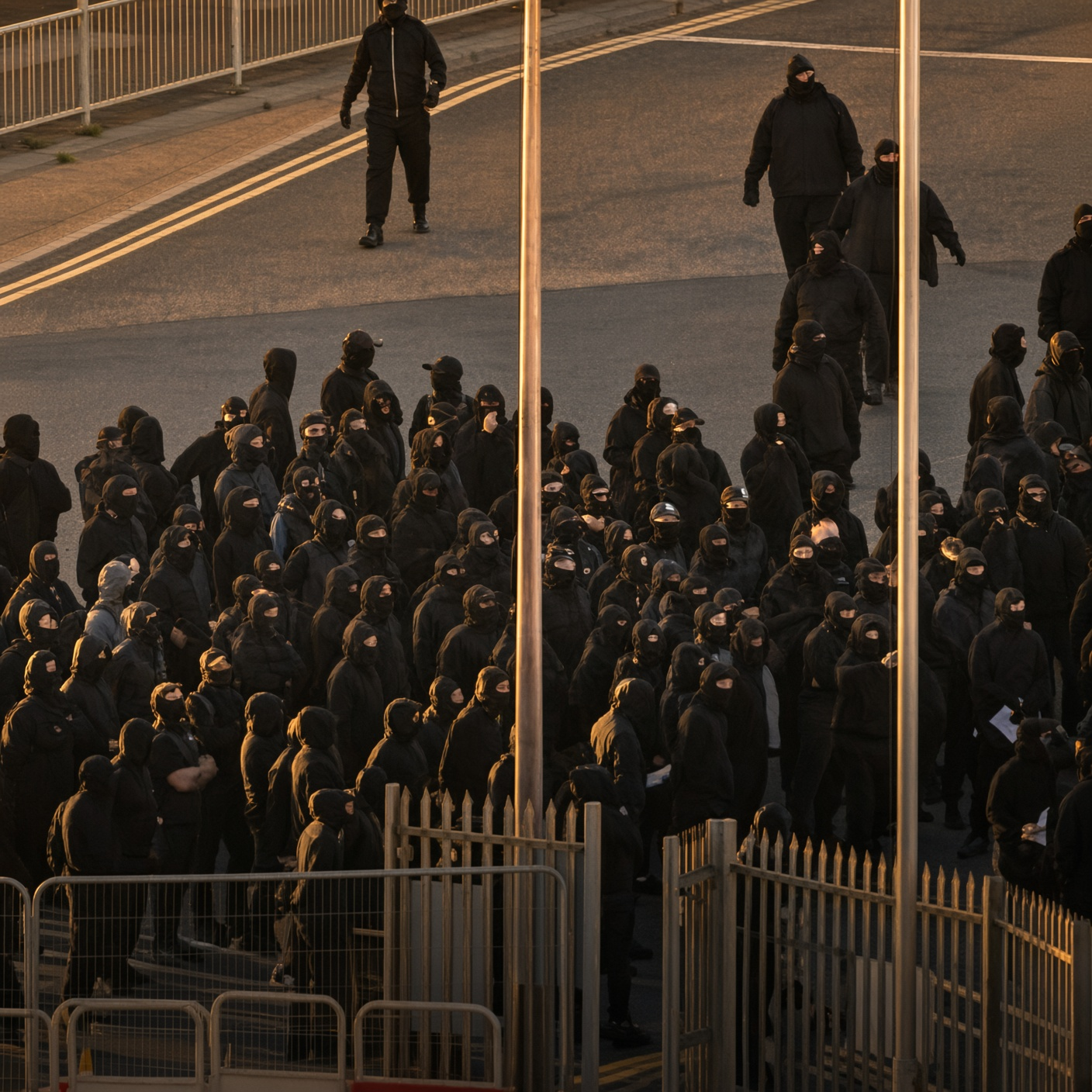
The protesters, many dressed entirely in black and wearing balaclavas, descended on the Kent port early on Saturday, September 5, blocking major approach roads and leaving motorists caught in queues stretching for about four miles.
Groups linked arms across roads while chants of “Stop the boats” and “Whose streets? Our streets” were heard during the demonstration.
Traffic entering and leaving the Port of Dover was halted during the most disruptive period, while the A20 was closed in both directions between key junctions around the town.
National Highways reported congestion extending for approximately four miles and delays of up to 45 minutes as protesters occupied several locations around the port.
The disruption affected tourists heading across the Channel as well as freight traffic using one of Britain’s most strategically important transport gateways.
Ferry operators acknowledged that some passengers missed their booked sailings and promised to place affected travellers on the next available departures.
P&O Ferries later reported delays of up to an hour after access began to reopen.
However, while some media reports described hundreds of holidaymakers as having missed ferries, neither the Port of Dover nor the ferry companies publicly provided a verified figure for the number of passengers who missed their original crossing.
The Port of Dover confirmed at 12.30pm that operations had returned to normal, all routes into and out of the port and town were open and traffic was again moving freely.
Kent Police said the people involved had dispersed by midday and no arrests were made.
The scale and organisation of the demonstration nevertheless prompted immediate questions about how hundreds of masked protesters had been able to obstruct access to such a critical piece of national infrastructure with apparently little advance intervention from police.
Kent Police described the event afterwards as a “spontaneous protest”.
Local officials challenged that description.
Conservative Dover District councillor Chris Vinson said what appeared to be several hundred masked men had arrived in coordinated groups, including in rental vans, before positioning themselves on roads into and out of the port.
He said the action had effectively brought Dover to a standstill.
Dover District Council leader Kevin Mills later questioned the initial level of police presence, saying he believed authorities should have known the demonstration was coming.
The dispute over whether the protest was truly spontaneous has become almost as politically significant as the blockade itself.
Reports following the demonstration linked it to Patriot Platform, a hard-right anti-migration organisation founded by activist Daniel Thomas, who is also known online as Danny Tommo.
Thomas has previously been associated with activist Stephen Yaxley-Lennon, better known as Tommy Robinson.
Videos of the Dover action circulated widely online, and Robinson shared footage while expressing support for the demonstrators’ opposition to small-boat migration.
The protest’s tactics were criticised from several different parts of British politics.
Labour MP for Dover and Deal Mike Tapp condemned the disruption to residents, tourists and local businesses and questioned the decision to arrive in the town with faces concealed.
Reform UK leader Nigel Farage also criticised the use of balaclavas, despite his party’s much tougher political position on illegal migration and Channel crossings.
Farage said people should not take to the streets masked in that way, while senior Reform figure Robert Jenrick also criticised what he considered intimidating behaviour.
The British government said people had a right to peaceful protest but that the action in Dover had moved beyond acceptable protest by causing serious disruption.
The controversy surrounding the balaclavas has additional legal significance because Britain recently strengthened police powers relating to face coverings at demonstrations.
Under the Crime and Policing Act 2026, police can designate an area around a protest when they reasonably believe offences are likely to occur or have already occurred and that a designation would help prevent further offending.
Inside such a designated area, deliberately using a face covering to conceal someone’s identity can itself become a criminal offence.
The maximum penalty is one month in prison, a fine of up to £1,000, or both, with exemptions for circumstances including health, religious observance and work.
The law does not mean that simply wearing a balaclava at every protest automatically constitutes an offence.
A police designation must first be made and the statutory conditions must be satisfied.
There was no indication from Kent Police’s public statements that the Dover demonstrators were arrested under those provisions, and the force confirmed that nobody was arrested during Saturday’s protest.
The lack of arrests has fuelled criticism from people who believe police should have intervened more forcefully once major transport routes were blocked.
Others have focused on the apparent intelligence failure rather than what officers did once they reached the scene.
Danny Shaw, a policing specialist and former BBC home affairs correspondent, said the incident raised serious questions about whether authorities had been caught unaware, particularly given the scale of disruption caused by a relatively small number of people at such a strategically important location.
The Port of Dover is not an ordinary local road junction.
It describes itself as the UK’s busiest international ferry port and a crucial gateway for both passengers and trade between Britain and continental Europe.
Recent port figures show millions of passengers and around two million freight vehicles use Dover each year.
The port has previously estimated that about one-third of UK trade in goods with the European Union passes through the gateway.
Even a relatively short blockade can therefore affect far more than tourists attempting to reach France.
Delays can disrupt freight schedules, supply chains and road networks far beyond the immediate port area.
Saturday’s disruption also forced the cancellation of the Dover Waterfront parkrun because organisers considered parts of the route unsafe or inaccessible.
Ferry companies attempted to reduce the impact on travellers once routes began reopening.
DFDS told passengers caught in the disruption that they would be accommodated on the next available departure.
P&O issued similar advice, while Irish Ferries also worked to place passengers who had missed their original booking on later services.
By early afternoon, the immediate transport crisis had largely passed.
The political argument behind it had not.
Dover has long been one of the physical focal points of Britain’s dispute over irregular migration across the English Channel.
Small boats carrying migrants and asylum seekers began arriving in significant numbers from 2018 onwards, and the issue has since become one of the most politically contentious parts of Britain’s immigration system.
House of Commons Library analysis says almost all people arriving by this route subsequently claim asylum.
In the year ending June 2026, about 33,000 people were recorded arriving by small boat, representing approximately 88 per cent of people detected entering Britain through unauthorised routes.
About 72 per cent of small-boat arrivals during that period were adult men, 13 per cent were adult women and 15 per cent were children.
But one part of the rhetoric surrounding the Dover protest requires context: Channel arrivals have fallen substantially this year.
Home Office operational data show crossings are down compared with 2025, following increased British and French enforcement activity.
Calculations based on the department’s daily figures put the year-on-year fall by early September at more than 40 per cent.
The British government says joint operations with France have prevented tens of thousands of attempted crossings since the election and resulted in the seizure of more than 1,100 boats and engines.
It has also agreed to fund additional French enforcement on the northern coastline, including a large increase in officers involved in preventing departures.
That decline has not removed migration as a political flashpoint.
Opponents of the government’s policy argue that thousands of people are still reaching Britain through a route they consider evidence that the border remains insecure.
Supporters of stronger enforcement say falling numbers demonstrate that pressure on people-smuggling networks and increased French cooperation are beginning to work.
The Dover demonstrators chose direct action rather than conventional political campaigning.
That distinction has drawn criticism even from politicians who share their opposition to small-boat migration.
The ability of one group to block a major international port while concealing their identities has also raised questions about whether similar tactics could spread.
Those concerns intensified almost immediately.
A day after the Dover blockade, hundreds of anti-immigration protesters gathered in Portsmouth after a large group of asylum seekers was brought ashore following a small-boat incident.
Roads were again blocked and police lines were challenged during confrontational scenes, extending scrutiny of how organised anti-migration groups are mobilising around Britain’s southern ports.
The Dover protest therefore lasted only a matter of hours, but its significance reaches beyond a Saturday morning traffic jam.
It exposed the vulnerability of one of Britain’s most important transport gateways to coordinated protest, raised questions about police intelligence and public-order powers, and demonstrated how deeply contested the issue of Channel migration remains even as the number of crossings falls.
For travellers caught in the queues, however, the consequences were much more immediate.
Roads were blocked, ferry departures were missed and a busy weekend journey through Dover became hours of uncertainty while masked protesters occupied the approaches to the port.
Traffic was flowing normally again by lunchtime.
The political fallout is likely to last considerably longer.






