A fierce election-campaign exchange between former prime minister Paul Keating and Peter Dutton remains a revealing example of how Australian political arguments can shift from policy to character, and from national debate to the experiences of a single family. Keating urged voters in Dutton’s Queensland electorate to reject him in extraordinary language. Dutton responded not with a defence of a particular government measure but with a story about his father’s small business and his own political awakening.
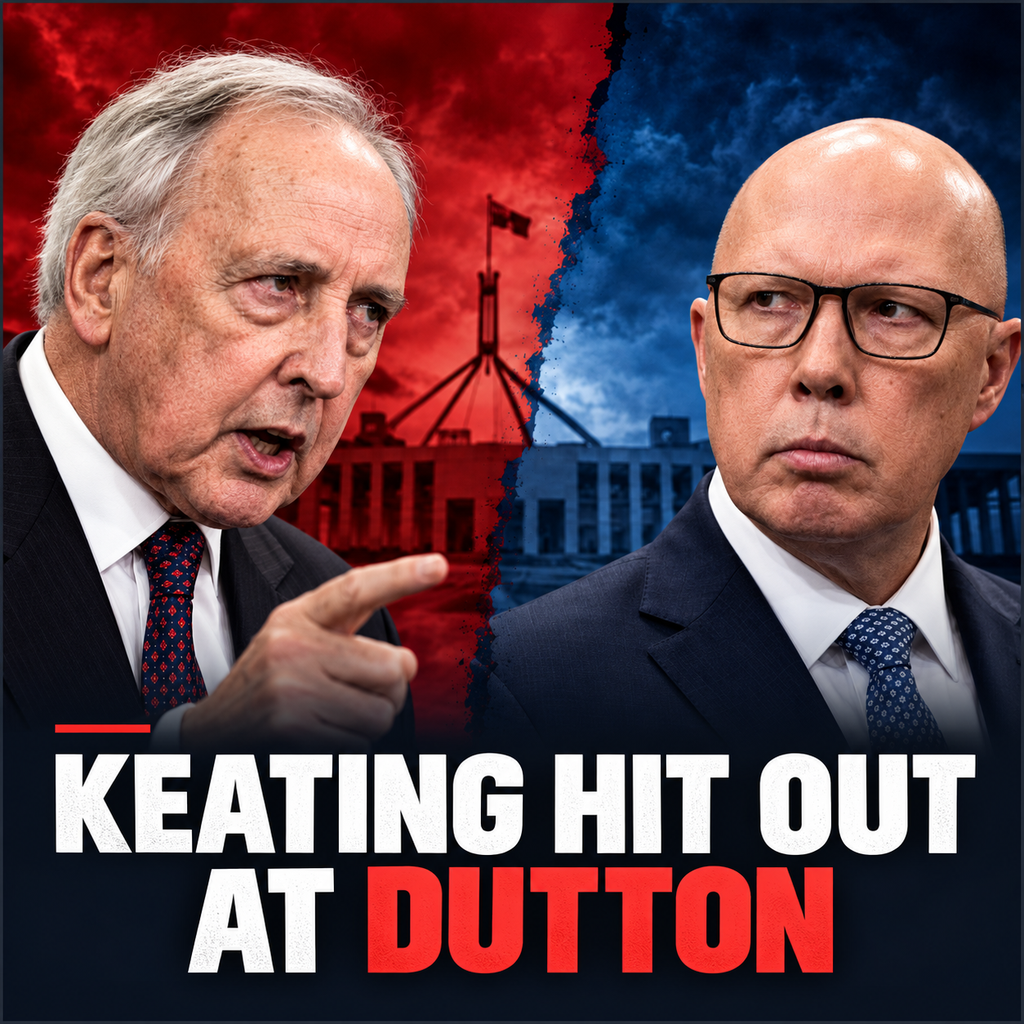
The encounter was documented in ABC reporting and on the public political record. It was not a parliamentary finding about either man, and neither man’s attack should be treated as an independently established assessment of the other. What made the dispute consequential was the contrast between its two stories: Keating’s condemnation of Dutton’s temperament, and Dutton’s claim that Keating’s economic management had shaped his family’s fortunes.
Keating, a Labor prime minister known for sharp parliamentary language, was criticising the then home affairs minister during a federal election contest. He urged voters in Dickson to drive what he called a political stake through Dutton’s “dark political heart”. The metaphor was deliberately confrontational. Its force rested on a judgement of character, not on a detailed explanation of a single bill, regulation or budget decision. Keating also described Dutton as exceptionally mean-spirited in his experience of public life.
Dutton’s response moved the argument to economic history. In a public statement reported by the ABC, he said Keating had almost destroyed his father’s small business through economic mismanagement and had inspired him to join the Liberal Party. That was Dutton’s personal account of the family’s experience. The ABC report did not independently establish a direct causal link between one government decision and what happened to the business, and a careful reading should not convert his account into a documented economic finding.
The response nevertheless illustrates a familiar fault line in Australian politics. Economic policy is experienced by people not only as an abstract change in interest rates, credit conditions or government spending, but also through the fortunes of employers, households and family enterprises. A family business can be affected by borrowing costs, customer demand, competition, taxation, lease arrangements and the overall economic cycle. People who live through a difficult period may form lasting political views about the government in office. Those views are politically important without, by themselves, resolving the economic causes of the hardship.
That distinction matters. A politician’s recollection can tell voters something meaningful about personal motivation, but it does not replace bank records, business accounts, macroeconomic data or an independent examination of policy effects. Nor does an opponent’s memorable insult establish whether someone has governed well. Both sides chose frames that were effective precisely because they made complex politics immediately human: a judgement about personal character on one side and a family story on the other.
The contest also had a very specific electoral setting. Dutton was seeking to retain Dickson against Labor candidate Ali France. Dickson was politically contested and was being watched as an indicator of the broader struggle between the Coalition and Labor. Keating’s appeal was therefore not just commentary from a retired political figure. It was an intervention aimed at the voters with the direct power to determine Dutton’s fate at the ballot box.
The Australian Electoral Commission’s final count supplies an essential check on what the rhetoric achieved. Dutton won the electorate, securing 54.64 per cent of the two-candidate-preferred vote to France’s 45.36 per cent. He received 52,968 votes in that final two-candidate count, while France received 43,980. That outcome does not show that Keating’s intervention had no influence on anyone. It shows only that the campaign, taken as a whole, did not produce the result he publicly urged.
Election results cannot isolate the effect of a single remark. A voter may dislike an attack while supporting its target, agree with an attack but vote on another issue, or be influenced by factors such as leadership, local services and economic expectations. A definitive claim that a particular intervention changed the margin would require evidence beyond a comparison of speeches and the final count. Political commentary often skips that uncertainty because a simple winner-and-loser narrative is easier to tell.
There was also a wider contest over how Dutton should be understood. Critics connected him to the Coalition’s leadership turmoil and to past controversies over his language on law and order. Supporters saw a politician willing to adopt positions they regarded as direct and uncompromising. The ABC reported Labor campaign criticism of his role in the challenge to Malcolm Turnbull, as well as comments he had made about African gangs in Melbourne. Those controversies explain why Keating’s character-based attack was designed to resonate, but they are separate issues and should not be treated as proof of the particular allegations contained in his remarks.
The then prime minister, Scott Morrison, declined to be drawn into Keating’s argument. Labor leader Bill Shorten also steered his answer to other political controversies rather than simply endorsing Keating’s every word. These responses show that the remark generated reactions across the campaign, but not a uniform position among the leading figures. Political parties are often cautious about embracing a veteran figure’s most colourful language even when it targets an opponent.
Keating’s intervention also sat alongside criticism he had made of Australia’s national security agencies and their influence on foreign policy. That debate involved a different policy question: who should shape national strategy and how elected ministers should use intelligence advice. It is useful background because Dutton’s Home Affairs responsibilities placed him close to security and border-policy debates. It would, however, be misleading to fold every national security disagreement into the single description of his character.
For businesses and households, the most concrete part of Dutton’s response was the assertion that government economic decisions had affected a family enterprise. The general mechanism is easy to understand. Higher borrowing costs can strain firms that depend on overdrafts or variable-rate finance; weaker spending can reduce sales; and policy uncertainty can make investment harder. But the existence of these mechanisms does not identify the cause of any one business’s difficulties. Responsible coverage draws that line clearly, particularly when claims about a private family’s circumstances are being used in a public argument.
The exchange raises a broader question about electoral accountability. Should a candidate be judged primarily on personal style, administrative decisions, economic outcomes or party allegiance? Voters are entitled to consider all of them. They are also entitled to distinguish between a deliberately cutting phrase, an individual’s lived experience and evidence about actual public outcomes. A slogan or anecdote can sharpen public attention; it cannot perform the work of a policy evaluation.
It is tempting to describe a political clash entirely through its most quotable sentence. That would miss the more important story. Keating attempted to make Dutton’s character the central issue in Dickson, while Dutton tried to make Keating’s economic legacy the reason voters should reject the criticism. Each invoked a different kind of authority: decades of political experience for Keating, and the account of a family business for Dutton.
The recorded election result provides a clear endpoint to the campaign contest. The larger debate about what makes an effective political leader remains open to interpretation, not something settled by a single insult or by one person’s account of a family hardship. Read carefully, the confrontation is less a fresh quarrel than a case study in the emotional language of Australian electoral politics — and in the value of checking that language against evidence.
The electoral data also reveals why describing a contest as marginal does not predict its final outcome. The margin reported during a campaign is a measure from an earlier count, not a promise about where votes will land. Preferences, turnout and changing local concerns all contribute to the final two-candidate figure. In Dickson, the count showed Dutton widening his share to 54.64 per cent. It remains impossible to allocate that movement to Keating’s rhetoric without independent evidence of how voters responded. Campaign reporting is strongest when it separates the measured outcome from theories about why it happened.
A further distinction is the difference between managing an economy and determining an individual business’s fate. Governments influence fiscal settings, taxation and regulation, but a small firm’s exposure also depends on borrowing arrangements, industry conditions and the choices of customers and owners. Dutton’s family story carried personal meaning and explained an element of his political identity. It did not provide enough information for a forensic account of the business. That is not a reason to dismiss the experience; it is a reason to describe precisely what can and cannot be concluded from it.
The comments also illuminate a structural feature of campaigning: prominent former leaders can speak with fewer immediate constraints than serving ministers. Keating did not need to draft a government policy response or negotiate a cabinet line when he made his attack. Morrison, by contrast, faced questions while responsible for leading the campaign and defending the government. His refusal to be distracted by the comments reflected a different political role. It would be wrong to turn that refusal into either endorsement or acceptance of Keating’s allegations.
There is a lesson for anyone evaluating strong campaign material on social media. An arresting phrase may be reproduced thousands of times with the surrounding explanation removed. The repetition makes it familiar but does not increase its evidentiary weight. A fair presentation pairs the comment with its source, identifies its original setting and includes the target’s reply. It also tells readers what was actually decided by the voters. In this case, the records support a striking confrontation and a clear electoral result, but not a simple claim that one insult defined the contest.