Jai Arrow has set himself an extraordinary goal after motor neurone disease brought his rugby league career to a premature end: he wants to still be here in another 10 years, watching his daughter grow up and showing other Australians living with MND that hope does not have to disappear with a diagnosis.
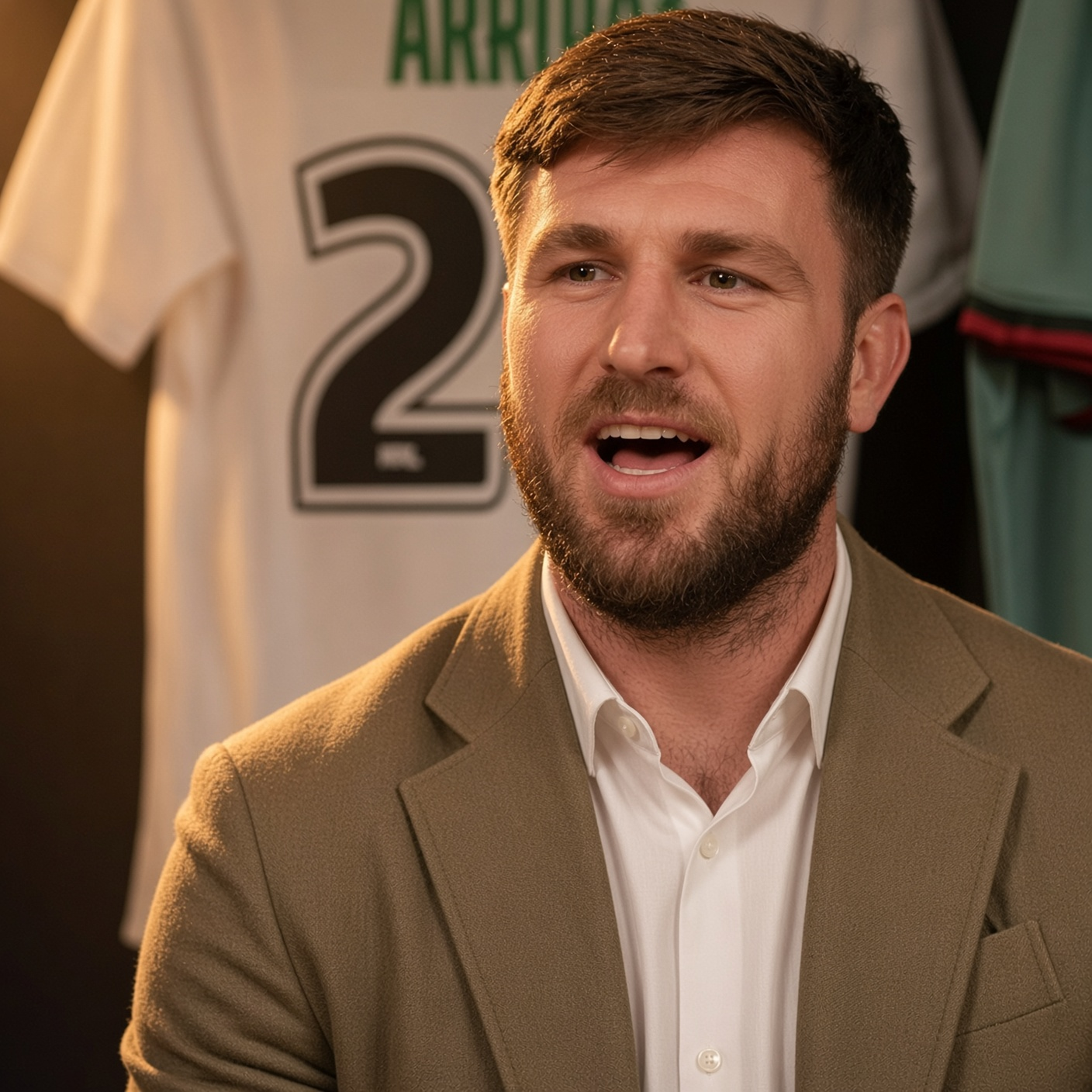
The former Queensland State of Origin forward spoke candidly about his future before making his emotional 100th appearance for South Sydney against the Sydney Roosters on September 4.
Arrow, 31, was diagnosed with motor neurone disease earlier this year after months of medical testing and worsening neurological symptoms.
The diagnosis forced him to retire immediately from professional rugby league in May.
But rather than treating the statistical outlook for MND as a countdown, Arrow says he intends to challenge it.
During an emotional appearance on Triple M’s Beau, Cat and Woodsy Breakfast, he said he was giving himself every hope of being alive for at least another decade.
He also wondered aloud why he could not become one of the people who lives with the disease for an exceptionally long time.
For Arrow, that ambition is not simply about himself.
His wife Berina and daughter Ayla have become central to the way he talks about the future, giving him reasons to focus on the years he hopes remain rather than the averages attached to his diagnosis.
A diagnosis that ended a decade-long NRL career
South Sydney announced Arrow’s medical retirement on May 20 after confirming he had been diagnosed with MND.
By then, he had played 178 first-grade matches across Brisbane, Gold Coast and South Sydney, as well as 12 State of Origin appearances for Queensland.
His career had been built around the qualities that made him one of the NRL’s most respected forwards: work rate, physical toughness and an ability to keep competing through injuries.
In 2025, his final full season, he won South Sydney’s George Piggins Medal as the club’s player of the year and the Bob McCarthy Clubperson of the Year Award.
But the symptoms affecting him through the following months could not be treated like another football injury.
After extensive testing, doctors reached the diagnosis that changed both his career and his family’s life.
Arrow said at the time that symptoms had begun affecting different areas of everyday life and that he was no longer medically cleared to train or play at the level required in the NRL.
It appeared his playing career had ended with 98 matches for the Rabbitohs.
Then rugby league found a way to give him two more.
The NRL changed the usual arrangements to get Arrow to 100
South Sydney approached the NRL, Rugby League Players Association and other relevant parties with a proposal that would allow Arrow to formally register two more Rabbitohs appearances while he was still physically capable of walking or running onto the field.
The plan was approved.
Arrow was permitted to start the Rabbitohs’ Round 26 match against former club Gold Coast and their Round 27 clash with the Roosters before being immediately interchanged.
The appearances took his South Sydney tally from 98 to 100.
There was no attempt to pretend Arrow was physically able to play a conventional NRL match.
The arrangement was symbolic, openly acknowledged as such and created to recognise what he had given the club during the previous six seasons.
His 100th appearance became one of the most emotional nights of the NRL season.
More than 41,000 people packed Allianz Stadium as supporters of South Sydney and the Roosters temporarily put aside one of Australian sport’s oldest rivalries.
Former Rabbitohs players formed a guard of honour.
Arrow walked onto the field alongside captain Cameron Murray before kick-off.
After the opening moment of play, Souths called for an interchange and Cody Walker replaced him.
The official appearance lasted barely a moment.
The significance of it lasted much longer.
Arrow embraced teammates before leaving the field and became visibly emotional when he reached coach Wayne Bennett.
His wife and daughter watched from nearby as the crowd rose to acknowledge him.
South Sydney then defeated the Roosters 50–20, but for much of the evening the result felt secondary to the farewell taking place around it.
‘Why can’t I be the one?’
Before that final appearance, Arrow gave one of his most detailed public accounts of how he was approaching MND.
The conversation became particularly emotional when former NRL player Beau Ryan raised the possibility that they might not see each other again.
Arrow rejected the suggestion.
His answer reflected the mindset he has repeatedly described since making his diagnosis public.
He understands the seriousness of the disease, but he does not want population averages to dictate how he approaches every day.
He said he gives himself every hope of surviving for at least another 10 years and spoke about wanting to defy the odds, much as he had done throughout his sporting career.
Arrow has cited unusually long-term MND survivors as evidence that individual experiences can differ dramatically.
That optimism should not be confused with a medical prediction.
Motor neurone disease is a progressive neurological condition affecting the motor neurons that carry messages from the brain to muscles used for movement, speech, swallowing and breathing.
As those nerve cells become damaged and die, muscles progressively weaken.
MND Australia says the speed of progression differs significantly between individuals.
The organisation lists average life expectancy at about two to three years from diagnosis, while stressing that survival varies from person to person.
There is currently no cure.
Multidisciplinary medical care, symptom management and support can help people live better for longer, while researchers continue trying to understand the disease and develop more effective treatments.
Arrow knows all of that.
His position is simply that he intends to approach his own case with the expectation that he can beat the average.
Family has changed what the fight means
Arrow’s public comments repeatedly return to Berina and Ayla.
The MND diagnosis ended a sporting career, but for Arrow the more confronting issue is what the disease could take from his role as a husband and father.
His daughter has become one of the clearest reasons behind the 10-year goal.
He wants time.
Time to watch her grow, to travel with her and to continue being present for ordinary family moments that suddenly carry a different significance.
Berina has spoken publicly about the family’s experience as an emotional rollercoaster, while praising the positivity her husband has shown since the diagnosis.
The Rabbitohs have also made clear that support for Arrow extends beyond football.
When his retirement was announced, the club said Jai, Berina and Ayla remained part of the South Sydney family and promised to stand alongside them through what comes next.
Coach Wayne Bennett described Arrow as someone who always put his family and teammates first.
That loyalty has increasingly been returned to him.
Support has spread beyond South Sydney
Arrow’s illness has generated an unusual level of unity across a sport normally built on tribal rivalries.
The Roosters played a major role in helping make his 100th South Sydney appearance possible.
Players from rival clubs publicly supported him.
Sydney Roosters chairman Nick Politis has also helped Arrow with costs connected to overseas medical travel.
Prime Minister Anthony Albanese, a lifelong Rabbitohs supporter, attended the 100th-game tribute and later described Arrow’s courage as an inspiration.
South Sydney players have repeatedly spoken about the motivation created by having their teammate around the club.
Arrow, meanwhile, has said one of the things he appreciates most is when teammates continue treating him normally.
That desire reflects another part of his adjustment to life with a serious disease.
He does not want every interaction to become a farewell.
He still wants jokes, conversations about football and the ordinary relationships that existed before anybody knew he had MND.
From football milestone to MND advocacy
The 100-game mark gave Arrow an ending to his South Sydney career that seemed impossible when he retired in May.
His next milestone is far less defined.
There are no competition points, premiership rounds or final sirens attached to it.
Instead, Arrow has increasingly spoken about using the attention surrounding his diagnosis to help people understand MND and support the search for better treatments and, ultimately, a cure.
For someone who spent his professional life measuring progress in games, metres and seasons, the new measures are very different.
Being present with his family matters.
Maintaining independence for as long as possible matters.
Helping another person with MND feel less alone matters.
And reaching years that statistics say will be difficult matters.
There is an unavoidable sadness around Arrow’s story because a career he had worked for since childhood was ended at only 31.
But Arrow himself has resisted making sadness the central theme.
His message is not that MND is less serious than doctors say it is.
It is that a serious prognosis does not remove a person’s right to hope.
That distinction may be why his story has resonated so strongly beyond South Sydney supporters.
He is not promising a medical miracle.
He is choosing a target.
Ten more years.
More time with Berina.
More time watching Ayla grow.
More opportunities to raise awareness for a disease that currently has no cure.
And, if he can manage it, proof for somebody receiving the same frightening diagnosis in the future that averages describe populations, not necessarily the exact limits of one person’s life.
Arrow’s NRL career is now officially over.
His fight for the next decade has only begun.






