Survivors of the Hunter Valley wedding bus crash are asking why so many warning signs failed to prevent a tragedy that killed ten people. Sharyn and Jason Junkeer have described the injuries, grief and lasting trauma they continue to live with, but their message is about more than the actions of the driver. They want authorities to address weaknesses in medical reporting, bus-company checks, road design and seatbelt safety before another family experiences a similar loss.
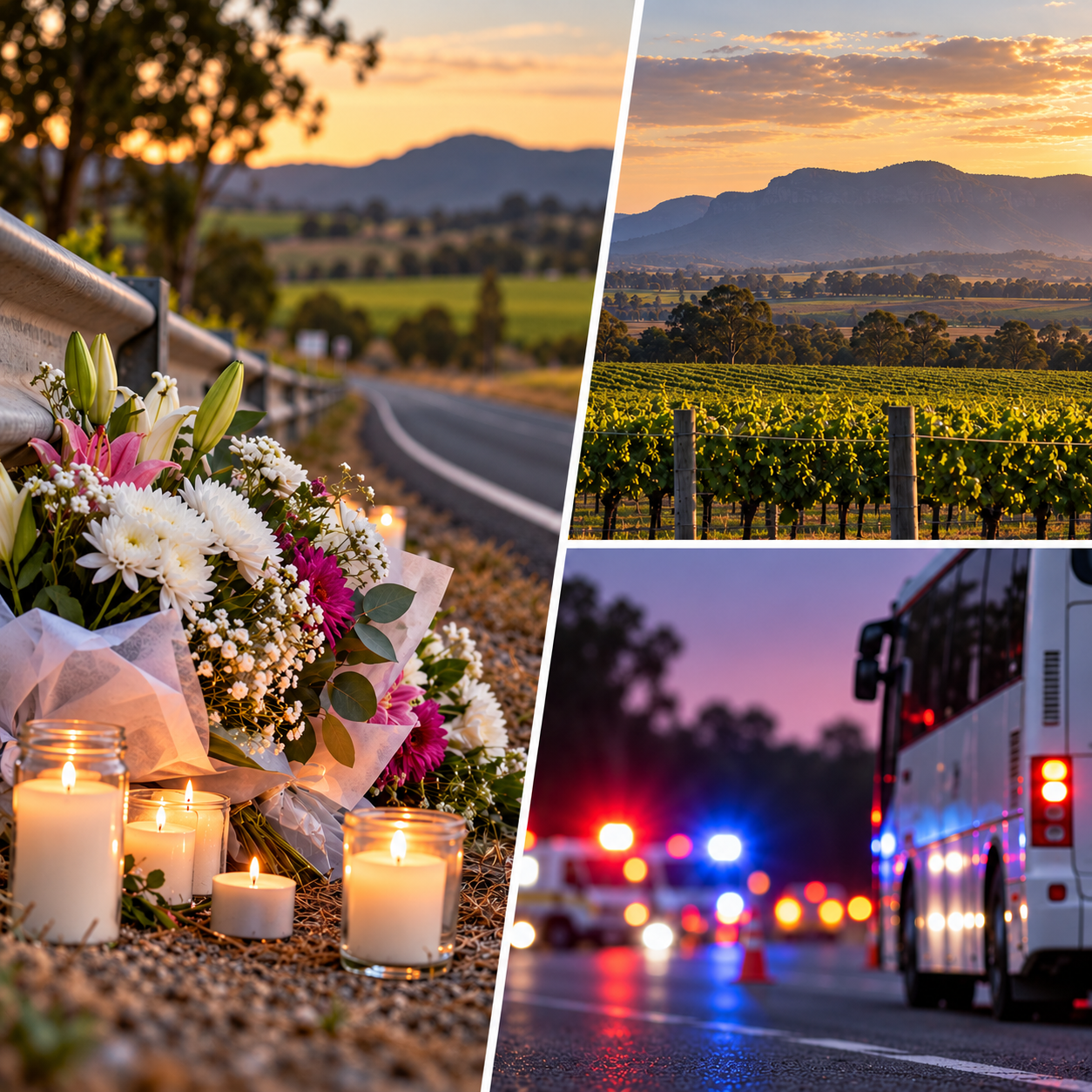
Their account, told to ABC's Australian Story, returns to the night a bus carrying wedding guests overturned near Greta in the Hunter Valley. The group had been celebrating a wedding at a vineyard and were travelling back to accommodation. Organising a bus was intended to make the journey safer. Instead, a crash at a roundabout claimed ten lives and left 25 others injured. Years later, the surviving passengers and bereaved families are still seeking answers about the systems meant to protect them.
Jason remembers seeing his wife Sharyn near the wreckage and trying to reach her amid the chaos. Sharyn had suffered devastating injuries, including fractures to her pelvis and lower back and a severe hip wound. She later needed a skin graft, rehabilitation and the slow process of learning to walk again. Jason experienced a brain injury and serious psychological trauma. Their recovery did not end when they left hospital. The damage affected work, everyday life and the way they remember what should have been a joyful family gathering.
The couple are acutely aware that they survived when others did not. Sharyn has stressed that she does not claim to speak on behalf of every bereaved family or passenger. That caution deserves respect. Each survivor and family has a different relationship to the event. The Junkeers are sharing their own experience to argue for systemic change, not to provide a universal account of what all those affected think or feel.
The driver, Brett Button, has already faced criminal consequences. He pleaded guilty to dangerous driving offences associated with the deaths and injuries and received a lengthy prison sentence. Reporting about the crash must preserve that legal outcome and avoid describing him as merely a suspect still awaiting trial. The criminal case addressed his conduct behind the wheel. The survivors' argument is that a prison term cannot by itself answer every question about the institutions that allowed him to operate the vehicle.
A transport safety investigation examined the crash and the circumstances surrounding Button's work. According to the ABC's reporting on the Office of Transport Safety Investigations findings, the bus was travelling at about 56.48 kilometres an hour as it approached the turn where it overturned. The investigation found that speed above approximately 47 kilometres an hour was likely to cause a rollover in the circumstances. Those figures are technical findings reported from the investigation, not estimates derived from a witness's impression.
Button had used tramadol to manage back pain and had taken more than his prescribed dose. His history of opioid use and earlier workplace concerns became central to questions about whether fitness-to-drive safeguards operated effectively. This is not a reason to stigmatise everyone prescribed pain medication. The issue is whether a commercial driver was assessed appropriately, whether relevant concerns were communicated through lawful channels and whether decision-makers had enough information to manage safety risks.
The investigation traced difficulties through earlier employment and recruitment. Button had been suspended from driving at a previous employer after concerns about his health. When he moved to another bus company, information about those issues was not passed on in the way safety advocates believe was needed. The ABC reported that privacy rules prevented the first operator from simply handing health information to the next without consent. It also reported criticism of the new employer's reference checks, including their limited examination of the driver's record.
That sequence raises a difficult public-policy question. Medical privacy protects workers from inappropriate disclosure of sensitive information, but employers transporting passengers must know whether a driver can carry out a safety-critical role. A responsible system needs both safeguards. Treating privacy as irrelevant would be wrong; treating it as a complete answer to serious safety concerns is equally unsatisfactory. The families want authorities to examine what should be reportable, by whom and under what conditions.
The investigation also examined how medicines are managed in commercial transport. Tramadol was not automatically prohibited for bus drivers, and the safety report identified gaps in clear reporting requirements for relevant medications. The effect of a medicine can depend on dosage, individual response and other factors. That is why the role of doctors, regulators, drivers and employers in monitoring impairment matters. A list of notifiable medication may be one tool, but it has to be supported by clear clinical and administrative procedures.
The former bus operator involved in hiring Button was later fined after pleading guilty to breaches of heavy-vehicle laws, according to the ABC's reporting. The company is no longer operating. Families have questioned whether financial penalties and individual criminal sanctions are enough to change industry behaviour. That debate is not a suggestion that every bus business operates unsafely. It reflects concern that employers need strong incentives to check licences, health information and work histories thoroughly.
The road environment is another part of the story. The crash occurred at a large, unusually shaped roundabout. The transport safety investigation considered how its elliptical design required changes in steering and speed as a driver proceeded. The road met applicable standards, but the findings prompted discussion about whether warning signs and approach speeds were sufficiently clear. The groom's father, road engineer John Gaffney, has questioned whether different signs or speed measures could reduce risk at such locations.
A design that formally meets a standard can still present challenges under particular conditions. Road authorities continually examine the difference between minimum compliance and what drivers can safely navigate in practice. The lesson is not that every roundabout is inherently dangerous or that its geometry alone caused the crash. The question is how road layout, driver behaviour, signage and vehicle stability interact, and whether changes could help prevent similar outcomes.
Seatbelts provide a further and highly practical issue. The bus was fitted with belts, but only a small minority of the 35 passengers were wearing them when it crashed. The driver did not give the instruction to buckle up that was required under company procedure. Survivors believe stronger warnings and a different culture of seatbelt use might have changed the toll. That is their assessment, and it aligns with the broader safety concern that passengers on coaches do not always treat belts with the same seriousness as they do in cars.
Governments have since considered measures to improve seatbelt messaging on buses, including visual and audio reminders. The transport investigation also pointed to the long period it could take before newer equipment requirements are reflected across an existing fleet. Such delays reveal a recurring transport-safety problem: a policy can be announced quickly, while replacing vehicles and changing habits takes much longer. That makes interim measures, clear driver instructions and effective education particularly important.
NSW has accepted, or accepted in principle, recommendations directed to Transport for NSW. Other recommendations involve different authorities. Roads Minister Jenny Aitchison has supported better notification of medications through medical-assessment processes. Those responses show work is under way, but acceptance of a recommendation is not proof that it has been fully implemented. The survivors' demand is for progress that can be demonstrated, not merely another statement that lessons will be learned.
Among the bereaved are Matt and Leanne Mullen, whose daughter Rebecca, a young doctor, died in the crash. Their experience illustrates why sentencing can bring little emotional resolution even when the court imposes a substantial term. The loss does not reverse, and questions about the preventability of the event can continue. For families like theirs, scrutiny of the system is bound up with the hope that future passengers will be safer.
The public interest in the story lies in those specific reform questions. Can employers check a safety-critical applicant's history effectively? Can clinicians and regulators communicate serious impairment risks without undermining necessary privacy? Are bus seatbelts treated as essential? Do difficult road layouts carry sufficient warning? The answers require evidence from governments, operators, doctors and engineers, not simply a demand that an offender be punished more severely.
Sharyn and Jason Junkeer have chosen to speak publicly despite the strain of recalling the crash. They are not describing a new collision, and their campaign should not be packaged as if another disaster has occurred. The development is their account and their call for action after the investigation exposed potential system weaknesses. Their challenge to authorities is simple: honour those who died by turning recommendations into practical protections, then show the public that the protections work.






