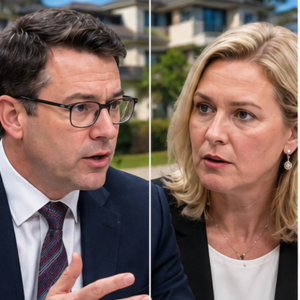
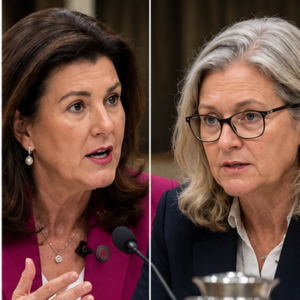
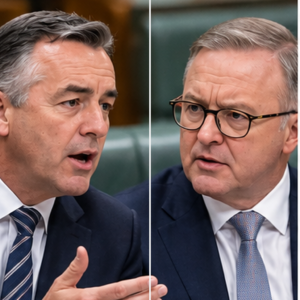
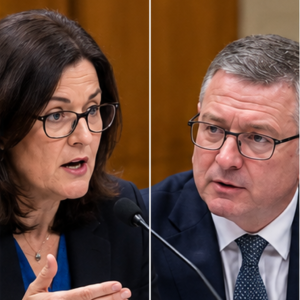
Pauline Hanson described Western Australian Premier Roger Cook as a “scared premier” after he questioned One Nation’s record on Medicare, tax cuts and social support during her June 2026 visit to Perth. Their exchange exposed a contest over who can credibly claim to speak for Australians struggling with household costs, rather than a simple dispute about personality.

Cook accused Hanson of dividing the community and argued that her political record should be judged by votes as well as speeches. He referred to tax relief, Medicare, childcare and pensions. Those points were accusations made by a political opponent; without a comprehensive vote-by-vote assessment they should not be presented as an independent audit of every decision Hanson has taken in federal parliament.
Hanson strongly rejected Cook’s description of her Medicare position. Speaking to ABC Radio Perth, she dismissed the suggestion she was opposed to Medicare as “a load of hogwash” and blamed Labor for spreading what she regarded as a false account. She then portrayed Cook’s criticism as evidence that Labor feared growing competition from One Nation in Western Australia.
The exchange took place against the background of Hanson’s push to recruit support outside One Nation’s traditional Queensland base. The party was seeking a larger political role in WA and signalling an intention to contest Labor-held areas. Cook’s attack responded to that prospect. Rather than ignore an opposition figure from federal politics, the premier tried to hold her to account for national policy positions with direct relevance to WA voters.
One reason the argument resonated was Medicare. Australians use the term to refer to several interconnected arrangements: access to subsidised medical services, rebates for consultations and tests, safety-net protections and a broader publicly funded health system. A claim about a parliamentary vote on one element cannot necessarily be equated with support for, or opposition to, the entire institution.
For patients, the immediate concern is often out-of-pocket cost. A federal decision changing Medicare rebates can affect what a GP or specialist charges, while state governments are responsible for running public hospitals and a substantial part of health-service delivery. Both levels of government play roles, but the levers are not interchangeable. A WA premier cannot simply change Commonwealth Medicare rebates, and a federal senator does not manage the day-to-day staffing of a state hospital.
That federal-state division matters when politicians seek to turn healthcare frustrations into votes. Long waits for some appointments, workforce shortages and rising household expenses can create a demand for simple explanations. Yet different parts of the problem call for different solutions: training and recruitment, regional workforce incentives, decisions on bulk-billing, hospital capacity, preventive health programs and transparent performance reporting.
Tax is another area where political slogans compress a complicated record. A senator may support one form of tax relief while opposing a wider package because it contains other provisions or distributes the benefits differently. Voters are entitled to ask precisely which bill, amendment or budget measure is being discussed, what the senator did and what the alternative would have been. Without that detail, a numerical claim about voting “against tax cuts” can mislead even when some individual votes can be documented.
Childcare and pensions have similarly different budget effects. Childcare subsidies are usually discussed in terms of workforce participation and affordability for parents, while pension changes raise questions about eligibility, income tests, fiscal sustainability and the treatment of older Australians. A party arguing for greater relief must also say how its policies would be funded and who would receive the benefit. A party criticising another’s record should explain exactly which proposals it considers decisive.
Hanson’s Perth visit also drew attention to her relationship with mining billionaire Gina Rinehart. Hanson told ABC that she regarded Rinehart as a friend, listened to her policy ideas and welcomed her support. She specifically credited Rinehart with suggesting a proposal about pensioners being able to work without losing pension entitlements or associated concessions. These are Hanson’s statements about their relationship and influence, rather than evidence that Rinehart directs the whole of One Nation’s platform.
Business involvement in politics is neither automatically illegitimate nor beyond scrutiny. Industry figures can offer expertise on investment, employment and regulatory costs. At the same time, parties should be prepared to explain how policy ideas are evaluated, whether beneficiaries stand to gain financially and what public consultation has occurred. The debate is particularly sensitive in a state where mining investment shapes employment and royalties.
Western Australia has a distinctive economic profile. Resources exports, regional jobs, ports, transport links and the cost of living in remote communities can look different from metropolitan concerns in eastern states. Policy proposals affecting energy, payroll costs or industrial relations can have uneven effects across those communities. A political party asking for votes in WA needs to address those differences rather than assume the same rhetoric will work everywhere.
Rinehart’s prominence amplified the interest in Hanson’s visit, but it did not change the central issue Cook raised. His argument was that populist promises should be measured against parliamentary choices. Hanson’s argument was that Labor’s allegations misrepresented her motives and that Cook was reacting to the emergence of a political alternative. Neither claim settles the policy record on its own.
There was also an important distinction between political popularity and governing authority. A party can gain support in opinion surveys without automatically being in a position to enact a tax change, alter Medicare or dictate a state budget. Australia’s systems require votes in parliaments, negotiations among parties and the passage of specific legislation. The effect of a minor party depends on the chamber, the bill and the numbers at that moment.
Cook’s use of the word divisive made the dispute about social cohesion as well as service delivery. Hanson has long framed her politics as speaking for people ignored by established parties. Her critics argue that parts of her rhetoric unfairly single out minority groups. Reporting that disagreement accurately requires describing what each side said, while avoiding the implication that every person who supports the party necessarily shares every claim made by its leader.
There are legitimate reasons for voters to be angry about high medical expenses, insecure housing, stagnant purchasing power or a pension that stretches less far than before. There are also legitimate reasons to demand evidence from anyone proposing a remedy. The political challenge is to connect grievances to specific spending, revenue and legislative decisions that can be checked later.
The Perth confrontation was therefore a useful test for both leaders. Cook had to justify his criticism with an accurate account of federal votes and real outcomes for WA residents. Hanson had to do more than reject the accusation: she needed to set out how One Nation would improve services and pay for its commitments if given greater influence.
Nothing in the exchange proved that WA had already shifted decisively towards One Nation, nor did it establish that Cook was literally afraid of Hanson. “Scared premier” was a political insult designed to suggest momentum. What the record does show is that established parties and challengers were competing over the same vulnerable voters, using healthcare, taxation and the cost of living as the terms of the contest. A reliable comparison of the politicians’ healthcare claims would need to examine particular parliamentary divisions, the wording of the measures and the parties’ stated reasons for voting as they did. A vote against a combined bill can reflect opposition to one provision rather than every objective mentioned in its title. Conversely, a senator who consistently opposes funding proposals should expect to explain the practical alternative. Neither a slogan about defending Medicare nor a rival’s list of alleged votes is sufficient by itself.
The same scrutiny is needed for pensioner employment proposals. Removing or easing an income test could increase the incentive for some older people to work, while changing Commonwealth expenditure and the distribution of support. Any serious estimate would consider how many eligible pensioners might take up extra work, their likely earnings, interaction with tax rules and how the reform would affect those who cannot work. Those questions matter more to retirees than the identity of a wealthy supporter who proposed the idea.
State political arithmetic differs from Canberra’s. One Nation’s ability to influence a Western Australian election depends on its candidates, local organisation and voters’ priorities in particular seats. A popular federal figure can draw attention to an event without ensuring a successful state campaign. Both Cook and Hanson were speaking strategically to people who might be considering alternatives, but an election result cannot be inferred from a packed room or one round of interviews.
For regional households, the cost-of-living question can be unusually sharp. Distance increases transport and service expenses, while local job markets depend on a few large sectors. A proposal that appears attractive in Perth may have a different effect in remote mining communities or agricultural districts. Parties should publish enough detail for families and businesses to assess who receives support and what trade-offs are involved.
Cook and Hanson were also competing over definitions of integrity. Cook asked whether her actions matched her promises; Hanson said his criticism distorted her policies. Each side’s claim can be tested only through a transparent comparison of records, not by assuming an insult settles the matter. That discipline remains essential when a heated exchange is recirculated as a headline long after its original date.
That makes the story relevant beyond the day the words were spoken in June 2026. Western Australians will still have to judge each proposal on its merits: what it changes, who benefits, what it costs and whether there is credible evidence it would work. A sharp retort can capture headlines; those policy questions should determine which side wins the argument.