More than 1,000 people gathered at Sorrento Beach in Perth on Sunday to remember Greg O'Neill, a father and regular ocean swimmer who died following a shark attack off the coast last month. The memorial brought relatives, friends, fellow swimmers and members of the wider community together at a place that had meant so much to him. It was a day of grief, gratitude and remembrance, even as the tragedy continues to influence debate about beach safety.
Mr O'Neill's family thanked those who supported them after his death and encouraged people to keep enjoying the water. ABC News reported that many attendees wore blue and that members of his swimming group entered the ocean during the tribute. The family message should be understood in that context: it was a reflection on a loved one's life, not a claim that shark risk can be ignored.
The event was a new development weeks after the fatal attack. It is different from reporting the original incident again. The gathering showed the impact of the death on a community of people who knew the beach as a place for exercise, friendship and daily routine, as well as a location now associated with a terrible loss.
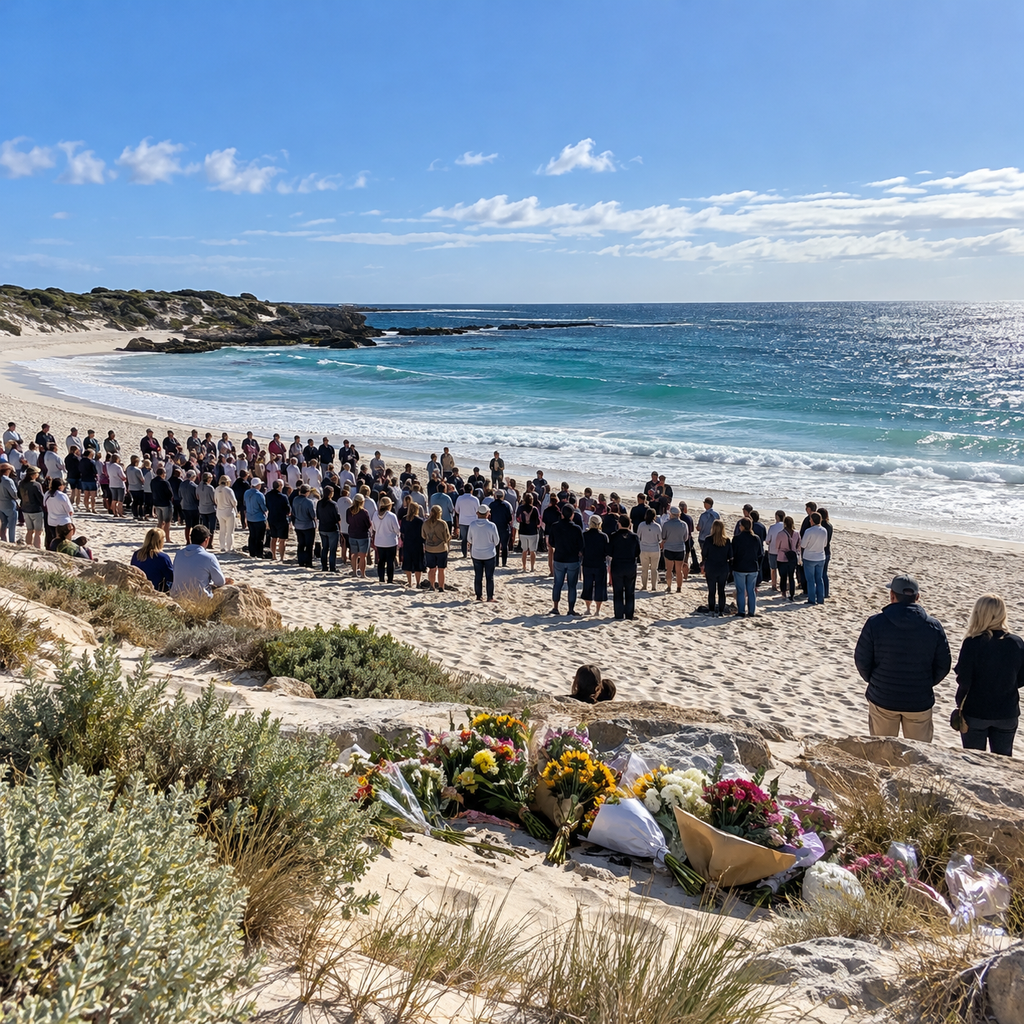
ABC News reported an attendance of more than a thousand people at the Sorrento Beach memorial, including members of Mr O'Neill's family and his swimming circle. Flowers, photographs and the crowd's presence marked the occasion. A representative image of a beach tribute can communicate that setting, but the approved AI illustration accompanying this article should not be passed off as a photograph of the gathering.
Mr O'Neill's daughter Bianca expressed gratitude for the kindness and support the family had received. She also spoke of the ocean as somewhere her father found happiness and healing. Her family's message was that the water should remain a place people can enjoy, notwithstanding the profound fear and sorrow caused by his death.
At the memorial, the family led a symbolic gesture involving sand and the surf. Such a gesture is meaningful because it returns attention to the person being remembered rather than the circumstances of the attack. The detail matters as part of a communal farewell, not as dramatic decoration for a headline.
Members of the Sorrento Squids, Mr O'Neill's regular swimming group, returned to the sea on Sunday. ABC reported that a friend who had been swimming with Mr O'Neill on the day he died went into the water for the first time since the incident. The return was emotionally significant within the group, but its personal meaning should not be exaggerated beyond what members have publicly said.
For regular swimmers, a beach can become part of the shape of everyday life. Early exercise, familiar faces and shared routines create bonds that may be invisible to occasional visitors. Losing someone in that setting can affect far more people than the immediate family, as the large gathering at Sorrento demonstrated.
Mr O'Neill died after being attacked by a shark close to Sorrento Beach in September. The event led to an emergency response and concerns about the safety of nearby water users. Sunday's remembrance did not change the known outcome of the attack; it gave the community a chance to support his family and honour him in a place strongly connected with his life.
The death was the third fatal shark attack recorded in Western Australia this year, according to the ABC's Sunday reporting. That figure has prompted calls for renewed consideration of monitoring and swimmer protection. It does not establish that every beach carries the same risk, nor does it support a numerical prediction of future incidents at Sorrento.
The attack drew intense attention partly because many West Australians use the coast routinely and often regard swimming or surfing as essential to their lifestyle. Public reactions may include grief, fear and disagreement over the appropriate balance between marine conservation and human safety. Those views should be attributed to those expressing them rather than cast as a single community consensus.
An order to locate and kill the shark believed to have been involved was issued in September, ABC reported, but later called off after the animal was not found. That sequence is part of the official response history and should not be misreported as a successful capture or as proof that the shark was still in a particular area on Sunday.
Western Australian authorities have been considering expanded shark-tagging and the potential use of artificial-intelligence-assisted drones for monitoring. Such proposals are aimed at providing better information or warnings, but they are not the same as a guarantee that people will never encounter a shark. Their implementation and effectiveness need to be assessed through evidence rather than claims of complete protection.
The head of Sorrento Surf Life Saving Club, Robert Doherty, told ABC he would support a shark barrier covering a limited area of the beach. His suggestion illustrates one approach within a wider set of options. It was not a statement that a barrier had already been approved, funded or installed.
Western Australia's SharkSmart service provides one way swimmers and families can put the broader beach-safety discussion into everyday context. Its government-run site and app provide reported sightings, tagged-shark detections and information about Surf Life Saving WA patrolled beaches. Checking those services before entering the water is a practical precaution, not evidence that a beach is free of sharks. There is no basis to infer that a particular alert would have changed the fatal incident involving Greg O'Neill, and the memorial should not be turned into a finding of fault.
Barriers, drone surveillance, patrols and tagging each involve different practical questions. They vary in the area they can cover, the information they provide, their ongoing costs and how they interact with the marine environment. The report of a proposal should therefore be distinguished from a policy decision or a proven outcome at Sorrento Beach.
Some beachgoers may wish to return to the water as soon as they feel ready, while others may avoid it for a time. Neither response is a measure of respect for the person who died. The family encouraged people to keep embracing life, but each person's choice about activities after a traumatic event will be influenced by individual circumstances and their understanding of risk.
Different monitoring tools answer different questions. A reported sighting indicates someone has seen a shark; a tagged detection depends on an animal being tagged and within range of equipment; a patrol or drone may have limits on visibility and the stretch of coastline it can observe. A proposed barrier, by contrast, would address a defined swimming area rather than the entire ocean. Understanding these distinctions helps explain why local debate continues even when community members agree that safety matters.
The strongest public-safety debate is one that starts with confirmed facts and openly acknowledges what proposed measures can and cannot accomplish. A renewed commitment to monitoring may increase opportunities for detection or warning, but it should not be presented as an absolute shield. Likewise, the fatal attack should not be used to imply that every encounter or sighting leads to an injury.
The emotional centre of Sunday's event was the family and their account of Greg O'Neill, not any technical proposal. People came to a familiar stretch of sand to support those closest to him. They remembered a husband, father, brother and friend who enjoyed the ocean and belonged to a community built around it.
ABC's report described many participants dressed in blue, speaking and reflecting near the shore. The choice of colour and the gathering's size made the tribute a striking visual event, but images of grieving people should be used carefully. Photographs of unrelated individuals or generated portraits should not be labelled as Mr O'Neill or his family.
The return of the Sorrento Squids to the water was particularly resonant. It linked remembrance to a routine Mr O'Neill had shared with them, while acknowledging the altered feelings that can follow a fatal event. The fact that a friend who was present during the attack joined the swimmers gives the gesture specific human context without requiring speculation about that person's private recovery.
There may be further discussion about the club's barrier suggestion and the state's broader monitoring program as warmer weather approaches. Those decisions are separate from the memorial, even though the death has helped focus public attention on them. A policy debate should never erase the individual's life at the centre of a story.
For the many people who use Perth beaches routinely, choices about entering the water may depend on weather, surf conditions, patrol availability and personal comfort as well as the latest shark advice. SharkSmart encourages people to check activity and current warnings before heading out. Such information supports informed judgement, but no monitoring system can promise that an encounter is impossible. That balance is consistent with the family's call to remember the joy the ocean brought Mr O'Neill without minimising the tragedy.
For the family, the gathering reflected support from more than a thousand people. For the wider community, it was an opportunity to acknowledge a loss together and consider how to use the coastline with care. The day did not settle every question about shark safety, but it made clear that Mr O'Neill was remembered as a person whose presence mattered to many.
The community response also shows how safety policy and grief run on different timetables. Family members and friends can gather for a memorial well before officials decide whether infrastructure such as a barrier should be assessed or funded. Proposals for additional monitoring require decisions about location, cost, maintenance and environmental effects; they should not be presented as a completed response. For Sunday, the verified new development is the large gathering and the messages shared by those closest to Mr O'Neill.
Future reporting should make the same distinction: Sunday's event was a memorial attended by more than a thousand people, while proposed additional safety measures remain matters of public discussion and government action. Respectful coverage can tell both stories without presenting either the attack or the grief as a spectacle.