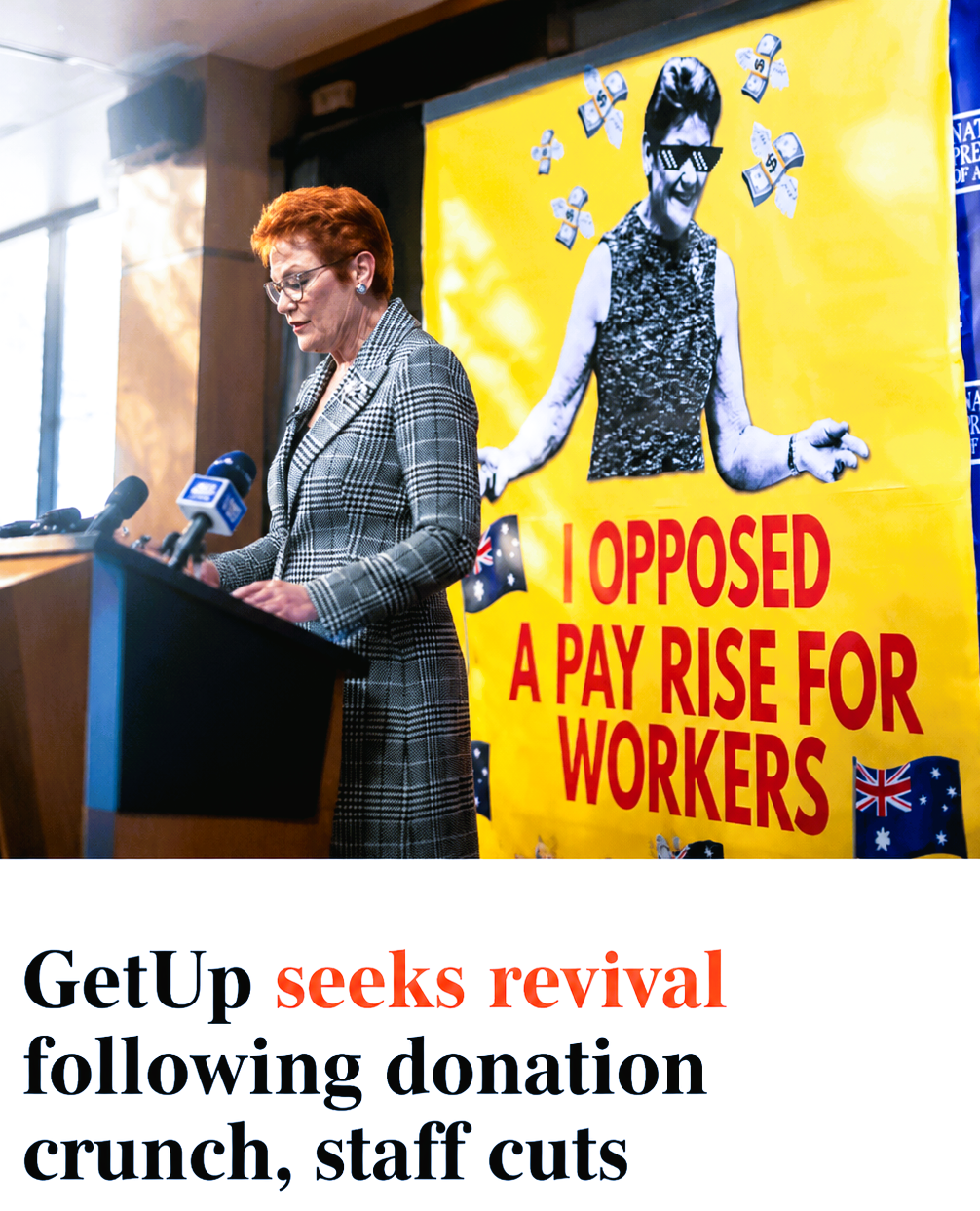
GetUp is attempting a major reset after a difficult period marked by falling donations, internal staff exits, and backlash linked to its high-profile campaign targeting Pauline Hanson’s National Press Club appearance.
The organisation is now facing an estimated drop of nearly $2 million in funding, forcing internal restructuring and raising questions about its long-term influence in Australian politics.
The financial pressure comes after its widely publicised effort to disrupt Pauline Hanson’s National Press Club debut, a move that generated intense debate across the political spectrum.
That campaign placed GetUp directly in the centre of one of the most polarising political debates in recent months, with supporters describing it as legitimate activism and critics calling it counterproductive and overly confrontational.
In the months since, the organisation has reportedly experienced a decline in donor confidence, contributing to financial strain and staffing changes.
Several internal departures have added to concerns about stability, particularly at a time when advocacy groups across Australia are competing for limited public donations and attention.
GetUp has long been one of Australia’s most visible political advocacy organisations, known for its campaigns on climate policy, social justice issues and progressive reform agendas.
However, the political environment in which it operates has become increasingly competitive and fragmented.
Donor behaviour has also shifted in recent years, with more supporters choosing to distribute smaller contributions across a wider range of causes rather than committing large recurring donations to a single organisation.
That trend has placed additional pressure on groups like GetUp, which rely heavily on consistent funding to maintain national campaigns and staffing levels.
The controversy surrounding the Pauline Hanson protest added further complexity.
While some supporters viewed the campaign as a necessary challenge to Hanson’s political messaging, others argued it risked reinforcing perceptions of partisanship and reducing broader public appeal.
Pauline Hanson herself has remained a central figure in Australian political debate, with her speeches and policy positions continuing to attract strong reactions from both supporters and opponents.
That ongoing attention has made her a frequent focus of activist campaigns, including those organised by GetUp and similar advocacy groups.
However, the financial consequences of such high-profile campaigns can vary significantly depending on public reaction.
In this case, the backlash appears to have contributed to reduced donor support and increased scrutiny of the organisation’s strategy.
Industry observers say the situation highlights a broader challenge facing advocacy groups in Australia: balancing attention-grabbing campaigns with sustainable funding models.
Without stable financial backing, organisations risk being forced to scale back operations or narrow their focus, limiting their long-term impact.
At the same time, political engagement in Australia is becoming more dynamic, with social media, grassroots movements and online fundraising reshaping how campaigns are run.
For GetUp, the immediate priority appears to be stabilising its finances and rebuilding donor confidence.
That will likely involve reassessing campaign strategies and rebuilding trust among supporters who may have been unsettled by recent events.
Whether the organisation can fully recover its previous level of influence remains uncertain, but its next steps will be closely watched across the political landscape.
As competition intensifies between advocacy groups, unions, and political movements, funding and public perception are becoming just as important as policy messaging itself.
The outcome of GetUp’s current restructuring phase will likely determine how effectively it can continue operating in Australia’s evolving political environment.






