Australia’s leading free speech advocacy organisation has applied to participate in a landmark High Court case challenging the federal government’s controversial prohibited hate group laws, arguing the proceedings are about protecting constitutional principles rather than defending the ideology of any particular political movement.
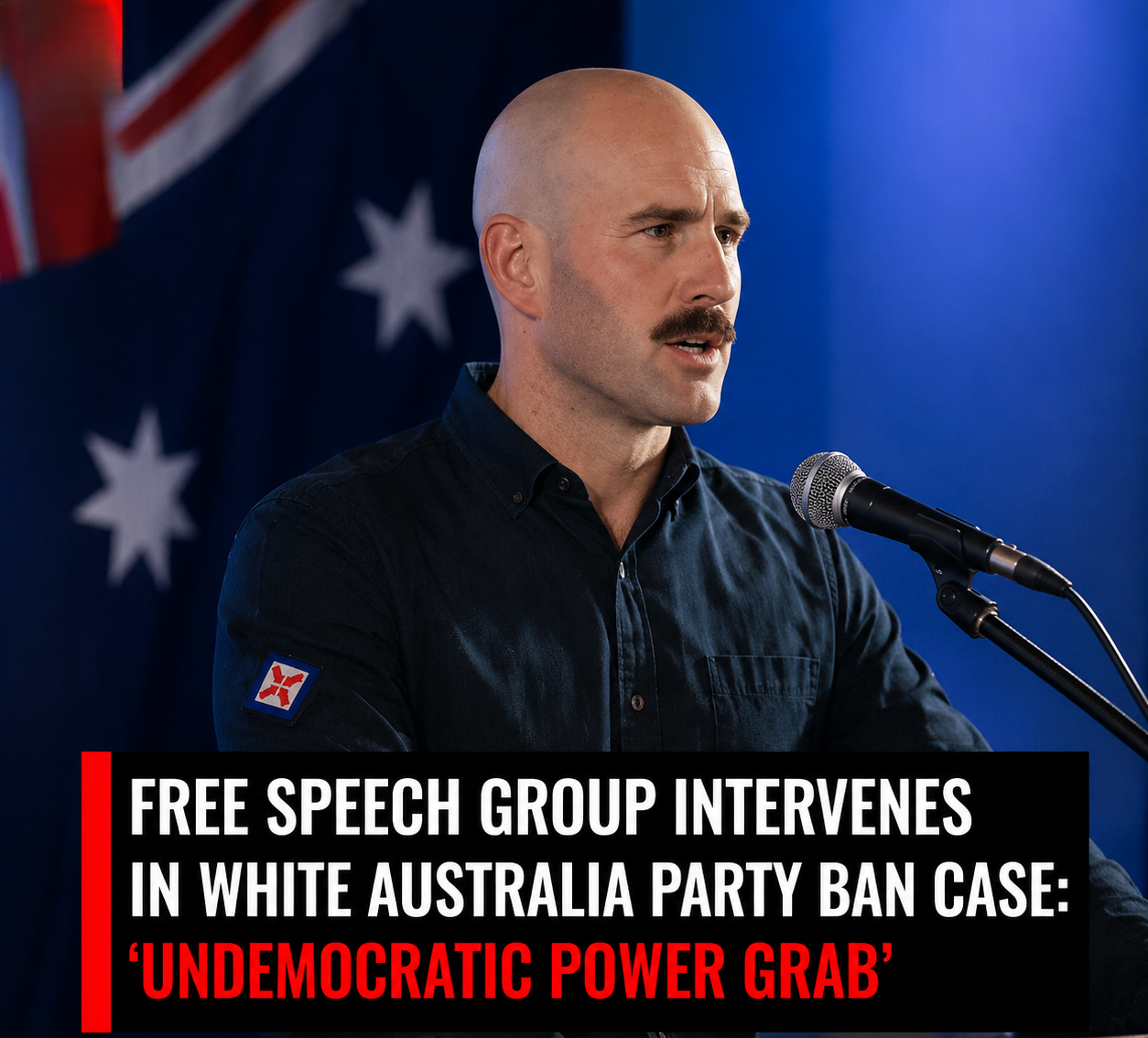
The Free Speech Union of Australia (FSU) has lodged an application seeking leave to appear as amicus curiae—commonly described as a “friend of the court”—during the High Court challenge brought by the White Australia Party (WAP) and its president, Thomas Sewell.
The constitutional case, scheduled to be heard on September 8 and 9, is expected to become one of the most significant legal tests of Australia’s recently enacted prohibited hate group regime. The proceedings will examine whether Parliament’s new powers are compatible with the implied freedom of political communication contained within the Australian Constitution.
The White Australia Party was listed as a prohibited hate organisation earlier this year under legislation introduced following the Bondi terrorist attack. The listing makes it a criminal offence to direct, recruit for, finance, train with, support or belong to the organisation, with offences carrying penalties of up to 15 years’ imprisonment.
The party and Mr Sewell subsequently launched constitutional proceedings, arguing the legislation unlawfully burdens political communication and prevents former members from participating in political life. Earlier this year, the High Court rejected the group’s application for interim relief but ordered that the broader constitutional questions proceed to a full hearing.
The Free Speech Union says its proposed intervention is not intended to endorse the White Australia Party or its views.
Instead, the organisation argues the case raises broader constitutional questions that could shape the limits of government power over political organisations for decades to come.
FSU Director Dr Reuben Kirkham said constitutional protections should apply equally regardless of whether the ideas involved are popular or deeply unpopular.
“The Constitution belongs equally to Australians of every political persuasion,” Dr Kirkham said.
He argued that constitutional safeguards exist precisely because governments cannot always be relied upon to exercise significant powers wisely or consistently over time.
According to the FSU, allowing governments to prohibit political organisations without rigorous constitutional scrutiny could establish a precedent extending well beyond the current case.
The organisation argues that future governments with different political priorities could potentially seek to apply similar powers against other organisations, including parties or advocacy groups holding very different political views.
Dr Kirkham said the legal principles established by the High Court would apply equally to future governments regardless of their political ideology.
“The constitutional principles established in this case will not be confined to the White Australia Party,” he said, arguing that the court should consider the long-term implications for Australia’s democratic system rather than focusing solely on the identity of the current litigants.
The proposed intervention asks the High Court to consider strengthening protections for political communication by requiring governments to provide increasingly compelling justification when legislation imposes substantial burdens on political participation or political expression.
In practical terms, the FSU argues that where laws significantly restrict political activity, courts should apply correspondingly greater constitutional scrutiny before upholding those restrictions.
The organisation has also launched a public campaign describing the prohibited hate group legislation as an “undemocratic power grab”, warning supporters that constitutional precedents established in this litigation may influence future governments regardless of political affiliation.
The Commonwealth, however, has defended the legislation as an important response to violent extremism.
The laws were introduced after the Bondi terrorist attack and provide the federal government with powers to designate organisations that satisfy statutory criteria as prohibited hate groups.
Supporters of the legislation argue the measures are intended to prevent extremist organisations from recruiting members, raising funds and expanding their activities while protecting public safety.
Government ministers have maintained that the legislation targets conduct associated with extremist organisations rather than restricting legitimate political debate more broadly.
The constitutional challenge has attracted close attention from legal academics and civil liberties advocates because Australia does not have a comprehensive national bill of rights guaranteeing freedom of speech.
Instead, Australia’s Constitution has been interpreted by the High Court as containing an implied freedom of political communication that protects the system of representative and responsible government established by the Constitution.
Unlike broad constitutional free speech protections found in some other democracies, the Australian doctrine operates as a limit on legislative power rather than creating an unrestricted personal right to freedom of expression. Courts have consistently held that the implied freedom protects political communication only to the extent necessary for Australia’s constitutional system of government.
Legal observers say the September hearing may therefore become an important test of how far Parliament can go when restricting organisations regarded as extremist while remaining consistent with constitutional protections for political communication.
The outcome is expected to influence future litigation involving political freedoms, extremist organisations and the limits of legislative power.
Regardless of how the High Court ultimately rules, the decision is likely to become a significant constitutional precedent affecting the relationship between national security legislation, democratic participation and political communication in Australia.
Importantly, the constitutional issues before the Court are distinct from any assessment of the White Australia Party’s ideology or activities. The High Court’s role will be to determine whether the legislation enacted by Parliament is constitutionally valid, not to endorse or reject the political views of any organisation involved in the proceedings. That distinction is expected to remain central throughout what is shaping up to be one of Australia’s most closely watched constitutional cases of 2026.