Trade Minister Don Farrell has challenged Liberal leader Angus Taylor to resist Nationals leader Matt Canavan’s campaign against Australia’s trade agreement with the European Union. Farrell is warning that rejecting the deal could hurt the national economy, while Canavan maintains the government has failed to secure enough for important Australian exporters, particularly farmers.
The confrontation exposes a difference between the two Coalition parties that Labor is eager to highlight. Canavan has presented opposition to the agreement as a firm Coalition position, but senior Liberal figures have reportedly disputed whether the issue has been settled through the party’s normal decision-making processes. Farrell’s appeal to Taylor is therefore both a policy argument and an attempt to force the opposition leadership to clarify its position.
The agreement has been concluded at the negotiating level but still requires the relevant ratification and implementation steps. It would be inaccurate to present the political fight as one over a treaty already fully implemented for every business. The dispute is about whether Australia should proceed with the negotiated terms, seek better concessions or risk losing the agreement altogether.
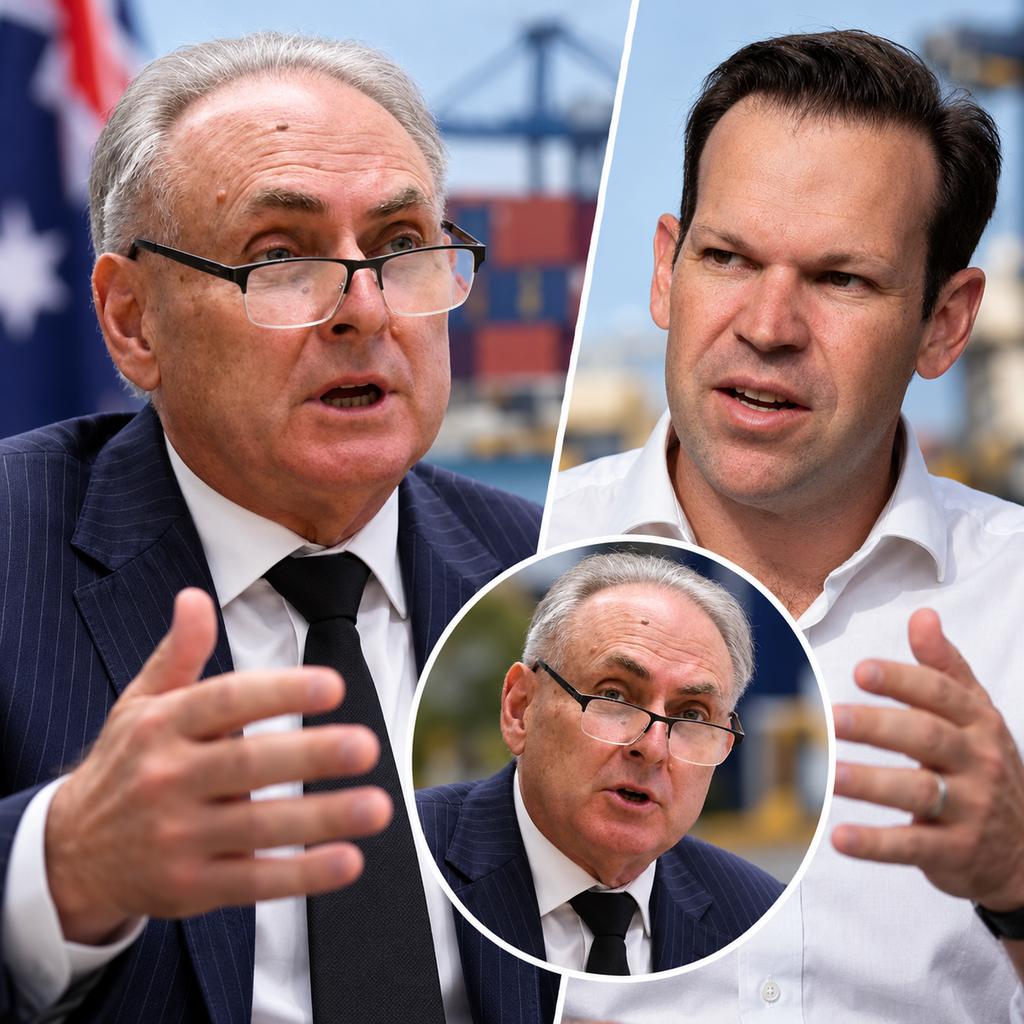
Farrell has argued that the proposed arrangement would bring substantial benefits by reducing tariffs and expanding access to the European market. He has said European negotiators made significant concessions and that reopening the process would be extremely difficult. From the government’s perspective, the possibility of wider trade and more stable access for businesses is worth accepting an agreement that does not give every industry everything it sought.
Canavan contests that judgement. In a separate ABC Radio National interview, the Nationals leader argued that Australian agriculture had not received the market access it deserved. The disagreement is especially sharp on red meat quotas, an issue farmers’ organisations have raised throughout the negotiations. Canavan’s position is that an agreement should be judged not only by the total number of tariffs reduced but by the practical treatment of industries asked to compete in European markets.
Both sides can point to genuine trade-offs. An agreement may help exporters of minerals, services and manufactured products while delivering less than hoped for cattle or sheep producers. Equally, a quota shortfall for one industry does not automatically negate gains elsewhere. The national economic case requires comparing those benefits and limitations across the whole package, rather than treating one sector as the entire economy.
The distinction between tariff elimination and quota access is often lost in political shorthand. Eliminating a tariff can make a product more competitive, but agricultural commodities may still face caps on the volume that receives a preferential rate. Exporters must also meet product standards, customs requirements and local market demand. A headline about the proportion of trade made tariff-free does not tell an individual beef producer precisely how much additional product can be sold.
Canavan and farming groups have questioned the beef and sheep meat access secured under the negotiated deal. Reporting has cited quota volumes below the ambitions many producers had set. Those figures are part of the disagreement, but the comparison needs a consistent account of what would have been available without a deal, what new access is actually granted and how markets could develop. Promises of improved access must also be measured against supply capacity and European competition.
Farrell has warned against assuming the European Union would reopen talks and offer Australia more favourable terms. European politics, domestic farming pressures and the complexity of ratification make renewed negotiations uncertain. His argument is that rejecting an agreement with multiple negotiated concessions does not guarantee a stronger one will be available later. That is a judgement about diplomatic likelihood, not proof that renegotiation is legally impossible in every imaginable circumstance.
The government also sees strategic value in diversifying trade. Australia’s businesses operate in a world where tariffs, geopolitical conflict and protectionist pressures can suddenly change commercial conditions. Building relationships with additional major markets may reduce dependence on individual destinations. A European trade framework could provide long-term planning confidence even if some exporters are disappointed by its immediate terms.
For the Nationals, the political pressure comes from rural producers who want reassurance that their industries were not sacrificed to secure a broader diplomatic win. Agriculture occupies an important place in the party’s identity and in regional economies. If farmers believe the terms are inadequate, Canavan has an incentive to resist and demand stronger protections. His opposition is not, on its own, evidence that he opposes trade generally or that every farmer shares his view.
The Liberal Party faces a different calculation. Its voters and business constituencies include supporters of trade liberalisation, alongside people concerned about agriculture and sovereignty. Senior Liberals have questioned whether Canavan was entitled to speak for both parties before a joint position had been formally adopted. As a result, a claim that the Coalition has unanimously rejected the agreement would overstate what the reporting establishes.
Farrell has tried to put the choice directly to Taylor. In his interview, he argued that defeating the agreement would amount to economic self-harm. That is the minister’s political and economic assessment, not an established consequence of a parliamentary vote. It remains for the government to demonstrate the scale and distribution of expected gains, just as opponents must explain what happens if their preferred renegotiation does not succeed.
There is also a procedural dimension. Trade agreements often involve negotiation, signature, scrutiny and domestic implementing legislation. Each step matters. A government can announce it has settled terms with an overseas partner while Parliament still has decisions to make before the arrangement operates as intended. Headlines that ignore those distinctions create unnecessary confusion about what businesses can rely upon immediately.
One point of particular concern is the treatment of steel and related industry tariffs. Canavan has raised possible disadvantages affecting Australian steel exporters. Those figures need to be tied to the exact tariff rules and market conditions before they can be treated as a confirmed cost to the industry. In the absence of a detailed independent comparison, they should remain attributed to his criticism rather than presented as a universal feature of the agreement.
Business groups have largely viewed the broader trade opening positively, while agricultural organisations continue to press for stronger outcomes. Neither camp is completely uniform. A national export strategy must weigh employment, investment and market access in diverse sectors without assuming that a gain to one cancels out the legitimate concerns of another.
For Australians outside the export sector, trade policy can appear remote. But it can affect investment decisions, prices, jobs in processing and logistics, access to imported goods and the prospects of regional industries. The benefits and costs will vary, and they may emerge over years rather than instantly. That is why a serious argument needs transparent modelling, sector-by-sector data and an honest account of uncertainty.
Farrell’s new challenge has sharpened a previously reported policy division into a direct leadership question for Taylor. Canavan is pressing for a different trade bargain; Farrell says reopening it risks losing broader advantages. Taylor’s own detailed response to the minister’s latest challenge has not been verified, so it should not be invented.
The immediate question is whether the Coalition parties can agree on a position before Parliament must decide how to proceed. The larger question is what level of agricultural compromise Australia should accept in return for wider market access. Both deserve scrutiny without portraying a negotiated agreement as fully ratified, or political predictions as inevitable economic results.
Parliamentary scrutiny will also provide a chance to examine implementation details that rarely feature in radio interviews. Exporters will want to know how rules of origin, standards recognition, customs procedures and dispute mechanisms operate. Even when a tariff falls to zero, businesses may face costs in proving that their products qualify. A deal that looks generous on paper may be harder for small exporters to use without accessible guidance.
Regional producers have particular reasons to scrutinise quota administration. If extra market access is limited, the way the quota is allocated can matter almost as much as its size. Different producers may have different capacity to use new openings, and downstream processors could be affected by the terms as well. The government’s case would be stronger if it explained not just the aggregate forecast but what specific agricultural businesses could realistically expect.
Diplomacy adds a further dimension. A decision to walk away from negotiated terms can affect Australia’s reputation as a trading partner, but accepting an unfavourable deal can also have long-term costs. Those are competing risks, not automatic outcomes. Any proposal to reopen talks should specify what improvements are sought, how negotiators expect to win them and what would happen if partners decline. Likewise, supporters should explain which concessions cannot be improved and why proceeding is nevertheless in the national interest.
The row cannot be resolved by assuming that a minister’s prediction of economic harm is a neutral forecast or that a party leader’s claim about exporters captures every industry. Australians need the treaty terms, credible analysis and parliamentary debate. Farrell, Canavan and Taylor have distinct responsibilities in providing that clarity, even though their immediate political incentives differ.






