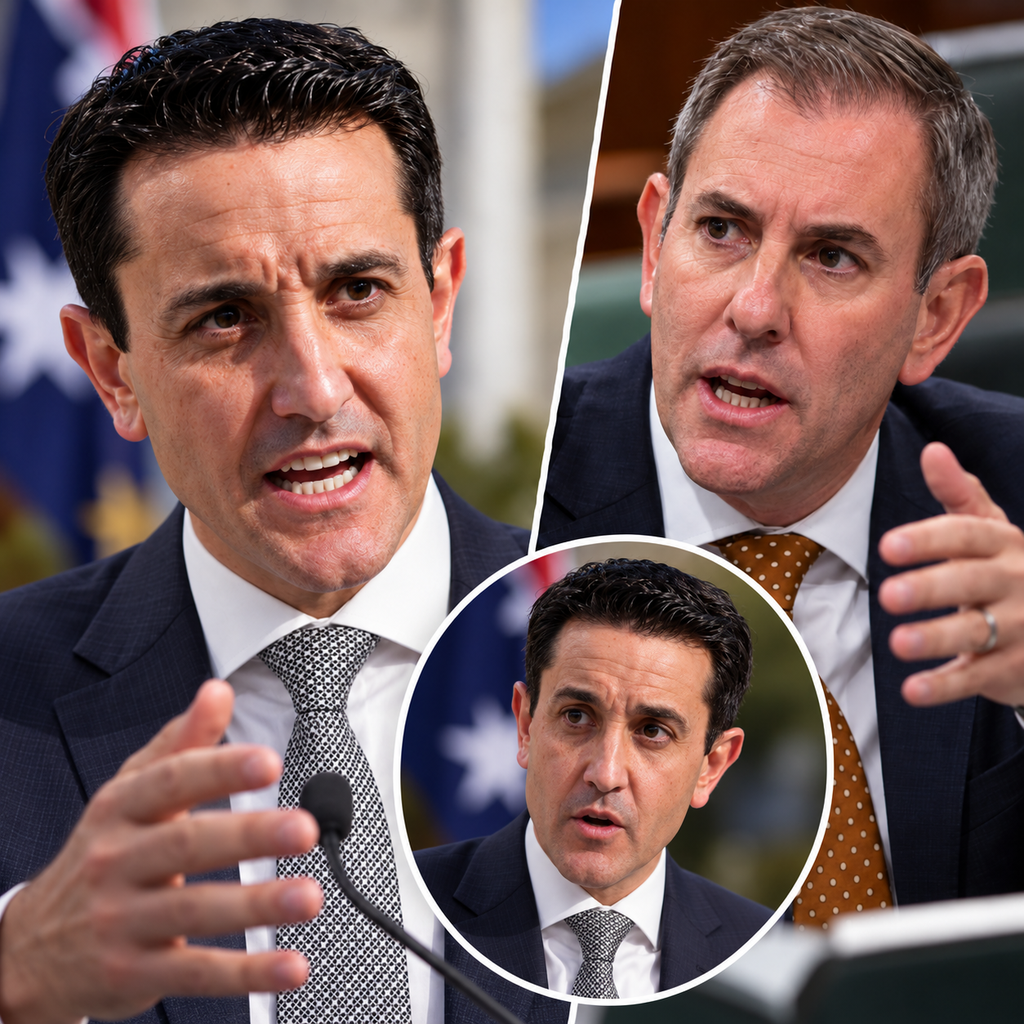
Queensland Premier David Crisafulli has put federal Treasurer Jim Chalmers’s proposed trust tax changes at the centre of a growing argument over who will pay for the Albanese government’s tax agenda. The political confrontation is not simply about the affairs of wealthy investors. Crisafulli says it reaches into the working lives of family businesses, regional employers and people who have organised their finances through trusts for years.
At stake is a federal proposal for a minimum 30 per cent tax on certain discretionary trust distributions. The government presents the change as an answer to tax planning arrangements it considers unfair. Opponents argue its reach could be much wider, catching ordinary businesses that use trusts for legitimate commercial reasons. Both descriptions are arguments about legislation still under consideration; the tax has not been enacted.
Speaking about Queensland’s economic challenges, Crisafulli criticised Canberra’s approach to business taxation and linked his concerns to the pressure already facing employers. His challenge carries extra political weight because Chalmers is a Queensland MP as well as the federal Treasurer. But there is an important qualification: Chalmers’s publicly reported defence of the proposal was not a newly confirmed, direct response to every criticism made by the Premier.
The row matters because a discretionary trust can be a vehicle through which a family controls business assets or allocates income. The structure is not inherently unlawful or abusive. Tax authorities and governments have long scrutinised how some trusts distribute income because the treatment can differ depending on who receives it and how the recipient is taxed. The government argues a minimum-tax rule would reduce opportunities for some taxpayers to obtain an advantage not available to people whose income is taxed directly.
That argument is contested by business owners and advisers who warn that applying a new minimum could affect more than aggressive tax minimisation. Some firms use corporate beneficiaries, often called bucket companies, to retain earnings and support future operations. Critics say the interaction between the proposed trust rules and subsequent company distributions needs especially careful design to prevent unfair outcomes. These are concerns about what the proposed legislation might do, rather than evidence that every trust or business would experience the same result.
The potential cost of changing existing arrangements has become another major source of controversy. Industry-linked analysis cited in reporting has suggested that restructuring and advice bills could reach billions of dollars. Such estimates depend on assumptions about how many trusts would be affected, what legal changes would be necessary and how businesses respond. They should not be mistaken for an audited cost already incurred by Australians.
For a small employer, the practical questions are specific. Would a trust holding business assets need to be reorganised? Would a distribution to a company face additional tax consequences? Could a succession plan designed for a family enterprise require new advice? Would the answer differ between a trading business and a trust holding passive investments? The existence of these questions helps explain the concern, but they cannot be resolved for every business from the political headlines alone.
Crisafulli has connected this uncertainty to broader worries about the Queensland economy. His address highlighted strains involving living costs, housing, health and regional businesses, while also presenting opportunities in critical minerals and newer industries. His broader case is that policy made in Canberra can carry unintended consequences for Queensland operators, particularly in areas where margins are already tight.
The Premier’s argument will resonate with businesses that want predictable rules before committing to investment or expansion. A construction firm planning its next project or a regional retailer weighing a new location may care as much about the cost of advice and the stability of its tax structure as the headline tax rate. That does not establish that the reform would necessarily reduce employment or investment. It explains why opponents have framed uncertainty as a legitimate commercial concern.
Chalmers and other federal ministers defend the direction of the trust reform on fairness grounds. Their position is that a person’s access to particular legal structures should not create opportunities to avoid the tax that others pay. Supporters of reform see the issue as one of confidence in the overall system: if high-income taxpayers can use complex arrangements unavailable to most workers, the distribution of the tax burden becomes a political question as well as a technical one.
The government also faces the challenge of proving that the proposed rule distinguishes effectively between avoidance strategies and ordinary commercial arrangements. A reform can have a defensible purpose while still needing adjustments to its scope, exemptions or transitional provisions. That is why the detail of draft legislation, consultation and parliamentary scrutiny matters more than the sharpest line delivered at a press conference.
Different tax systems also intersect. State stamp duty rules can affect whether assets are moved from a trust into another structure. Queensland’s approach to restructuring relief has been questioned in reporting as business groups look at the potential costs of changes. But it would be misleading to assume that a federal trust proposal automatically changes state stamp duty law, or that identical relief already exists in every jurisdiction. The costs depend on the relevant state rules and the particular transaction.
Even estimates of government revenue require care. A forecast of what a tax measure could raise over several years is not money already collected. It is a modelling outcome that can change with the final design, taxpayer behaviour and economic conditions. The same caution applies to claims that the measure would force a particular business into closure: consequences must be established, not assumed from opposition to the bill.
There is a political calculation for both sides. Crisafulli can position himself as an advocate for Queensland employers while challenging a federal Treasurer from his own state. Chalmers can argue that resisting reform protects tax advantages that undermine fairness. Voters may find parts of both arguments persuasive: they can support measures against aggressive tax avoidance while also expecting safeguards for legitimate family enterprises.
A meaningful assessment therefore needs more than a contest between slogans. It needs a clear explanation of which distributions would be covered, whether existing arrangements would be grandfathered, how corporate beneficiaries would be treated, and what transitional relief would apply. Independent assessment of compliance costs would help, as would examples that show the effect on businesses of different sizes.
The opposition’s criticism does not establish that the proposal is fundamentally unfair, just as the government’s fairness rationale does not settle whether its drafting is proportionate. The question for lawmakers is whether the intended tax outcome can be achieved without imposing avoidable disruption on businesses that were following the law under existing rules.
For Queensland households, the immediate lesson is not to assume a new 30 per cent trust tax has taken effect. It has not. What is unfolding is a political and legislative dispute over the design of a possible future tax rule, with potentially significant consequences for advisers, businesses and families depending on what Parliament ultimately agrees to.
Crisafulli has made Chalmers’s approach a target. The Treasurer and the federal government are defending the principle behind reform. The decisive contest now lies in the detail: who would actually pay more, who would be protected, and whether lawmakers can demonstrate that the benefits outweigh the costs.
A further problem for policymakers is the difference between a trust’s legal structure and its economic activity. A trust may be used to own shares, land or a business, and the tax effect of any change depends on who receives a distribution and what transactions follow. It would be inaccurate to treat every discretionary trust as a tax loophole. Equally, the fact that a structure serves a genuine business purpose does not mean every distribution through it should automatically receive the most favourable possible treatment. The legislative challenge is to draw workable boundaries and explain them clearly enough that taxpayers can comply without unnecessary legal uncertainty.
There is also a distributional question. The policy is presented as a reform to stop unfair advantages, but families with different incomes and arrangements may be affected differently. Some will have options to reorganise; others may face legal or financing constraints. Published revenue forecasts are not a substitute for examples showing how the reform would affect a small trading enterprise compared with a high-wealth investment structure. Transparency on those examples could help Parliament separate reasonable exceptions from provisions that might undermine the policy’s purpose.
Advisers are likely to look closely at start dates, grandfathering and interactions with existing anti-avoidance rules. A poorly timed transition could require rushed decisions by families who have held assets in one structure for decades. A generous transition, on the other hand, may allow more taxpayers to retain arrangements the government wishes to change. Both options carry fiscal and equity consequences. None of those choices can be settled from the announcement of a proposed rate alone.
For the business community, the test will be whether consultation is more than an exercise in collecting submissions. Clear responses to identified problems, updated impact analysis and publicly explained drafting changes would allow the government to demonstrate that it has listened without abandoning its tax objective. Crisafulli’s criticism gives that scrutiny a political spotlight, but the result will ultimately depend on the substance of the legislation and the evidence supporting it.






