A Victorian coroner’s findings into the death of 22-year-old Kyle Hudson have intensified scrutiny of online wagering companies and renewed calls for stronger limits on gambling advertising across Australia.
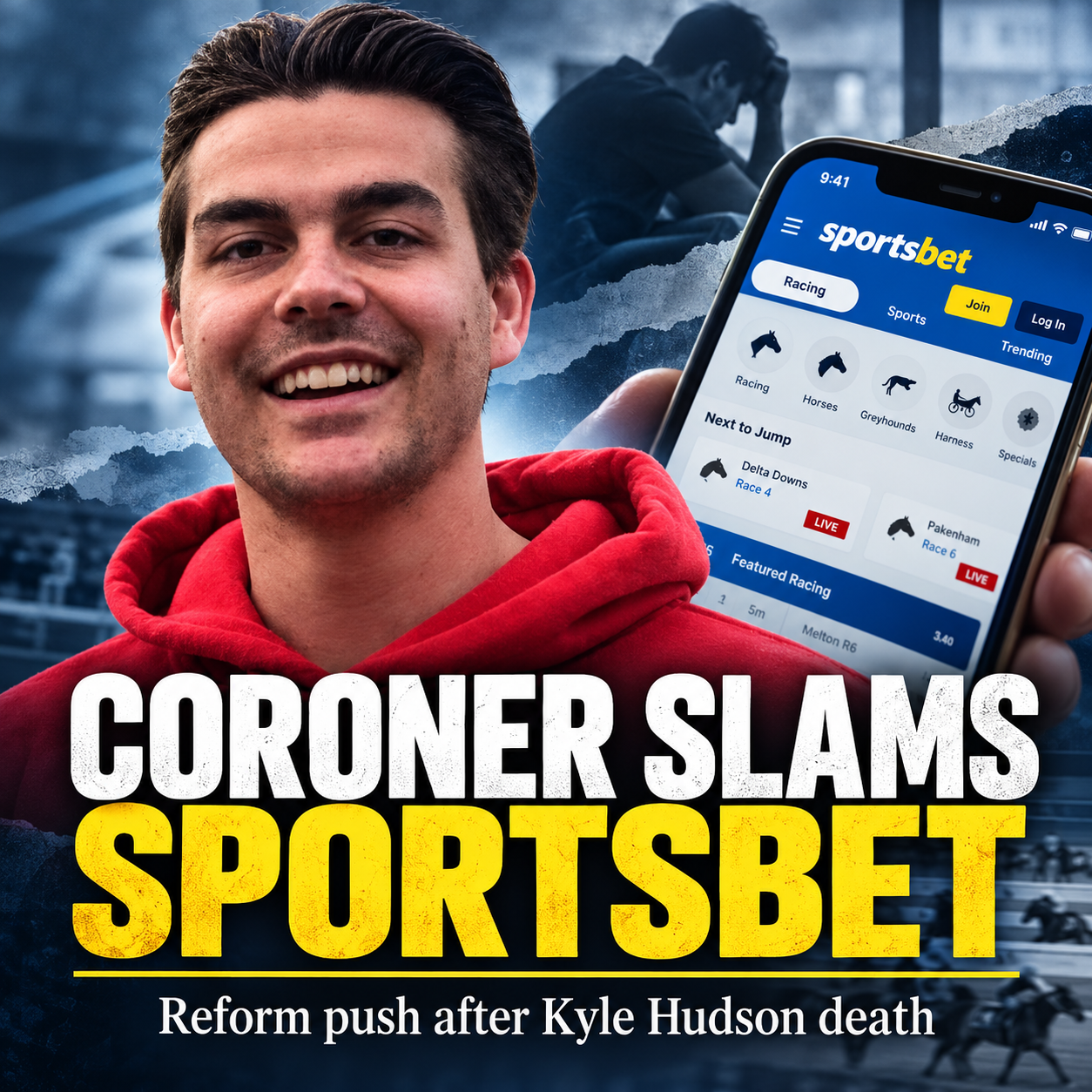
Coroner Paul Lawrie found that Mr Hudson’s gambling addiction was a main and direct cause of his death in 2021. The finding, published on 20 October 2026, is a formal coronial conclusion, not simply an allegation by campaigners or a claim made by his family.
The figures emerging from the case need particular care. Mr Hudson placed bets totalling $895,733 across multiple bookmakers. That was the aggregate amount wagered, not the amount he ultimately lost. The coroner identified net gambling losses of $47,945.
Conflating those numbers would significantly exaggerate the financial loss and obscure an important feature of repeated wagering: money can be staked, returned and staked again many times while net losses accumulate.
What the inquest found
According to the findings reported by the ABC and recorded by the Coroners Court of Victoria, Mr Hudson opened a Sportsbet account on his 18th birthday. Over the following years he used multiple bookmakers and developed a harmful pattern of online betting.
Mr Hudson was a student and casual worker. His family and partner tried to help him regain control over his gambling. The evidence outlined at the inquest showed how difficult those efforts became when accounts on different platforms could be accessed independently.
The coronial investigation examined the events leading to his death, the responses of wagering operators and possible measures to prevent harm to other young people. Reporting on it should remain sensitive. The public-interest finding concerns industry safeguards and the relationship between addiction and harm, not the personal details of his death.
The coroner criticised the view put forward on behalf of Sportsbet that Mr Hudson did not have a gambling problem. The company said his death was tragic and that it would consider the findings and recommendations, while acknowledging more work was needed on consumer protection.
Those positions should be reported separately: the coroner made findings about the case; the operator responded to those findings; and policy makers must determine whether and how to change the law.
Why multiple betting accounts matter
A central concern in the case was the fragmented picture of a customer’s activity. A wagering company may see how often a person bets on its own service but have little or no visibility of accounts held elsewhere.
That can create gaps in risk assessment. A gambler’s pattern on one platform might not reveal the scale of behaviour across a group of operators. A temporary account suspension or a self-declared spending limit can also fail to reflect activity on other services.
Coroner Lawrie called for consideration of a national gambling data system capable of supporting better research and evaluating the effectiveness of operator safeguards. His recommendation addresses what information regulators and researchers need in order to identify harmful behaviour and judge whether interventions work.
Such a system would also require careful design, independent governance and privacy safeguards. The fact that a coroner has recommended it does not mean it already exists or that every detail of a future database has been decided.
The advertising debate
The inquest has also renewed attention on the prevalence of gambling promotions around sport, digital platforms and everyday media.
The coroner recommended that the federal government consider a broad ban on gambling advertising across mainstream and social media. He also urged restrictions on inducements targeted at young customers, including promotional betting offers.
Those are recommendations to government, not advertising restrictions that took legal effect on the day the findings were published.
The advertising question is politically difficult because gambling money supports a range of commercial activities, from sports sponsorships to media advertising. Supporters of tighter restrictions argue that the social cost of gambling harm should outweigh commercial interests. Wagering businesses and organisations receiving sponsorship may argue for narrower, targeted safeguards.
This case adds evidence to that argument, but it must be described precisely. The coroner noted that there was no direct evidence proving that specific advertisements caused Mr Hudson’s own betting behaviour. That limit does not invalidate broader concerns about advertising exposure, but it should not be concealed in the reporting.
What policy is already changing?
Federal gambling policy has been the subject of sustained debate following a parliamentary inquiry led by the late Labor MP Peta Murphy. The 2023 inquiry recommended major changes to gambling advertising, including restrictions connected to sport.
According to ABC reporting, new national measures are scheduled to come into effect in January, including an opt-out option for online betting advertising. Those measures are not equivalent to the sweeping advertising prohibition now urged by the coroner.
This distinction matters: a recommended ban, a law passed by parliament and an industry practice are separate categories. Policy debates are easiest to understand when readers can see which proposals remain on the table and which obligations are actually in force.
What the figures reveal — and what they do not
The coroner recorded approximately $895,733 in cumulative wagers and net losses of $47,945. The first figure captures repeated amounts staked over time, including money that may have been returned in winnings and bet again. The second is the balance of losses after the relevant betting outcomes. Treating the larger number as money permanently lost would exaggerate the financial outcome and undermine the accuracy of a case that already raises serious concerns without sensationalism.
Neither number on its own describes the full effect of harmful gambling. Frequent account activity, distress, borrowing, disrupted relationships and access to betting promotions can matter, but such details should only be assigned to an individual when the findings support them. This article focuses on the coroner’s public conclusions rather than imagining the private circumstances of Mr Hudson or his family. The loss figures are relevant to consumer protection and financial harm, not a reason to reduce the person to a statistic.
What Australia’s 2026 gambling reforms actually change
The federal government has already passed the Interactive Gambling Amendment (Gambling Reform) Bill 2026, according to the responsible department and the ACMA. The reforms include restrictions on wagering advertising, stronger controls around certain inducements and measures supporting BetStop, the national self-exclusion register. The department says these reforms commence on 1 January 2027. That means the legislation is not the same as an already functioning blanket ban on all gambling advertising as at 20 October 2026.
This is a key distinction when assessing the coroner’s recommendation. A recommendation to consider a comprehensive prohibition goes further than some narrower controls already legislated for future commencement. The policy debate concerns whether those restrictions will be enough, how they will be enforced and whether more extensive limits should be considered. It would be wrong either to describe reform as nonexistent or to claim the coroner’s preferred outcome has already become law.
Practical consumer protections and their limits
The Australian Communications and Media Authority explains that BetStop allows a person to exclude themselves from Australian-licensed online and phone wagering providers in one registration. While somebody is registered, covered businesses must prevent betting, close the relevant accounts and stop sending marketing messages. That is a significant consumer-protection mechanism, but its existence does not answer every concern about advertising exposure, financial stress or gambling-related harm.
For households, practical questions include what financial records show, which operators are licensed, and where independent support can be found. People should not be encouraged to chase losses or treat gambling as a method of repairing a budget. The National Gambling Helpline and Gambling Help Online provide confidential support. The availability of those services can be reported without claiming they would necessarily have changed the outcome in a particular death.
The evidence policymakers still need
The case raises questions about how betting companies identify harm, how regulators check compliance and how advertising restrictions can be evaluated. Reductions in the number of advertisements, for example, would not automatically prove a reduction in gambling-related harm; changes in user behaviour and enforcement outcomes would also matter. Conversely, the presence of regulated advertising does not itself establish that every viewer experiences harm. Decisions should be based on evidence and clear legal obligations.
Sportsbet’s actions and the coroner’s criticisms must be described according to the published findings, not converted into an unsupported criminal conviction or civil penalty. Future coverage should distinguish company statements, findings of fact, recommendations and measures Parliament has actually enacted. The central human consequence is already serious, and a careful account is more useful than language designed to intensify shock.
A tragedy with a public-policy consequence
Mr Hudson’s family said they were pleased with the findings. Their loss should not be treated as a political prop; it is the basis of a rigorous inquiry that considered whether the systems meant to protect customers were adequate.
The most useful response to the findings will be a close examination of the proposed reforms, the evidence supporting them and the practical ways operators could identify gambling harm earlier. That examination also needs to account for the reality that a person may gamble across several services, not just one.
As the federal government considers its next steps, readers should keep three facts separate: Mr Hudson’s total wagers were $895,733; his net losses were $47,945; and the coroner’s proposed advertising restrictions remain recommendations rather than enacted nationwide law.
Support in Australia is available from Lifeline on 13 11 14 and Gambling Help Online on 1800 858 858.






