Commonwealth Bank has responded after footage showing a man apparently being prevented from making a cash payment at a branch went viral, reigniting Australia’s increasingly heated debate over the future of physical money.
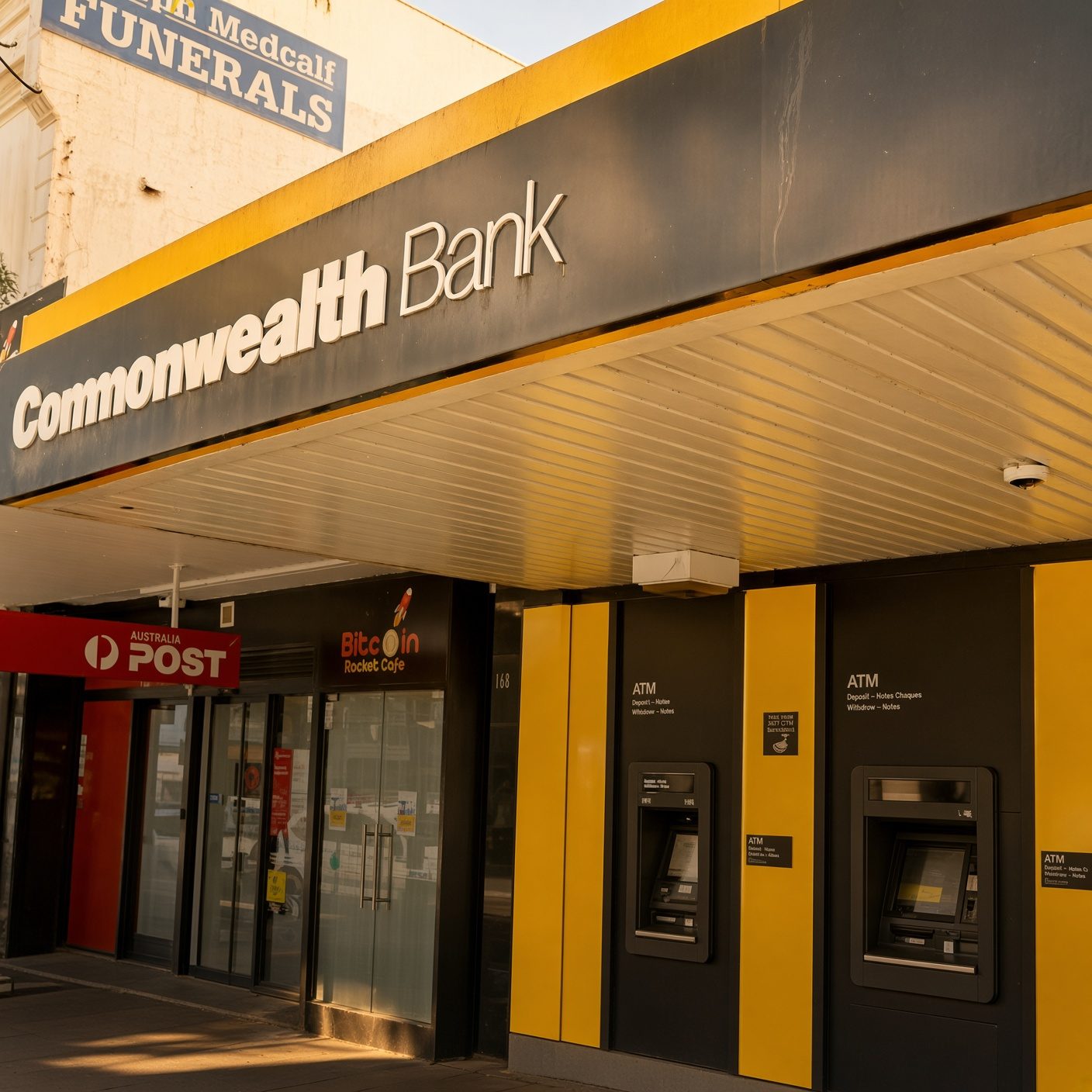
The resurfaced video shows a customer standing at a Commonwealth Bank counter with a bundle of $50 notes while attempting to make what he describes as a repayment of a debt.
The teller does not process the cash in the way the man requests and instead directs him towards the bank’s digital system, including the CommBank app.
The exchange quickly attracted criticism online, with viewers questioning how a major Australian bank could appear unwilling to take physical Australian currency from someone standing inside one of its branches.
Commonwealth Bank has now rejected the suggestion that it has stopped accepting cash.
The bank says its cash services remain available and that customers can still make cash deposits over the counter.
Instead, it says some transactions require additional identity verification because banks must comply with anti-money laundering and financial-crime rules.
That distinction is central to understanding what the viral clip does — and does not — prove.
Why the teller may have asked for the app
Commonwealth Bank’s current branch rules state that it may require anyone making an over-the-counter cash deposit to verify their identity before the transaction is accepted.
The process differs depending on whether the person depositing the money is already a CommBank customer.
Existing customers can generally be identified through the bank’s CustomerCheck system, their signature or valid identification.
For non-CommBank customers, the rules can be more demanding.
A person depositing cash over the counter into a business or other non-personal account may be required to hold a KYC-verified CommBank profile and Customer ID Number.
KYC stands for “know your customer”, a process banks use to confirm a person’s identity and manage risks including money laundering, fraud and other financial crime.
CommBank says a non-customer can create the required profile through its app using appropriate identification.
Importantly, creating that profile does not mean the person must become a conventional CommBank banking customer or open a transaction account.
For someone without the necessary smartphone, identification or ability to use the app, the bank says identity verification can also be completed at a branch, although that process may take longer.
That context offers a possible explanation for why the employee in the footage directed the man towards the app.
But the short viral video does not provide enough information to establish exactly which account he was paying, whether he was a CBA customer, whether the receiving account was personal or commercial, what identification had already been provided or whether another compliance requirement applied.
It would therefore go too far to conclude from the clip alone that Commonwealth Bank simply refuses cash payments.
CBA says cash services have not been withdrawn
The bank has emphasised that Australians can still use cash through its branch and ATM network.
Its published guidance specifically continues to provide for over-the-counter cash deposits.
Some large business deposits face additional checks.
From January 2026, for example, people depositing $10,000 or more in cash over the counter into certain business accounts are required to have a CommBank profile as part of measures the bank says are designed to reduce financial-crime risk.
The bank has also been expanding QR-based cardless cash deposits and withdrawals through compatible ATMs.
For CommBank, the issue is therefore not whether physical cash continues to exist within its banking system, but how customers and third parties are identified before particular cash transactions are completed.
That explanation has not completely neutralised the public reaction.
To many people watching the video, the symbolism is difficult to ignore: a person physically holding Australian dollars inside Australia’s largest bank is apparently told that completing the transaction requires a digital step.
The frustration taps into a much broader concern that essential services are increasingly being designed around people who have smartphones, apps, reliable internet connections and confidence using digital technology.
Legal tender does not mean cash must always be accepted
The controversy has also revived a persistent misunderstanding about Australian currency.
Australian banknotes are legal tender under the Reserve Bank Act.
But that does not mean every business or service provider is legally required to accept banknotes in every circumstance.
The Reserve Bank says a provider can generally specify the commercial terms on which it will accept payment before a contract is entered into.
A retailer, for example, may tell customers before a purchase that it accepts cards only.
In most situations, refusing legal tender cash under those conditions is not itself unlawful.
Existing debts are potentially more complicated.
The RBA says that where a person tenders legal currency in payment of an existing debt and no alternative method of settlement was specified beforehand, refusing that cash could potentially have consequences if the creditor later tried to enforce the debt.
The bank stresses that this is a general explanation rather than legal advice and that individual cases can depend on contracts and other circumstances.
That nuance matters in the Commonwealth Bank video because the man appears to describe what he is doing as repaying a debt rather than simply purchasing a new product.
But without seeing the underlying agreement or knowing exactly what obligation he was trying to settle, it is not possible to conclude that the teller’s actions were legally improper.
Australia’s new cash mandate does not apply to banks
Australia has also introduced new rules requiring some businesses to maintain access to cash payments, but those rules do not generally apply to banks.
Since January 1, 2026, certain supermarkets and motor fuel retailers have been required to provide consumers with a reasonable opportunity to pay cash for in-person transactions of $500 or less between 7am and 9pm.
The Australian Competition and Consumer Commission is responsible for enforcing those industry codes, with penalties applying from July 2026.
The mandate was designed to ensure Australians can continue purchasing essential groceries and fuel using cash.
It does not create a general rule that every Australian business, financial institution or service provider must accept cash for every transaction.
That means the new supermarket and petrol-station laws do not automatically determine whether the Commonwealth Bank interaction shown in the video was acceptable.
Cash use has stopped falling
The intensity of the reaction to the video also reflects an important shift in Australian payment behaviour.
Cash use declined dramatically over several decades as debit cards, tap-and-go payments and mobile wallets became dominant.
But the Reserve Bank’s latest Consumer Payments Survey suggests that decline has now stabilised.
About 15 per cent of Australian consumer payments were made in cash in 2025, compared with roughly 13 per cent in 2022.
For in-person transactions, about 19 per cent of payments were made using cash.
About half of Australians still used cash during a typical week.
The RBA estimates approximately 1.5 million Australian adults rely heavily on cash for everyday transactions.
Older people and lower-income households are more likely to be heavy cash users, although Australians across all demographic groups continue to use notes and coins.
One-third of survey respondents said they would face hardship or major inconvenience if withdrawing or spending cash became difficult.
That group includes people who primarily pay digitally but want cash available as a backup.
Cash remains particularly useful during power failures, natural disasters and telecommunications outages, when card terminals and online banking systems may not work.
It can also be important for people who use physical money to manage a household budget or who have accessibility, security or privacy concerns about digital payments.
Convenience for banks can become a barrier for customers
Financial institutions have strong reasons for shifting more activity into digital channels.
Apps can make transactions faster, reduce branch workloads and allow banks to apply automated identity and fraud controls.
Customers increasingly prefer those channels as well.
But the Commonwealth Bank footage illustrates how a system built around digital efficiency can create friction for people whose preferred or only option remains cash.
Telling a technologically confident customer to download an app may take only minutes.
For someone without a smartphone, reliable mobile data, suitable identification or digital confidence, the same requirement may create a significant obstacle.
The RBA’s own research shows that access to both cash withdrawals and cash deposit services has become less convenient for Australians compared with three years earlier.
That makes the way banks implement anti-money laundering requirements almost as important as the requirements themselves.
Financial-crime controls can be legitimate while the customer experience remains unnecessarily difficult.
Those two things are not mutually exclusive.
The viral video leaves unanswered questions
What the footage clearly shows is a frustrated customer trying to use physical cash and a bank employee directing him towards another method of completing the transaction.
What it does not establish is that CommBank has introduced a blanket ban on cash deposits or that the teller was free to accept the money without completing legally or internally required identification checks.
CommBank’s published policy directly contradicts the broader claim that it no longer accepts cash at branches.
Over-the-counter deposits remain available.
The real controversy is narrower but still important.
As Australian banking becomes increasingly digital, people who turn up with physical money are encountering more identity checks, more digital processes and potentially more difficulty completing transactions in the way they once could.
The law does not guarantee that every pile of Australian banknotes must be accepted immediately simply because the notes are legal tender.
But neither has cash disappeared.
Half of Australians still use it in a typical week, millions consider access to it important and governments have already begun introducing protections to stop essential parts of the economy becoming completely cashless.
The Commonwealth Bank video has gone viral because it sits directly on that fault line.
The bank says the incident is about verification and financial-crime controls.
Many Australians watching it see something broader: another sign that using their own physical money is becoming harder in an economy increasingly built around apps.






