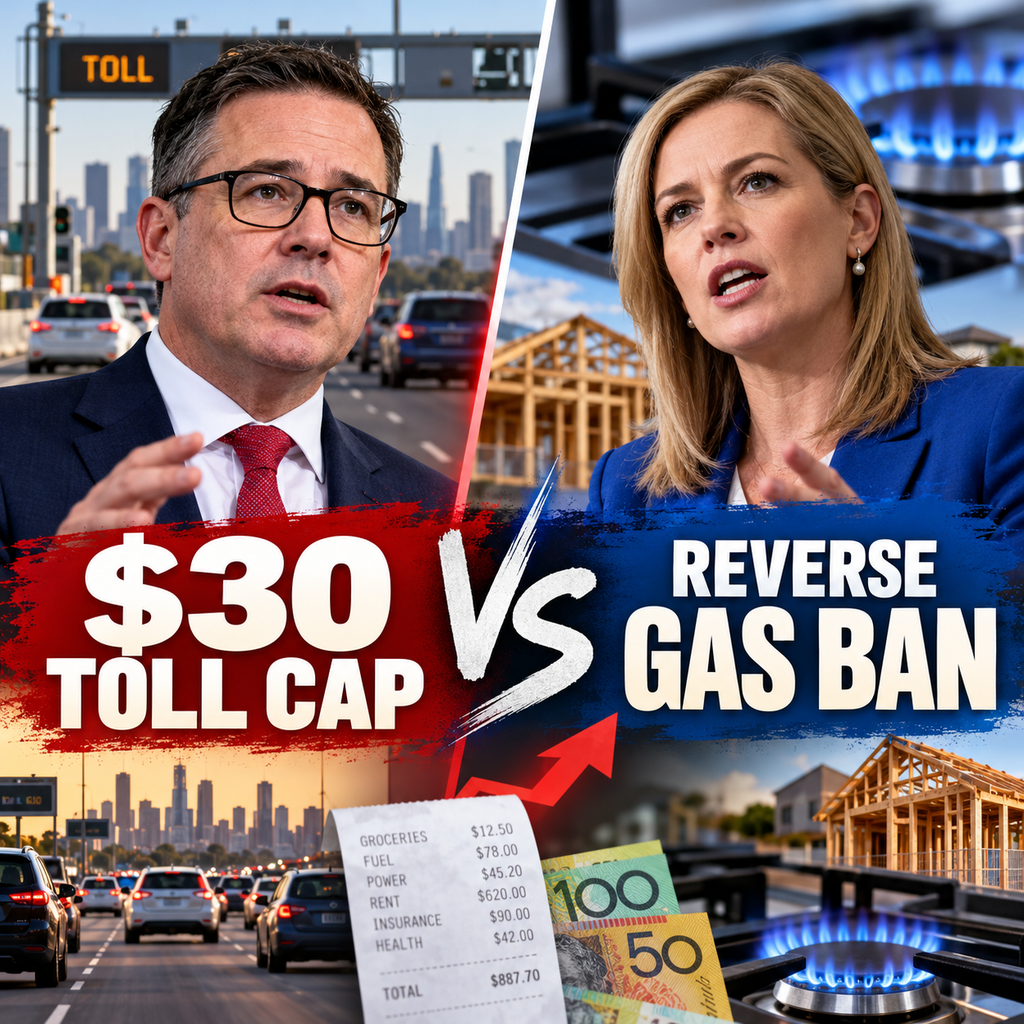
Victoria’s major parties have turned to tolls and household energy costs in the lead-up to the 28 November state election. Premier Ben Carroll is promising a $30 weekly toll cap, while Opposition Leader Jess Wilson says a Coalition government would overturn the ban on gas connections in new homes.
Labor says its toll measure would help motorists and eligible small businesses if the government is returned. The Coalition says households and builders should be able to choose gas for cooking and heating rather than be constrained by Labor’s policy for new builds. Both are promises contingent on an election outcome, rather than changes already in force.
Carroll has promised a $30 weekly cap on eligible toll-road use, with a rebate mechanism intended to operate from the beginning of the following year if Labor is re-elected. The ABC reported that the proposal would apply to individuals and eligible small businesses, with certain claim limits.
The rebate system is important because it suggests drivers would not necessarily see an immediate flat-price charge at every toll point. They may need to pay qualifying tolls and then receive relief through the prescribed process. The exact administration would depend on the final program rules if it is established.
A cap administered through rebates would be different from a toll operator cutting its charges at the gantry. The driver’s account could still show the ordinary toll, with eligible relief calculated later. That distinction matters to households whose budgets are tight between paydays and to small businesses that track fuel, road charges and vehicle maintenance as operating costs. The government has yet to publish every administrative condition of the proposed scheme, so the headline $30 figure should not be mistaken for a guarantee that any driver spending more will automatically receive an immediate refund.
The reported upper reimbursement limits include $350 in a week and $5,000 in a year, and eligible small businesses could claim for up to five vehicles. Those limits are conditions within the proposed scheme, not a promise that every driver could claim the maximum.
The Coalition’s earlier plan would cap weekly toll spending at $50 for two years. Labor’s new proposal has a lower headline figure, but differences in eligibility and reimbursement could affect what drivers actually receive. The fine print matters as much as the number on the campaign poster.
Both sides are drawing on the popularity of targeted toll relief. New South Wales has operated a $50 weekly toll cap, but Victoria’s proposals have their own terms and remain campaign commitments.
At a construction site, Wilson said a Coalition government would reverse Labor’s ban on gas connections for new homes within 100 days of taking office. She framed the issue as one of household choice and criticised what she called Labor’s ideological approach to gas.
New South Wales is a useful point of comparison, but not proof that Victoria’s future scheme would operate in the same way. The NSW government introduced a $50 weekly toll cap in July 2026. Eligibility, eligible road use, claim limits and processing can vary between jurisdictions. Some Victorian drivers use toll roads daily for work, while others live far from toll routes and would see little direct benefit. Those differences explain why a policy with a clear weekly dollar figure can have an uneven effect across the state.
The existing gas restriction applies to connections in new homes, not to householders being ordered to remove gas appliances they already own. The Coalition’s proposed repeal would change the rules for future developments if it wins government; it would not automatically decide the cheapest energy option for every home.
Wilson has argued that households should be free to choose how to heat homes, cook food and operate businesses. Supporters of restrictions on new gas connections can point to electrification and long-term emissions objectives. The policy dispute concerns how those competing considerations should be balanced for future homes.
With the Victorian election scheduled for 28 November, both parties have a strong incentive to present measures that households can readily understand. Toll prices are visible in weekly budgets, while gas connections can affect upfront building choices and future household energy options.
The gas issue has a different timetable. Victoria’s published energy rules say all-electric requirements for new homes and most new commercial buildings are scheduled to apply to building permits from 1 January 2027, subject to exemptions and transitional arrangements. Existing gas connections are not simply ordered to be removed. The government’s information also describes later requirements for replacement of some gas hot-water systems in existing homes. Wilson’s election pledge to reverse the new-building restrictions should therefore be understood against rules that vary according to building type and when permits are issued.
The toll promise is particularly relevant to people who use toll roads most working days. Under Labor’s proposed rebate approach, eligible motorists would need to meet the scheme’s rules and claim back qualifying expenditure. It is not a guarantee that every trip would immediately be billed at a flat rate.
Small businesses also stand to be affected. A tradie, courier or mobile service operator may use toll roads several times a day. Labor says eligible businesses could claim for up to five vehicles — cars, utes, vans or motorbikes. Its proposed maximum rebate is $350 in a week but $5,000 over a year, so a claim at the weekly maximum could not continue unchecked throughout the year. The existing tax treatment of vehicle costs is a separate consideration.
The restriction concerns future gas connections in new homes and other specified new buildings. Victoria’s government says new homes and many new commercial buildings will generally need to be all-electric from 1 January 2027, subject to exclusions and transitional rules. Different requirements apply to existing homes and renovations. Builders and renovators therefore face different questions depending on the nature and timing of their project.
The government argues a well-designed all-electric home can have lower ongoing energy bills and avoids paying two sets of fixed gas and electricity service charges. Its published modelling says an all-electric new home can save around $990 a year against an otherwise comparable dual-fuel home, or more where solar is installed. Those are government estimates based on assumptions, not a guaranteed saving for every family. Appliance prices, household usage, insulation and energy tariffs can all change a real-world result.
The Victorian government’s own estimates put the annual running-cost advantage of an all-electric new home at about $990 compared with a comparable dual-fuel home, and higher with solar, but those are modelled examples rather than individual household bills. The Coalition emphasises choice and questions the capital cost of changing appliances or installing electric systems. A purchaser considering a new home needs to distinguish upfront connection and appliance costs from continuing charges for gas and electricity. Climate, house design, tariff, solar panels and how a family uses heating all affect the result.
Wilson argues the new-home gas restrictions restrict choice and may increase upfront costs. Labor presents the shift towards electric homes as a way to reduce long-run energy bills and emissions. The actual comparison depends on the property, appliances, energy tariffs and construction choices; neither campaign claim supplies a universal figure.
Home builders, property developers, plumbers, electricians, gas suppliers and landlords all have commercial reasons to follow the policy dispute. A change after contracts have been signed could affect project specifications or schedules, while long lead times for appliances and connections make certainty important. On tolls, freight operators and mobile service businesses may need to know how rebates interact with multiple registered vehicles. These business effects are questions for policy design, not confirmed savings or losses from proposals still subject to an election outcome.
A regular toll-road commuter may experience very different savings from an occasional driver, just as a renter has different control over household appliances from someone building a new home. A rebate also raises a timing question: does the user have to pay the full toll bill before receiving assistance? Until administrative rules are published, that detail should be treated as unsettled.
Commercial operators face a similar split in circumstances. A tradesperson crossing the city for several jobs may pay tolls throughout the week; a builder planning a new development may be more concerned with electricity supply capacity, equipment prices and connection requirements. Businesses with delivery vans could be eligible for a toll rebate under the Labor proposal, but only within the detailed scheme limits. There is no single cost-of-living figure that captures these effects for every household and firm. That is why the two policy announcements need to be judged against their separate eligibility rules.
The promises and their key terms have been announced, but voters have yet to decide which party governs Victoria. Detailed rebate arrangements, any changes to gas-connection rules and the effect on individual household bills would follow only if the relevant measures were put into effect.
For Victorian voters, the promises offer different sorts of relief. Toll rebates could be felt relatively soon by frequent drivers if Labor is re-elected and implements the scheme. Gas policy affects long-term building and appliance choices if the Coalition takes office. Neither promise changes household bills until the relevant policy is enacted.






