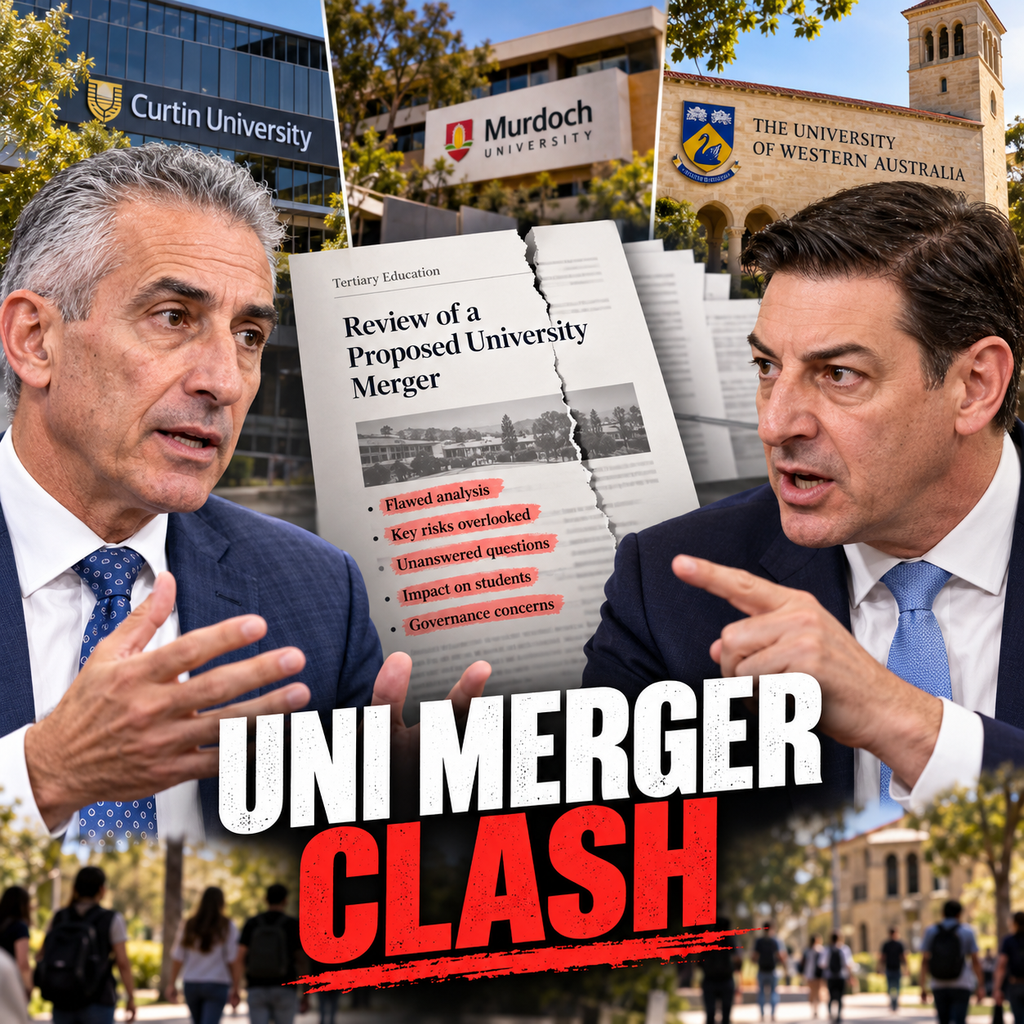
Western Australia’s proposed merger of Curtin University, Murdoch University and the University of Western Australia has sparked a political row over the evidence used to justify it. Opposition Leader Basil Zempilas has attacked the quality of a taxpayer-funded Deloitte report; Education Minister Tony Buti says the proposal deserves serious consideration.
The dispute escalated in parliament after Buti claimed Zempilas had privately expressed support for a three-way merger. Zempilas denies making those comments. Their competing accounts are unresolved, and no university merger has been approved.
The proposal concerns three established universities with different histories, academic strengths and communities. The government argues a merger could reduce duplicated offerings, concentrate investment and strengthen Western Australia’s position in higher education.
Buti and Premier Roger Cook have described the idea as a major opportunity. No final merger has been approved, and the universities’ legal and administrative arrangements cannot be treated as though they have already changed.
The resistance from within the university sector is unusually substantial. Curtin vice-chancellor Harlene Hayne has warned that the merger could bring cost, waste and loss of choice, jobs and institutional identity. Murdoch vice-chancellor Andrew Deeks has dismissed the idea as ‘nonsense’, while the University of Western Australia has not adopted the same formal opposition. Those differences matter because any merger would have to reconcile universities with separate governing bodies, courses, research programs and financial commitments. Buti’s promised gains cannot be assumed to outweigh those concerns before a detailed plan is produced.
Questions about the proposal intensified when mistakes were identified in Deloitte’s taxpayer-funded cost-benefit report. The ABC reported criticism of errors linked to the use of artificial intelligence. Deloitte characterised the errors as minor and said they did not affect the report’s central analysis.
Zempilas mocked the report’s quality, saying a university student handing in comparable work would receive an ‘F’. He argued that the errors undermined the case Buti was asking the public to accept. The grade was a politician’s criticism, not an assessment made by a university.
Buti subsequently indicated that he would seek some money back from Deloitte. That acknowledgement of a problem with the report does not determine whether the merger is sound or unsound, but it gives opponents a concrete reason to demand scrutiny of the underlying evidence.
The consulting-report row is not just about proofreading. The government needs reliable assumptions about enrolments, research income, staffing, property and the cost of merging systems before it can credibly argue that the transition will save money. Deloitte says the mistakes were minor and did not affect the substantive analysis; Buti has indicated he will ask for money back. Neither statement determines whether the business case is correct. They show why a major structural decision cannot rest on a headline forecast without methods and assumptions open to scrutiny.
Buti told parliament that Zempilas had previously said he personally supported the merger and wanted to appear alongside him when it was announced. Zempilas has denied making the remarks. Because the exchange concerned a private conversation, neither version should be treated as independently established.
Buti and Zempilas have offered contradictory versions of a private discussion. There is no independently confirmed record settling what was said, and their argument does not resolve whether the merger proposal is sound.
Curtin University vice-chancellor Harlene Hayne has strongly criticised the plan, warning of cost, waste and loss of choice, jobs and institutional legacy. Murdoch vice-chancellor Andrew Deeks has also rejected the idea. UWA leaders have not adopted the same formal stance and have described the exercise as an opportunity.
Current students are entitled to know much more than whether a future campus might change its name. They enrol in particular accredited degrees, sometimes with placement requirements and professional recognition. Moving a course or changing its teaching location could affect commuting, accommodation and part-time work. A student already halfway through a degree may have arranged work and family responsibilities around a known timetable. Any eventual transition would need to explain how existing courses, credits and support services would be handled before those students could judge the benefits being promised.
For current students, the stakes include more than a new name on the gate. They want to know whether their courses would continue, whether credits would transfer, and whether campus locations, placements, timetable and student services would change. Those details have not been settled by the proposal.
A degree also involves expenses outside tuition. Students make decisions about travel, rent, textbooks, placements, part-time work and access to laboratories or libraries. A more centralised institution could improve facilities in some locations but require longer journeys from others. Any proposal claiming substantial savings should spell out how those savings would arise, whether campuses would be retained, and what happens to highly specialised programs that cannot be easily consolidated.
The announcement does not itself change HECS-HELP or FEE-HELP debts. Any course or fee changes would depend on later decisions and the arrangements for enrolled students, as well as applicable higher-education rules.
Australia’s tertiary regulator, TEQSA, explains that providers changing or withdrawing courses are expected to manage the interests of students enrolled in affected programs. Its guidance on teach-out arrangements describes allowing existing students to finish an accredited course or move to a mutually agreed alternative without disadvantage. That general standard is useful when assessing a proposed restructure; it is not evidence that the WA merger has triggered a teach-out or a regulatory enforcement process.
TEQSA’s published requirements are relevant in principle if universities decide to withdraw or substantially change courses. The regulator describes ‘teach-out’ arrangements that allow enrolled students to finish or move to an agreed alternative without disadvantage. That does not establish that Curtin, Murdoch or UWA has announced a course closure, nor does it mean a political proposal automatically triggers a tuition refund. It identifies the regulatory obligations that would matter if a merger later led to changes in actual course delivery.
Quality assurance is another important issue. Academic accreditation, professional placements and recognition by licensing bodies can differ from course to course. Nursing, teaching, engineering and allied-health degrees may involve obligations beyond an institution’s marketing materials. Students and employers would need details of the transition from the universities and relevant accrediting bodies, not an assumption that merging administrative structures automatically preserves every arrangement.
The disputed report sits at the centre of a major investment decision. Savings projected from shared administration or research facilities would have to be weighed against transition spending, technology integration, staffing changes and disruption to existing courses. Mistakes in a business case make independent scrutiny more important, even if they do not automatically invalidate every conclusion.
Student finance is another reason for precision. HECS-HELP and FEE-HELP are federal loan schemes, and the announcement of a merger proposal does not automatically alter someone’s HELP balance, their repayment obligations or the cost of a course. If fees, enrolment status or course structures change in future, students would need formal notices and reliable information from their provider. The federal Tuition Protection Service has rules for provider default, but an ordinary discussion of a merger is not itself a provider default. Those protections should not be offered as a blanket promise that any disruption would be compensated.
International students have additional practical concerns because a course or campus change may affect accommodation, travel and compliance with enrolment conditions. The government’s proposal has not established that any individual student’s visa or enrolment would change. But uncertainty about degree continuity can affect recruitment and the universities’ reputations before a merger is even decided. For universities competing for students and research partnerships, institutional trust has financial consequences that cannot be captured by a simple count of duplicated administrative roles.
The economic case also has to account for up-front systems integration, potential staff redeployment, changes to campuses, and the value of existing research collaborations. Projected savings based on international-student growth or external funding would depend on assumptions that have not yet been publicly tested.
The universities themselves are not interchangeable. Their specialisations, campus footprints and communities differ, so claims about duplication require more than a statement that all three offer higher education. A consultation that makes space for staff, students, regulators and industry could identify benefits or major risks that a preliminary consultancy report missed. No final verdict is justified until those competing considerations are tested.
The government would also have to explain the upfront price of integration. Combining payroll, research administration, student records, libraries and digital systems can be complex even when the long-term objective is to reduce duplication. Academic staff may have separate employment agreements; campuses carry property and maintenance commitments. For regional and international students, a shift in location or course availability can change the economics of an Australian education. The contested Deloitte report should be assessed with those transition costs in view, rather than only the projected size of the eventual institution.
Buti still has a merger proposal to defend, and Zempilas has a credibility argument to prosecute. The universities themselves have raised differing concerns. No final decision has been made, and students and staff are still waiting to learn what, if anything, would change.






