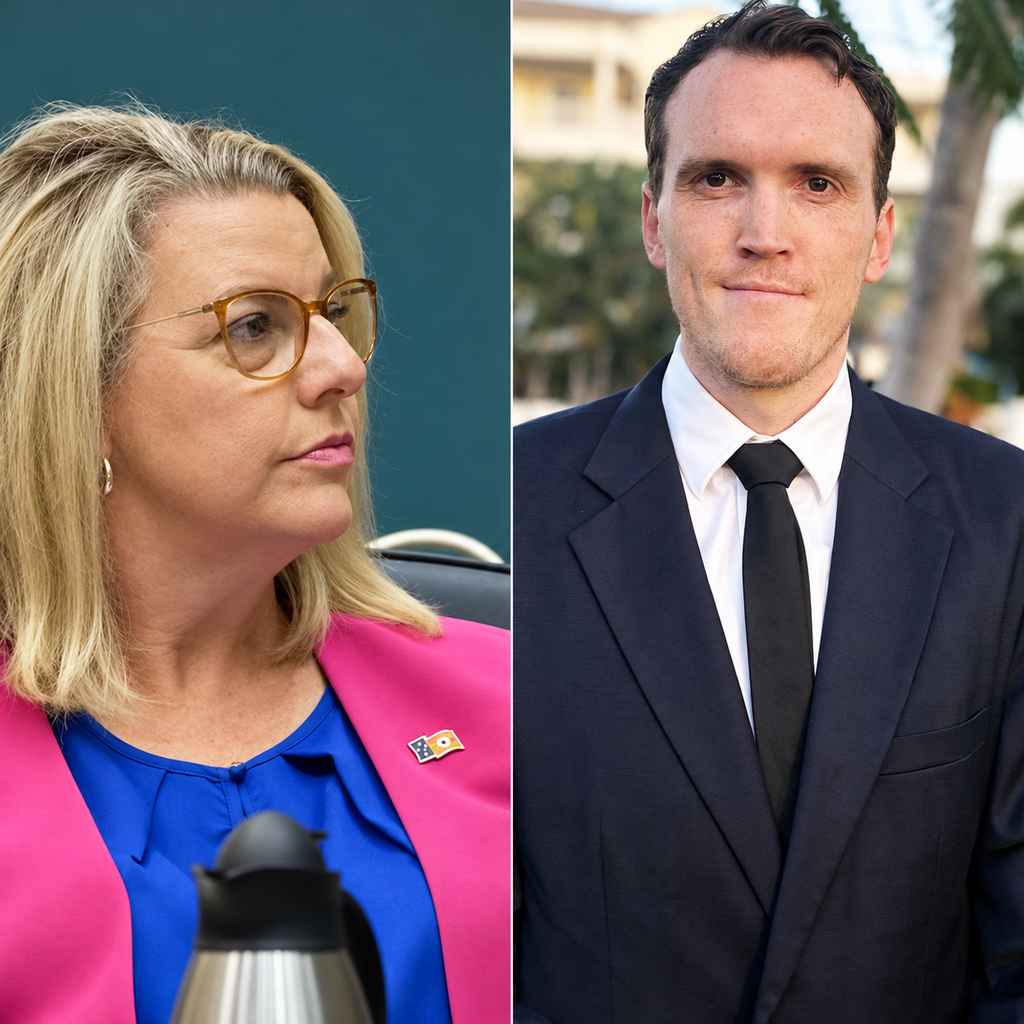
A Northern Territory lawyer has demanded a detailed public explanation of a funding dispute that has left people charged with serious offences unable to secure legal representation. Clancy Dane says Attorney-General Marie-Clare Boothby and Legal Aid NT must explain what is needed to restore services.
Boothby says the Country Liberal Party government is negotiating a funding agreement and maintains that public money must be used responsibly. The legal aid organisation has reduced services while the dispute remains unresolved, and some criminal matters have been halted.
The dispute affects defendants, complainants, court staff and taxpayers. It also requires careful legal language: an accused person receiving a stay has not thereby been acquitted, and criminal allegations remain allegations until a court determines them.
A case that brought the problem into focus
ABC reporting described a man accused of seriously assaulting a woman who appeared in Darwin Local Court without a lawyer. The man told the court he had extremely limited funds, medical issues and family responsibilities.
He had reportedly been refused legal aid amid restrictions on taking new criminal cases. Judge Ben O’Loughlin granted a stay after considering the circumstances. That does not mean the alleged conduct was proven or disproven.
The wider concern is that the criminal justice system must both protect the public and conduct fair proceedings. A person unable to afford representation can face enormous difficulties defending serious allegations.
Victims and complainants may also experience substantial distress when matters remain unresolved. A stay can mean waiting much longer for evidence to be tested in court.
Legal Aid NT has cut access to services
Legal Aid NT has reduced assistance as the funding disagreement continues. An internal communication reported by the ABC indicated additional limitations on duty-lawyer support for some defendants not in custody, with exceptions applying in particular circumstances.
The effects have spread through court lists in Darwin and elsewhere in the Territory. Defence lawyers say cases involving serious violence and sexual offences are among those delayed.
Such accounts require attribution. They do not establish that every case has been stayed or that every person accused of an offence is receiving no support.
Legal representation may be available through private lawyers, community organisations or other providers, but those options depend on eligibility, capacity and an individual’s financial circumstances.
What Boothby says about government funding
The Attorney-General says the government has increased baseline funding and offered a multi-year agreement. She has criticised the legal aid service’s failure to sign an arrangement and says funds should not go to people who can genuinely afford private representation.
Departmental information reported by the ABC says the organisation had been allocated $13 million for 2026–27, with $3.4 million released and the remainder dependent on a signed agreement. An allocation is not the same as cash already transferred.
Boothby’s position emphasises stewardship of public resources and eligibility rules. Those concerns are legitimate subjects for government oversight, but the resulting restrictions must also be assessed by their effect on access to justice.
The publicly available reporting does not contain a direct reply from Boothby to Dane by name. Her statements concern the broader funding dispute, and should not be rewritten as a personal exchange that did not occur.
Dane says both sides owe the public answers
Dane argues that the Attorney-General and the legal aid service need to set out precisely why an agreement has not been reached and what each requires to restore services.
He says the impact extends beyond accused people, affecting victims who may be forced to wait while alleged offenders remain in the community under their existing legal circumstances.
NT Criminal Lawyers Association president Beth Wild has also warned that delays can undermine the court system. Those assessments come from practitioners and should be reported as their concerns rather than automatic predictions about all cases.
Cases are affected by different facts and orders. A stay or adjournment can sometimes be revisited if circumstances change. It is not a blanket cancellation of charges.
The right to a fair criminal process
A fair system must balance the interests of accused people, victims and the community. Trials involving serious allegations can be complex and legally demanding, particularly where disclosure, witness examination and rules of evidence are central.
People on low incomes may be unable to buy the expertise needed to defend a serious case. If courts cannot proceed fairly without representation, delays may result.
Those delays carry financial costs too. Repeated listings consume court time, affect lawyers and witnesses and create uncertainty for families. The reporting does not quantify the total cost of this dispute, so a precise dollar loss would be speculation.
Even people convinced that an accused person is guilty must respect the presumption of innocence. The purpose of a trial is to decide allegations through evidence and lawful procedure, not merely to move cases through a crowded list.
Similarly, victims deserve timely processes. Long uncertainty can be harmful, even if a stay is required to protect the fairness of proceedings.
What needs to change
The immediate questions are concrete: what funding agreement is being sought, which terms remain disputed, how much money is available for current services and when representation could resume.
Boothby says negotiations continue. Dane says the public needs a precise account of the impasse. Legal Aid NT’s own explanation is also important, and the ABC reported it did not answer questions about the terms.
Until a workable arrangement is reached, some cases may remain delayed. That is not a finding about anyone’s criminal liability; it is a warning about the consequences of a service funding dispute for an entire justice system.
Why legal representation is essential in serious matters
An accused person may face complicated questions involving the admissibility of evidence, witness credibility and the legal ingredients of an offence. Serious criminal cases are not necessarily capable of being defended fairly by someone with no legal training, especially when they have limited resources or health difficulties.
The High Court’s principles concerning fair trials have been relevant to applications to halt proceedings where an accused person lacks representation through no fault of their own. Whether a particular application succeeds depends on the case and the court. It is not an automatic entitlement to have charges dismissed.
A stay can protect the fairness of a proceeding, but it can also leave victims waiting for resolution and witnesses facing further uncertainty. That is why the consequences of a funding dispute cannot be reduced to a simple choice between helping defendants and protecting victims. The system needs a fair process for both.
Lawyers such as Dane have warned that cases may be delayed when the legal aid service cannot take new matters. Those assessments should be tested against court orders and the organisation’s available capacity, rather than expressed as a claim that every criminal prosecution has stopped.
The financial question goes beyond the allocation to Legal Aid NT. Adjournments and repeated hearings can consume court time and administrative resources. The reporting does not provide a verified total economic cost for these delays, so assigning a large dollar figure to the crisis would be speculation.
What the funding figures do and do not show
An annual allocation, a baseline increase, the amount released during a financial year and an agreement not yet signed are all different measures. Their relationship matters to whether a service has cash available to meet ongoing obligations.
The NT government says it has provided stronger funding arrangements and wants accountability for spending. The department said $13 million was allocated for 2026–27, but only $3.4 million had been released while further funds depended on an agreement. That distinction helps explain why different sides can make seemingly contradictory statements about ‘record funding’ and a service shortage.
Legal Aid NT’s statutory obligations and operational decisions are another part of the picture. The funding provider may set conditions, but an organisation must also determine how to allocate limited staff and funds across competing legal needs. Without the terms of the agreement and operating budget, it would be misleading to assign the whole dispute to one individual.
For Territorians, the immediate questions are practical. Can someone with a serious charge obtain a lawyer? Can a victim expect a matter to proceed within a reasonable period? Is there a published timetable for restoring services? Those questions are more useful than a general statement that one side has offered enough or the other has refused to cooperate.
Boothby’s emphasis on preventing publicly funded representation for those able to pay privately should be considered alongside protections for genuinely indigent defendants. Ensuring eligible people receive help is not the same as allowing unlimited spending without oversight.
The dispute remains unresolved. The most important next step is a funding arrangement that can be explained clearly, applied consistently and shown to restore workable representation while preserving financial accountability.
That explanation must account for the people whose cases are already delayed, not only an eventual annual budget.
A funding agreement that exists on paper but does not restore access to lawyers will not, by itself, resolve the immediate court delays.






