Beloved New Zealand actor Sir Sam Neill, whose extraordinary five-decade career carried him from the emerging New Zealand film industry to the dinosaurs of Jurassic Park, has died suddenly in Sydney aged 78.
Neill died on Monday, July 13, surrounded by his family, according to a statement released by his loved ones.
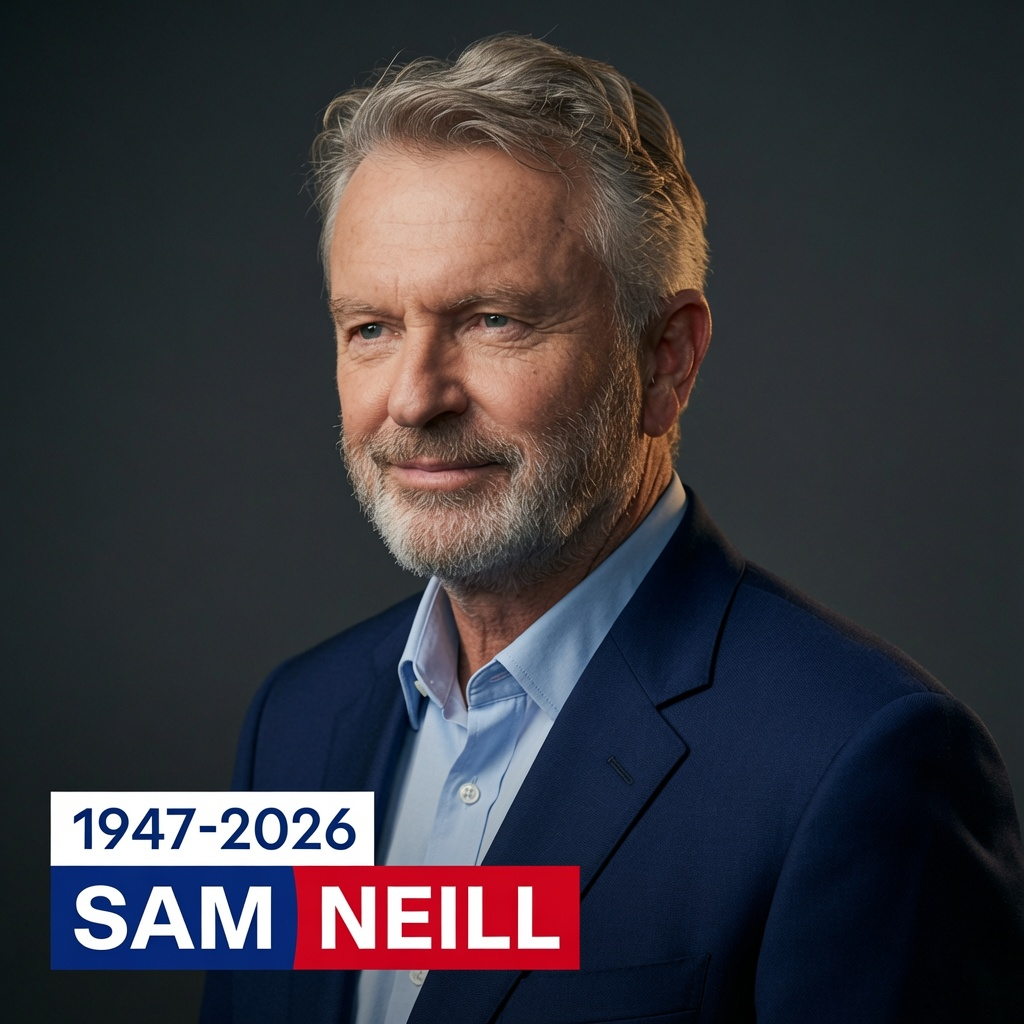
The family described his death as “sudden and unexpected” and said the actor passed with the dignity that had characterised his life.
“It is with immense sadness that the whānau of Sam Neill share the news of his passing on Monday 13th July, in Sydney Australia,” the family statement said.
“Sam was surrounded by family and passed with the dignity that has characterised his whole life.”
“The loss was sudden and unexpected but blessed by the fact that Sam remained cancer free.”
The family thanked staff at St Vincent’s Private Hospital in Sydney for their care and asked for privacy as they confronted what they described as an “immeasurable loss”.
No specific cause of death was immediately announced.
News of Neill’s death triggered an outpouring of grief across Australia, New Zealand and the international film industry for an actor who spent more than half a century moving effortlessly between Hollywood blockbusters, intimate dramas, cult horror films and some of the most beloved productions made on either side of the Tasman.
For millions of moviegoers, he will forever be Dr Alan Grant.
For Australian and New Zealand audiences, however, Sam Neill was much more than the man who stared down a Tyrannosaurus rex.
A sudden death after Neill declared himself cancer-free
The actor’s death comes only months after he publicly shared extraordinary news about his health.
Neill had been diagnosed with stage-three angioimmunoblastic T-cell lymphoma, a rare form of blood cancer, after first experiencing swollen glands while promoting Jurassic World Dominion in 2022.
He later revealed the diagnosis in his 2023 memoir, Did I Ever Tell You This?.
His initial chemotherapy treatment eventually stopped working.
Neill then moved to a different treatment and underwent regular infusions as doctors fought to control the disease.
He spoke candidly about the physical toll of treatment, describing chemotherapy as brutal and miserable while repeatedly insisting that he had little interest in allowing cancer to define his life.
In April 2026, Neill revealed that a scan had shown no cancer in his body.
“I’ve just had a scan just now and there is no cancer in my body, that’s an extraordinary thing,” he said in an interview at the time.
The news was especially remarkable because Neill had previously acknowledged how close he had come to death.
His family specifically stressed on Monday that he remained cancer-free when he died.
The statement means his previous blood cancer should not automatically be described as the cause of his death.
His family has said the loss was sudden and unexpected, and no further medical explanation had been made public at the time of writing.
From Nigel in Northern Ireland to Sam in New Zealand
Neill was born Nigel John Dermot Neill in Omagh, Northern Ireland, on September 14, 1947.
His father was a New Zealander serving with the British Army and his mother was English.
When Neill was seven, the family moved to Christchurch.
It was during childhood that Nigel became Sam.
Neill later recalled that there were several boys named Nigel at his school and that the name Sam offered a simpler identity for a shy child who had struggled with a stammer.
New Zealand became his home and the country with which his career and public identity would be inseparably connected.
Before becoming an international leading man, Neill worked in the developing New Zealand screen industry.
He was employed by the New Zealand National Film Unit and worked behind the camera as well as in front of it.
His breakthrough arrived with Roger Donaldson’s 1977 political thriller Sleeping Dogs.
The film became a landmark in New Zealand cinema and helped introduce Neill to audiences beyond his adopted homeland.
Two years later, his performance opposite Judy Davis in Gillian Armstrong’s My Brilliant Career strengthened his international reputation.
Hollywood and British productions followed.
Neill appeared as Damien Thorn in Omen III: The Final Conflict and delivered an intense performance in Andrzej Żuławski’s Possession, a film that would develop an enduring cult following.
By the late 1980s and early 1990s, he had established the quality that would define his career.
Sam Neill could seemingly belong anywhere.
He could play an Australian husband in a psychological thriller, a Soviet naval officer in a Hollywood blockbuster, a romantic figure in a period drama or a quietly eccentric New Zealander without appearing to be performing a career reinvention.
The role that made Sam Neill a global star
In 1993, Steven Spielberg’s Jurassic Park transformed Neill into one of the most recognisable actors in the world.
He played palaeontologist Dr Alan Grant, the practical, deeply sceptical dinosaur expert invited to inspect John Hammond’s extraordinary island theme park.
The character became the human centre of a film that was changing blockbuster cinema through its groundbreaking visual effects.
Neill’s performance gave audiences someone grounded to follow through the spectacle.
Grant was intelligent but never presented as an invulnerable action hero.
He was frightened when the dinosaurs escaped.
He ran when running was the sensible option.
And his initially uncomfortable relationship with children gradually developed into one of the film’s emotional threads.
Jurassic Park became a global phenomenon.
The image of Grant removing his sunglasses in stunned disbelief as he sees a living dinosaur remains one of the defining moments of 1990s cinema.
Neill returned to the role for Jurassic Park III in 2001 and again more than two decades later in Jurassic World Dominion.
The 2022 film reunited him with Laura Dern and Jeff Goldblum.
For generations of viewers, the reunion carried enormous nostalgia.
Yet Neill’s career could never be reduced to one franchise.
A career that moved between Hollywood and home
Neill’s filmography was remarkable for its range.
He starred alongside Nicole Kidman and Billy Zane in Phillip Noyce’s tense 1989 thriller Dead Calm.
He appeared with Sean Connery and Alec Baldwin in The Hunt for Red October.
In Jane Campion’s acclaimed The Piano, Neill played Alisdair Stewart, a performance far removed from the warmth audiences associated with Alan Grant.
He appeared in A Cry in the Dark, known in Australia as Evil Angels, the dramatisation of the Lindy Chamberlain case starring Meryl Streep.
His darker genre work included John Carpenter’s In the Mouth of Madness and the science-fiction horror film Event Horizon.
Australian audiences embraced him in films including Death in Brunswick and The Dish.
In The Dish, Neill played Cliff Buxton, the quietly capable scientist at the Parkes Observatory during the Apollo 11 moon landing.
The film became an Australian favourite, and Neill’s restrained performance was central to its warmth.
On television, his work ranged from Reilly, Ace of Spies to The Tudors and Peaky Blinders.
As Major Chester Campbell in Peaky Blinders, Neill once again demonstrated his ability to turn his natural authority into something threatening.
He could be reassuring in one role and deeply unsettling in the next.
That versatility allowed him to sustain a screen career across more than five decades.
A new generation discovered him in Hunt for the Wilderpeople
In 2016, Taika Waititi’s Hunt for the Wilderpeople introduced Neill to another generation of viewers.
He played the gruff and isolated Uncle Hec opposite Julian Dennison’s Ricky Baker.
The film followed the unlikely pair as they became the subjects of a national manhunt in the New Zealand bush.
Neill’s performance was funny, understated and deeply moving.
Hec was a character who could easily have become a caricature.
Instead, Neill gave him loneliness, irritation, tenderness and humanity.
The role seemed to capture many of the qualities audiences had come to associate with the actor himself: dry humour, emotional restraint and a refusal to make a fuss.
Hunt for the Wilderpeople became one of New Zealand’s most successful films and reinforced Neill’s place in the country’s screen culture.
He had become an international star without appearing to leave New Zealand behind.
Anthony Albanese pays tribute to a star of Australian stories
Australian Prime Minister Anthony Albanese was among those paying tribute after Neill’s death was announced.
“Sam Neill starred in so many beloved Australian stories and he earned a special place in Australian hearts,” Albanese said.
“Wry and dry, thoughtful and laconic, Sam fought illness with the same dignity, humour and conviction that gave strength to his every performance.”
“He will be much mourned and long remembered. May he rest in peace.”
The tribute reflected Neill’s unusual position in Australian cultural life.
He was proudly associated with New Zealand, but his contribution to Australian film and television was immense.
His career repeatedly crossed the Tasman.
He worked with Australian directors, actors and production companies and appeared in stories that became part of the country’s screen identity.
For many Australians, Neill never felt like a visiting international star.
He felt familiar.
He faced cancer with characteristic humour
Neill’s approach to his illness became another reason audiences felt close to him in his later years.
He did not hide his diagnosis, but he resisted becoming publicly defined by it.
When his memoir was published in 2023, headlines around the world focused on his cancer.
Neill quickly reassured fans that he was alive and working.
He explained that the book had begun as a project during treatment, when acting work had temporarily stopped and he needed something to occupy his days.
The memoir was not intended to be a conventional cancer book.
It became a collection of memories from an extraordinary life in film.
Neill wrote about actors, directors, family, mistakes and the strange experiences accumulated over decades on sets around the world.
Even when discussing the possibility of death, his public comments often carried the dry humour that became his trademark.
He said he was not frightened of dying but found the idea of retirement horrifying.
Work mattered to him.
So did ordinary life.
Life among the vines and farm animals
Away from acting, Neill built a very different public identity at his Central Otago vineyard, Two Paddocks.
He established the wine business in the early 1990s and became closely associated with the region’s pinot noir.
His social media accounts gave fans a window into life on the property.
There were farm animals, vines, jokes and observations delivered in Neill’s unmistakably dry style.
The animals were often given names connected with famous friends and colleagues.
His online presence felt strikingly different from the carefully managed accounts of many Hollywood stars.
Neill appeared comfortable being slightly ridiculous.
That informality strengthened the affection audiences felt for him.
He was a knighted international actor who had worked with Steven Spielberg, Jane Campion, Meryl Streep, Sean Connery and Nicole Kidman.
Yet he could appear equally delighted talking to an animal on his farm.
Honoured as a New Zealand screen legend
Neill received major recognition for his contribution to acting and screen culture.
He was appointed an Officer of the Order of the British Empire for services to acting in 1991.
He later became a Distinguished Companion of the New Zealand Order of Merit and accepted redesignation as a Knight Companion in 2022.
In 2025, he was honoured with the New Zealand Screen Legend Award, recognising more than five decades of acting and storytelling.
The award placed formal recognition around something audiences in New Zealand had understood for years.
Sam Neill was part of the country’s cinematic history.
His early career coincided with the growth of a modern New Zealand film industry capable of telling its own stories and reaching international audiences.
He then became one of the actors who demonstrated that a New Zealand performer could build a major global career without severing that connection to home.
A screen presence audiences trusted
There was no single Sam Neill role.
That may be the clearest measure of his career.
Some actors become inseparable from one character.
Neill created an iconic character in Alan Grant but continued to move through genres and generations.
He could carry a thriller.
He could play a villain.
He could disappear into a historical drama.
He could make a New Zealand bush comedy emotionally devastating.
His performances rarely demanded attention through obvious theatricality.
Neill’s strength was often in what he held back.
A pause, a dry line or a restrained reaction could tell the audience more than a speech.
That quality made him particularly effective opposite spectacle.
In Jurassic Park, the dinosaurs were revolutionary.
Neill made the fear believable.
In The Dish, the moon landing was one of humanity’s greatest technological achievements.
Neill helped make the story feel intimate and Australian.
In Hunt for the Wilderpeople, the landscape was vast.
His performance kept the story focused on two lonely people slowly becoming family.
‘Much mourned and long remembered’
Sam Neill is survived by four children and eight grandchildren, according to reports following his death.
His family has asked for privacy and said further details will be shared later.
For now, the announcement leaves audiences with the shock of a death described by those closest to him as sudden and unexpected.
Only months earlier, Neill had spoken with gratitude about being cancer-free after years of treatment.
He had survived an illness that once left him believing he might be “on the way out”.
He continued working.
He continued talking about films, wine and life with the same dry humour that had followed him through his career.
Then, on Monday, his family announced that one of New Zealand’s greatest actors had died in Sydney.
For Hollywood, Sam Neill was the star of one of the biggest films ever made.
For New Zealand, he was a screen legend who carried the country’s cinema onto the world stage.
For Australia, he was the familiar face in stories that became national favourites.
And for generations who first met him standing in a field, staring in wonder at a living dinosaur, he will always be Dr Alan Grant.
As Albanese said, Sam Neill will be “much mourned and long remembered”.






