One Nation treasury spokesman Barnaby Joyce has refused to guarantee that every policy the party takes to the 2028 federal election will be independently costed by the Parliamentary Budget Office, as scrutiny intensifies over the price of the populist party’s rapidly expanding economic platform.
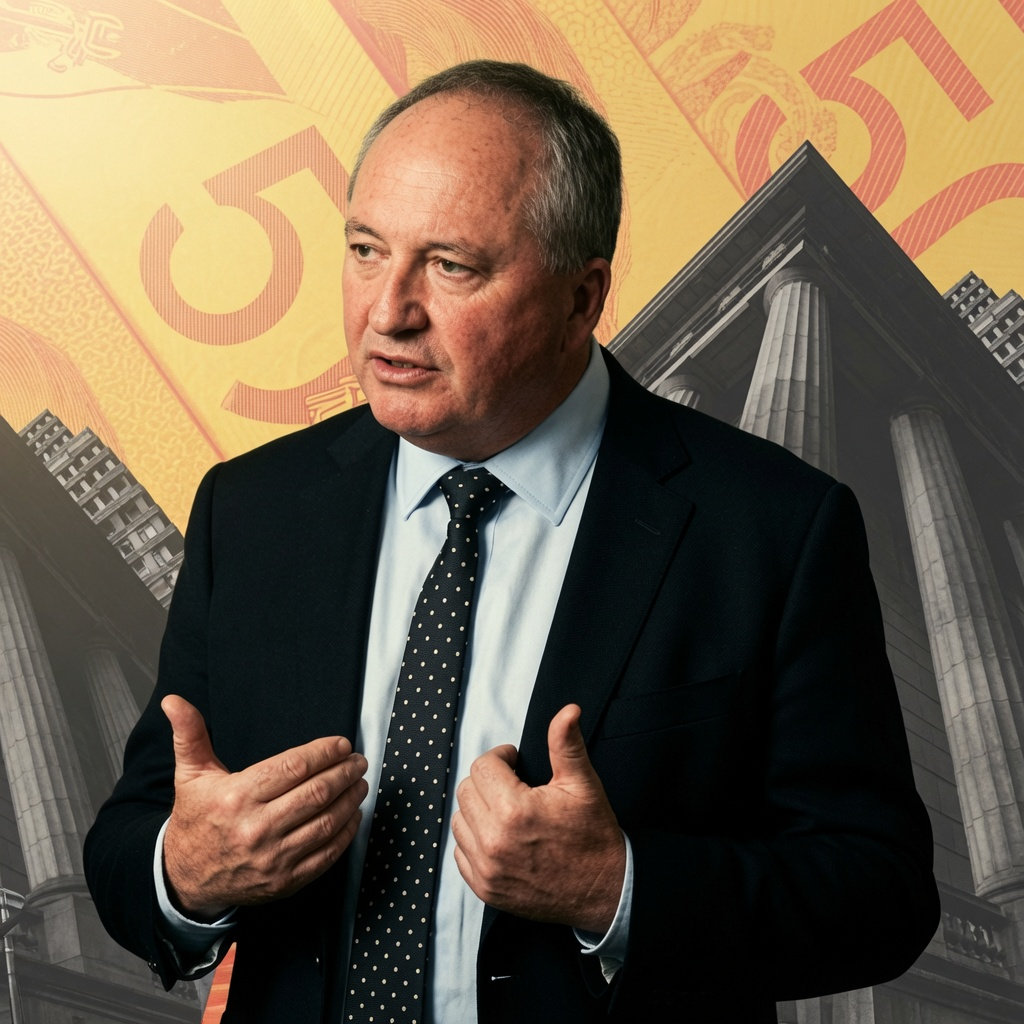
Joyce said One Nation would make its “best attempts” to put policies through the costing process but repeatedly stopped short of promising voters that the party’s entire election program would receive independent budget analysis.
The former Nationals leader argued One Nation lacked the staffing and parliamentary resources available to Labor and the Coalition.
“We will give our best, we will do it to the best of our ability, and I look forward to that,” Joyce told Sky News.
Pressed on whether that commitment covered all One Nation policies — including increased defence spending and the indexation of income tax brackets — Joyce declined to provide an absolute guarantee.
“I’m not going to give a sort of guarantee like that, because that means I have the resources to do it,” he said.
“If I get the promise that we’re going to have the resources to do it, it certainly makes it a lot easier.”
The exchange has opened a significant new line of attack against One Nation at a time when Pauline Hanson’s party is seeking to convince Australians it is capable of moving beyond protest politics and presenting itself as a serious alternative to the major parties.
The question is no longer simply whether voters like One Nation’s policies.
It is whether the numbers add up.
Joyce says One Nation cannot match the major parties’ resources
Joyce argued that demands for comprehensive costings ignored the enormous difference between One Nation’s parliamentary operation and the machinery available to Australia’s established parties.
“It’s incredibly unfair that a party like the Liberal Party with 88 support staff and the Labor Party with like 480 are sort of saying: ‘Oh, well, why don’t you provide costings?’” he said.
When asked whether One Nation would abandon Parliamentary Budget Office costings if it did not receive additional staff, Joyce again focused on the party’s limited resources.
“We’re going to give our very best attempts,” he said.
“You’ve got to realise, and I think it’s fair to accept, that we don’t have the resources.”
There is no doubt that a minor party operates with fewer political staff than a government or a major opposition.
Developing a detailed national platform requires policy research, legal work, consultation and the drafting of precise assumptions that allow economists to model a proposal.
But the existence of the Parliamentary Budget Office complicates Joyce’s argument.
The PBO was established in 2012 as an independent and non-partisan institution designed to provide Parliament with budget and fiscal analysis.
One of its core functions is responding to requests from senators and members for costings of policy proposals and analysis of budget-related matters.
In other words, a parliamentarian does not need to employ an entire Treasury department inside a political office to ask the PBO to examine a policy.
The office itself performs independent analysis.
The PBO also has a published prioritisation framework intended to provide equitable access to its resources across Parliament. That framework acknowledges larger non-government parties will generally receive more costing resources because of their parliamentary representation, but access is not restricted to Labor and the Coalition.
That makes the political argument over resources more nuanced.
One Nation may genuinely have fewer staff to develop detailed policy specifications. But once a sufficiently defined proposal exists, its parliamentary representatives have access to the independent costing system created precisely to improve fiscal scrutiny.
What the Parliamentary Budget Office actually does
The PBO is central to this dispute because political debate often uses the phrase “fully costed” without explaining what it means.
A policy costing is not simply a politician attaching a large dollar figure to a press release.
The PBO uses the most recent available economic and budget information to estimate the financial impact of a policy proposal.
Costings also carry an expiry date, usually linked to the next budget update, because changing economic conditions and new government data can substantially alter the estimated price of a policy.
This is particularly relevant before the 2028 election.
A policy costed in 2026 may need to be updated after subsequent federal budgets and economic statements.
Joyce is therefore correct when he says upcoming budget numbers can change the policy environment.
But that does not remove the value of independent costing.
It means policies need to be tested and, where necessary, tested again as fiscal assumptions change.
During an election caretaker period, parliamentary parties and independent parliamentarians can also request PBO costings of publicly announced election policies.
The PBO publishes those requests and releases the completed analysis under its legislative framework.
Separately, the Election Commitments Report is designed to improve transparency around the budget impact of election platforms.
The PBO says the report plays an important role in encouraging parliamentary parties to announce fully costed commitments and publish their platforms before polling day.
The report automatically covers the major parties identified under the framework and can also include minor parties and independents that choose to participate.
For a party now openly discussing its potential to replace one of Australia’s traditional major political forces, participation in that level of fiscal scrutiny would be a significant test of its claim to be ready for government.
The $90 billion question hanging over One Nation
Joyce’s comments follow an Australian Financial Review analysis estimating that a selection of One Nation’s signature cost-of-living policies could cost the federal budget at least $90 billion over four years.
The package examined included halving the fuel excise for three years, introducing income splitting for couples with dependent children and removing GST from insurance policies.
Other One Nation proposals include changes to alcohol excise and increased Medicare funding.
Each policy is politically attractive to a constituency facing genuine financial pressure.
Fuel costs flow through household budgets and business expenses.
Insurance premiums have become a major affordability concern in disaster-prone communities.
Families with children are confronting housing, childcare and grocery costs.
Access to bulk-billed medical care remains a significant concern for many Australians.
But policies that reduce taxes or increase spending have a budget impact unless they are offset by new revenue, lower expenditure elsewhere or stronger economic growth that produces additional government receipts.
This is where One Nation’s platform faces its most important test.
It is relatively easy for an opposition party to identify individual taxes voters dislike.
It is much harder to explain how multiple tax reductions and spending increases interact across the entire federal budget.
Asked about the AFR’s $90 billion estimate, Joyce neither accepted nor rejected the figure.
“So, the whole thing there, first of all, $90 billion is a long way from a trillion,” he said.
“So that’s incumbent upon Angus to explain that.”
Joyce said some policies required significantly more detailed work, particularly income splitting.
“We have a budget coming forward and a lot of these numbers are going to change within that budget and within that paradigm,” he said.
“I just spent the weekend in Brisbane, sitting down with economists, sitting down other accountants … to try and sort of break these numbers down.”
Why Angus Taylor is talking about $1 trillion
The difference between the $90 billion estimate and Opposition Leader Angus Taylor’s warning of a cost approaching $1 trillion has become a central part of the political fight.
The figures are not direct estimates of precisely the same package over precisely the same period.
The AFR examined a group of prominent One Nation cost-of-living measures over four years.
Taylor’s attack considered a broader collection of One Nation positions and projected their fiscal implications over a decade.
In a major speech to the Sydney Institute, the Opposition Leader accused One Nation of offering an incoherent economic program that could increase inflation, force interest rates higher and dramatically worsen Australia’s debt position.
“That’s what One Nation’s policies would do,” Taylor said.
“It’s a one-person show. The policies are incoherent. They don’t add up.”
Taylor has argued that major One Nation commitments involving migration, income tax, fuel excise and defence could add roughly $1 trillion to debt over 10 years.
He warned the resulting fiscal expansion could drive higher inflation and impose additional pressure on mortgage holders.
One Nation rejects the attack and has accused Taylor of misrepresenting its policies.
Joyce’s immediate response was to point out the enormous gap between the competing estimates and demand the Liberal leader explain his calculations.
That is a legitimate political challenge.
If the Opposition Leader claims a rival party’s policies could cost close to $1 trillion, the assumptions behind that estimate deserve scrutiny.
But the reverse is equally true.
If One Nation says Taylor is wrong, the most powerful response would be to publish detailed policy specifications and independent costings showing exactly where the Liberal leader’s calculations fail.
The Coalition has its own costing problem
Taylor’s attack has also exposed the Coalition to accusations of hypocrisy.
Labor has pointed to estimates suggesting Coalition commitments could involve as much as $544 billion in uncosted promises, including a proposal to lift defence spending to three per cent of gross domestic product.
Taylor insists the Coalition has a record of taking costed plans to federal elections.
“We have always taken costed plans to elections,” he said.
“The Greens and One Nation, the minor parties, have never done that. Their policies are incoherent.”
The distinction between an announced policy position years before an election and a final costed election platform is important.
Political parties routinely announce ambitions and policy directions before every implementation detail has been finalised.
The fiscal test becomes sharper as polling day approaches and a party asks voters for authority to form government.
That standard should apply to the Coalition.
It should also apply to Labor.
And if One Nation wants to be treated as a genuine contender for national power, it increasingly applies to One Nation.
Can abolishing the climate department pay for One Nation’s promises?
One Nation has said its cost-of-living agenda could be funded partly through government spending cuts, including abolishing the Department of Climate Change, Energy, the Environment and Water.
The party has long argued that Canberra wastes billions of dollars on climate policy, bureaucracy and programs it regards as ideologically driven.
For supporters, cutting those areas is precisely the point of electing One Nation.
They do not view the policies as painless savings inside the existing system. They want a fundamentally different set of spending priorities.
But there is a crucial difference between identifying a department for abolition and demonstrating the amount of cash that would actually become available for new promises.
A government department’s expenditure is not simply an administrative bill that disappears when the department’s name is removed from a building.
Departments administer programs, grants, regulatory functions and statutory responsibilities.
If a government abolishes a department but continues some of its programs elsewhere, those costs remain.
If it terminates the programs, the political and economic consequences of those decisions must also be explained.
The PBO’s election costing methodology specifically examines whether funding identified as a saving is genuinely available and uncommitted.
This is why independent costing matters.
It separates a political promise to “cut waste” from a budget calculation showing how much money can actually be redirected.
Joyce has inherited One Nation’s toughest portfolio
Joyce only recently took on the role of One Nation’s treasury spokesman after joining Hanson’s party.
The appointment gives him responsibility for one of the most difficult stages in One Nation’s political evolution.
The party’s rise has been powered by clear, easily understood positions on issues including immigration, fuel tax, climate policy and the cost of living.
Those positions can be communicated in a television interview or social media video in seconds.
Treasury policy is different.
Income splitting requires decisions about eligibility, household definitions, interactions with existing tax offsets and the treatment of different family structures.
Indexing tax brackets requires assumptions about inflation, wages and the long-term revenue base.
Defence spending targets involve multi-decade procurement, workforce and capability questions.
Removing taxes from insurance or alcohol changes Commonwealth revenue and can create flow-on effects for states, industries and consumers.
A party preparing for government must turn slogans into legislation.
Joyce’s experience as a former deputy prime minister and cabinet minister is one reason his Treasury appointment matters.
He understands how aggressively major parties, departments and the media will interrogate the numbers.
His weekend meetings with economists and accountants suggest One Nation recognises the scale of the task.
But refusing to guarantee comprehensive independent costings gives the Coalition an obvious weapon.
One Nation now faces the price of being taken seriously
For years, One Nation could campaign primarily as a protest party.
Its supporters wanted it to challenge the political establishment, raise issues the major parties avoided and force national debate onto subjects including immigration and energy.
That political model requires clear positions.
It does not necessarily require a shadow Treasury operation capable of presenting a government-ready fiscal program.
One Nation’s growing electoral support has changed the standard.
If the party wants to replace the Coalition as the principal force on the Australian right — or even seriously present itself as a potential government — voters are entitled to know what its promises cost.
That does not mean every policy announced in 2026 must retain exactly the same price tag in 2028.
The PBO itself warns that costings can change as new budget and economic information becomes available.
It does mean One Nation will need to define its policies with enough precision for independent analysts to test them.
Joyce is right that One Nation does not have Labor’s staffing machine.
He is also right that a federal budget between now and the election will change the fiscal numbers.
But those arguments become less persuasive as One Nation’s ambitions grow.
A party cannot simultaneously ask Australians to imagine it running the Commonwealth and argue that it lacks the resources to tell them what its entire platform would cost.
The PBO exists to provide independent, non-partisan budget analysis to Parliament. Its published framework recognises differences in parliamentary representation while still providing access to senators and members.
One Nation now has experienced parliamentarians, a Treasury spokesman who has served as deputy prime minister and a political platform attracting intense national attention.
The next step is arithmetic.
Angus Taylor’s $1 trillion attack should be tested.
The AFR’s $90 billion estimate should be tested.
The Coalition’s own spending promises should be tested.
And One Nation’s policies should be tested.
By refusing to guarantee that every policy will go through independent costing before 2028, Joyce has left the central question unanswered.
If One Nation believes its economic plan can survive scrutiny, why not put the full plan in front of the Parliamentary Budget Office and let the numbers speak?






