Australia is preparing to significantly strengthen enforcement of its world-first social media age restrictions after the federal government accused major technology companies of failing to properly prevent children under 16 from accessing their platforms.
The proposed reforms would substantially increase financial penalties for companies that fail to meet their legal obligations while also expanding the investigative powers of Australia’s online safety regulator. The measures represent the latest stage of the government’s effort to ensure social media platforms actively enforce the country’s age restriction laws rather than relying on minimal compliance.
Prime Minister Anthony Albanese said some of the world’s largest technology companies have been doing “the bare minimum” to comply with Australia’s under-16 social media ban. According to the government, new legislation will double the maximum financial penalty for non-compliance from existing levels to as much as A$99 million. Ministers argue the stronger penalties are necessary because existing enforcement mechanisms have not produced sufficient improvements in age verification and account restrictions.
The reforms would also provide Australia’s eSafety Commissioner with expanded investigative powers. Under the proposed changes, regulators would be able to require technology companies to produce documents, technical information and evidence demonstrating how they are preventing underage users from creating or maintaining accounts. Authorities say the additional powers are intended to improve transparency and make it easier to determine whether platforms are genuinely complying with the law.
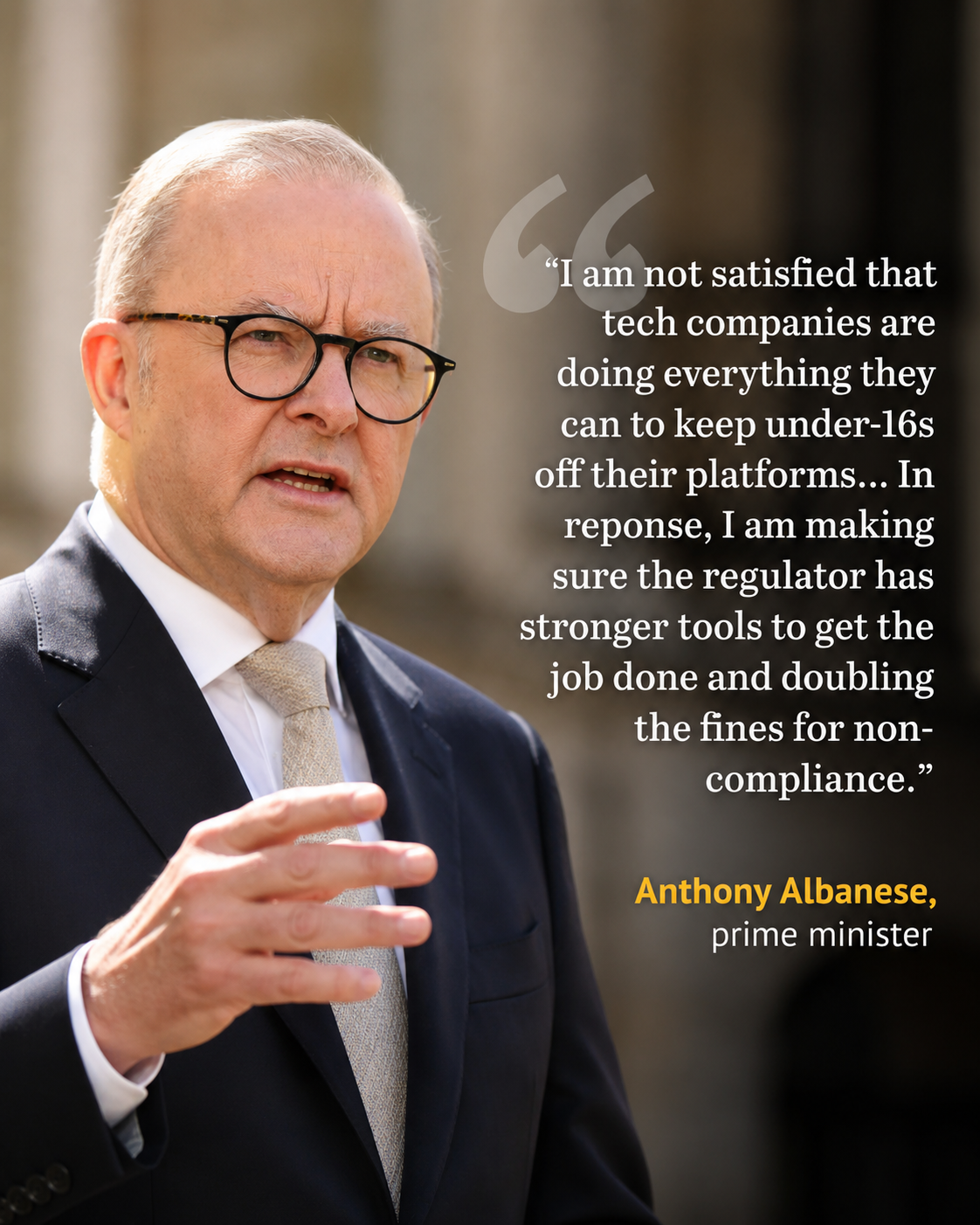
The government’s decision follows research suggesting that many children continue accessing social media despite the legislation. Studies have indicated that a large proportion of teenagers are still able to use social media platforms by creating alternative accounts or using other methods to bypass age verification systems. Officials argue these findings demonstrate the need for stronger enforcement rather than weaker regulation.
Technology companies have responded by pointing to the extensive measures already introduced since the legislation took effect. Industry representatives say millions of accounts believed to belong to underage users have been removed, suspended or restricted while platforms continue investing in improved age assurance technologies. They also note that accurately verifying a person’s age online presents significant technical and privacy challenges, particularly without collecting additional personal information from users.
Child safety advocates have broadly welcomed the government’s latest proposal. Families who have campaigned for stronger online protections argue that meaningful penalties are necessary if technology companies are to treat child safety as a priority rather than simply a compliance exercise. Several advocacy groups have also called for continued monitoring of messaging services, recommendation algorithms and emerging online platforms that may fall outside existing enforcement efforts.
Not everyone agrees that stronger penalties alone will solve the problem. Some digital policy experts argue that while age restrictions may reduce children’s exposure to harmful content, broader reforms addressing platform design, recommendation algorithms and online safety standards will also be needed. Others have suggested that parents, schools and technology companies all have important roles alongside government regulation in improving children’s online safety.
Australia’s approach continues to attract international attention. Since introducing the under-16 social media restrictions, several other countries have explored similar legislation or strengthened their own online child protection frameworks. The Albanese government argues that Australia’s experience demonstrates the need for governments to require technology companies to take greater responsibility for protecting young users.
The proposed legislation will now proceed through the parliamentary process, where lawmakers will debate the expanded enforcement powers and higher financial penalties. If approved, the changes would give regulators stronger tools to investigate compliance while substantially increasing the consequences for companies found to have failed to take reasonable steps to prevent underage access.
For Australian families, the debate reflects a broader question about the responsibilities of governments and technology companies in the digital age. While opinions differ on the most effective methods of protecting children online, there is broad agreement that social media platforms will face increasing scrutiny as regulators seek stronger evidence that age restrictions are being enforced in practice rather than existing only on paper.






