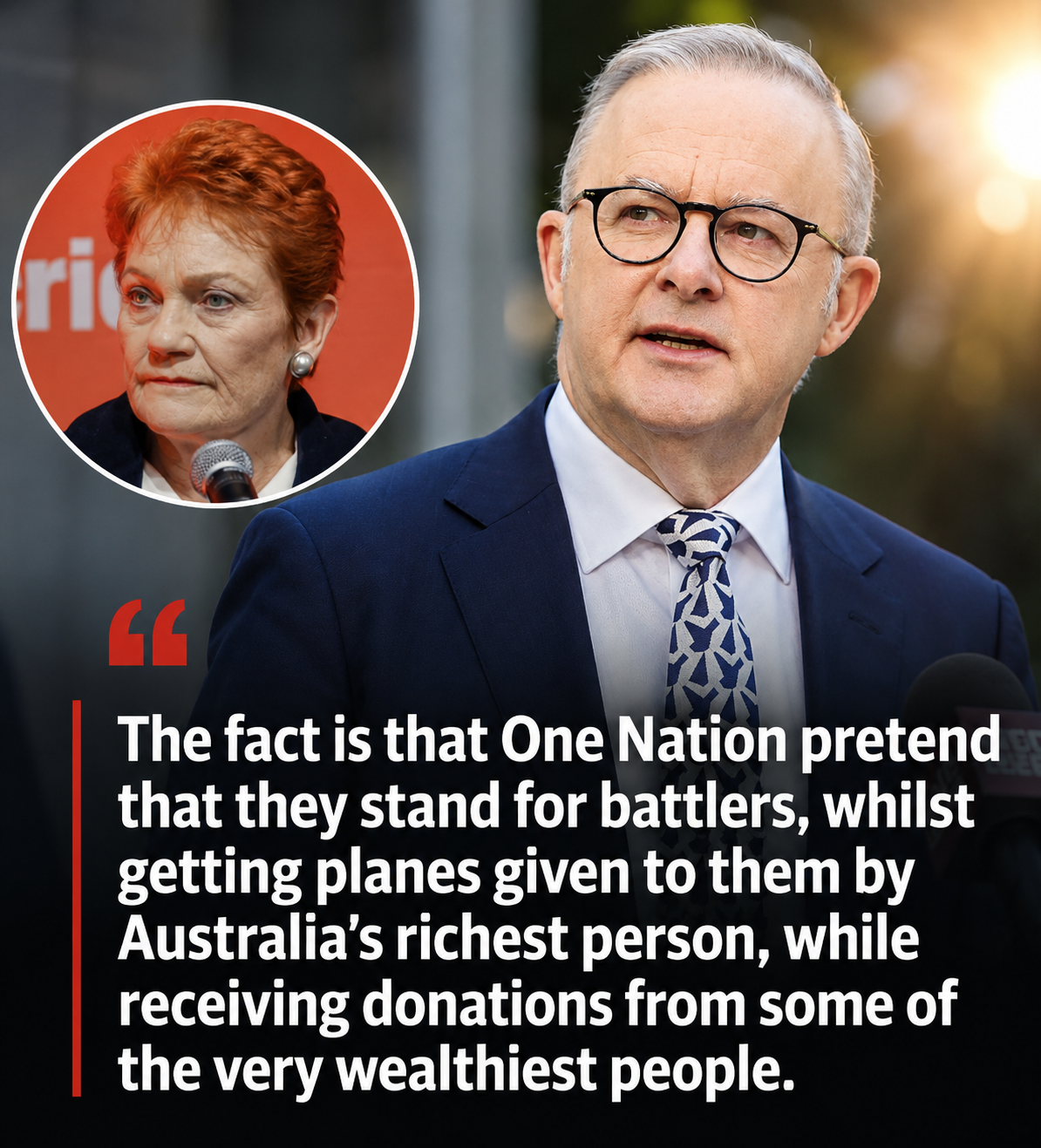
Anthony Albanese has sharpened his attacks on Pauline Hanson’s One Nation, accusing the party of pretending to stand up for Australian workers while opposing policies that Labor says directly benefit working families.
The Prime Minister’s latest comments highlight growing concern within Labor about the political momentum One Nation has built in recent months.
What was once viewed as a protest party on the fringes of Australian politics is increasingly becoming a significant force capable of influencing the national debate.
And for Labor, that presents a challenge that cannot be ignored.
At the centre of the dispute is a simple but politically powerful question: who truly represents ordinary Australians struggling with the rising cost of living?
Albanese argues that One Nation has built its message around defending workers and battlers while simultaneously opposing policies that his government says are designed to improve living standards.
According to the Prime Minister, the party has opposed measures such as minimum wage increases, Medicare expansion, childcare support and free TAFE initiatives that Labor claims are helping working Australians.
But the political reality facing Labor is that One Nation’s message is resonating with a growing number of voters.
Recent polling has suggested Pauline Hanson’s party is attracting support from Australians who feel the political system is no longer delivering for them. In some surveys, One Nation has even emerged as a major challenger to the traditional political order.
The rise has not happened by accident.
Across Australia, many households continue to feel pressure from housing costs, rental stress, grocery bills, insurance premiums and broader cost-of-living concerns.
While economic indicators may show improvement in some areas, voters often judge governments based on their own financial circumstances rather than national statistics.
That gap between economic data and lived experience has become fertile ground for parties seeking to position themselves as alternatives to the major parties.
One Nation has focused heavily on issues such as migration, housing supply, government spending and national identity.
Supporters argue the party is raising concerns that many Australians believe are not receiving enough attention in Canberra.
Critics argue the party relies on simple slogans and divisive rhetoric without offering practical solutions to complex problems.
The disagreement reflects a broader shift occurring throughout Australian politics.
Traditional party loyalties are becoming weaker, and voters are increasingly willing to support minor parties or independents when they become frustrated with the major parties.
Labor is clearly aware of this trend.
In recent weeks, senior government figures have repeatedly directed criticism toward Pauline Hanson and One Nation, treating them less like a fringe movement and more like a genuine political threat.
That strategy reflects growing recognition that many of the voters being attracted to One Nation were once considered part of Labor’s natural support base.
These are often voters concerned about job security, living costs, housing affordability and the future direction of the country.
The battle for those voters could prove decisive in future elections.
For Albanese, the challenge is demonstrating that Labor’s policies are delivering tangible improvements in daily life.
For Hanson, the challenge is convincing Australians that One Nation can move beyond protest politics and become a credible long-term alternative.
The Prime Minister’s latest attack therefore represents more than a disagreement over policy.
It is part of a much larger contest over who will speak for Australians who feel squeezed by economic pressures and increasingly disconnected from the political establishment.
As cost-of-living concerns continue to dominate household conversations, that battle is unlikely to fade anytime soon.
And with One Nation continuing to rise in polls and attract national attention, Labor appears determined to fight aggressively for every voter it believes may be slipping away.






