Prime Minister Anthony Albanese has used a meeting with Apple executive chair Tim Cook in California to promote Australia’s online child-safety agenda, saying Cook regarded the country’s social-media restrictions as “world-leading” while the government continues to develop a broader Digital Duty of Care for online platforms.
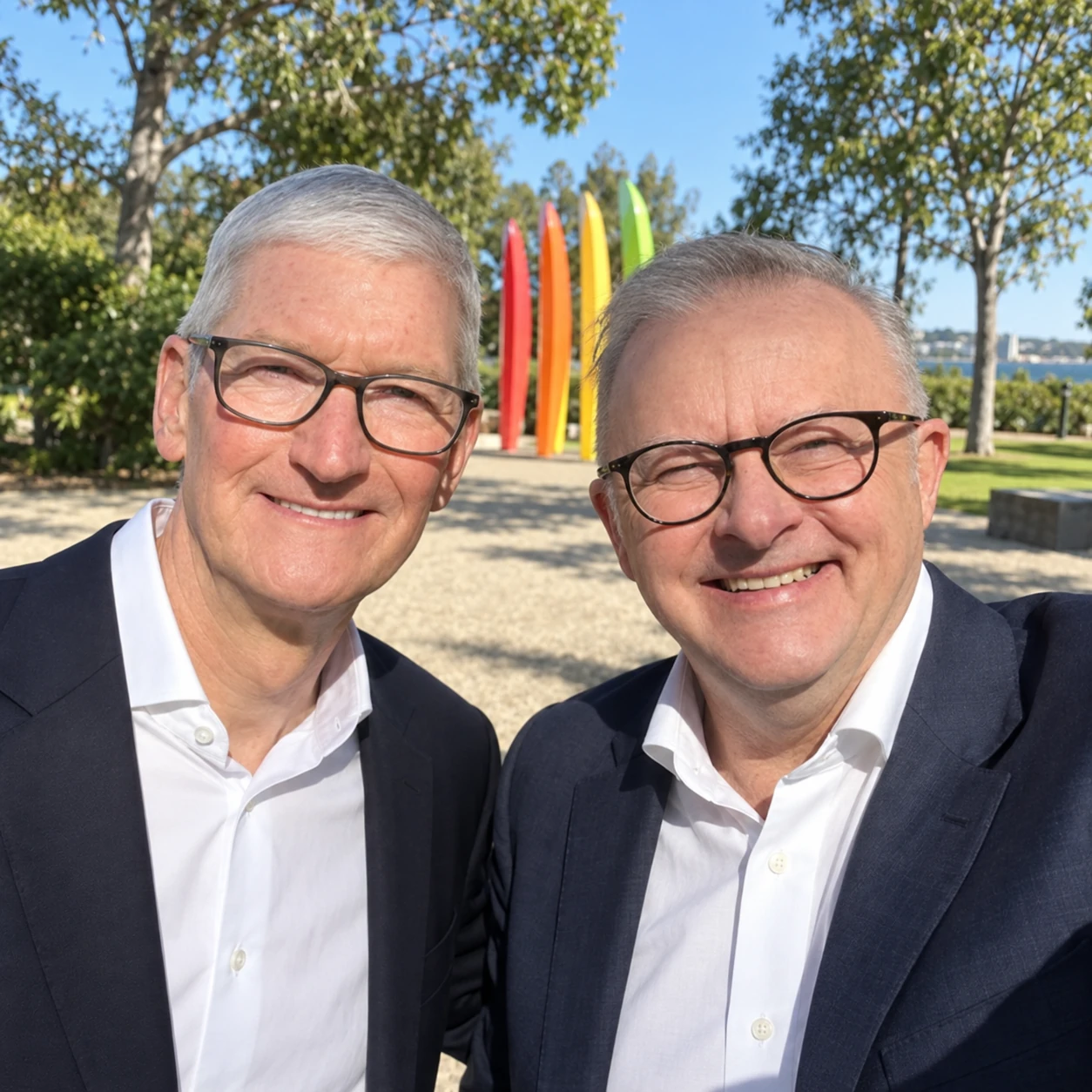
The meeting at Apple Park formed part of Albanese’s United States visit before he travelled to New York for the United Nations General Assembly. Online safety, parental controls, artificial intelligence and technology investment were among the issues discussed.
Apple has recently expanded parental-control features across its devices, including tools that allow families to manage screen time, app access, communication and age-appropriate experiences. The company has presented those tools as part of a wider child-safety strategy built into its operating systems.
Albanese linked the discussion to Australia’s under-16 social-media rules, which place responsibility on designated platforms to take reasonable steps to prevent children below the minimum age from holding accounts.
After the meeting, Albanese said Cook viewed Australia’s approach as world-leading. Cook also publicly emphasised Apple’s support for protecting children online and the importance of tools that help parents manage young people’s technology use.
That should not be interpreted as confirmation that Apple has endorsed every element of Labor’s separate Digital Duty of Care exposure draft. The government has not published a detailed Apple submission supporting the full proposal, and Cook’s praise was directed more broadly at Australia’s social-media and child-safety push.
The distinction matters because the Digital Duty of Care goes beyond the under-16 account restriction. The draft legislation would create new obligations for online services to identify, assess and mitigate foreseeable risks to users, supported by stronger transparency and regulatory requirements.
Labor is also proposing “My Feed, My Way”, which would require social-media platforms to offer Australians greater control over whether their default feeds are personalised by recommendation algorithms.
The government says these measures are intended to change the incentives of technology companies by making safety a design responsibility rather than relying primarily on users to report harm after it occurs.
Opposition politicians have raised concerns about censorship, regulator power and the possibility that broad definitions of harm could encourage platforms to restrict lawful speech. Supporters of the proposal argue that risk-based regulation already exists in other safety-critical sectors and that digital services should not be exempt from comparable duties.
Apple occupies a different position from a social-media platform because it controls devices, operating systems and an app ecosystem rather than a single public feed. That gives the company substantial influence over how children access services, even where it is not itself responsible for the content inside third-party social apps.
Parental controls at the device level can therefore complement platform regulation. A parent can restrict when an app is used, who a child communicates with or what categories of content are accessible, while the platform remains responsible for its own age assurance and safety obligations.
Those layers are not interchangeable. A strong parental-control system does not remove a social-media company’s legal duties, and government regulation does not eliminate the role of parents in deciding how children use phones and tablets.
Privacy is another major issue. Age assurance and child accounts can require services to establish whether a user is above or below a threshold without collecting more personal information than necessary. Australian privacy regulators have stressed that online-safety goals do not create a blank cheque for excessive data collection.
Apple has long promoted privacy as a key part of its product design, including on-device processing for some safety features. That positioning makes its relationship with government policy particularly significant: the company wants to show that safety controls can expand without normalising broad surveillance of users.
The Albanese government, meanwhile, is trying to turn Australia’s domestic policy into an international leadership argument. Officials have pointed to overseas governments considering age restrictions, algorithm controls and systems-based online-safety laws as evidence that the debate is moving in Australia’s direction.
There is still uncertainty about long-term effectiveness. Removing or blocking under-16 accounts can be measured relatively quickly, but it is harder to determine whether young people become safer overall, move to different services or find ways around age controls.
The same applies to parental-control tools. Their availability does not guarantee use. Families need to know the features exist, understand how to configure them and have enough digital literacy to adjust settings as children grow older.
That is one reason governments increasingly see device makers as part of the online-safety ecosystem. The operating system sits between the user and individual apps and can provide controls that work across multiple services at once.
For Apple, engagement with Canberra also has commercial and regulatory significance. Technology companies operate across dozens of legal systems and prefer rules that are technically workable and reasonably consistent. Australia’s decisions can influence product design if other governments adopt similar approaches.
For the Australian government, a public meeting with Cook provides a high-profile example of a major technology company engaging with its agenda. But endorsement should not be overstated. Support for child safety in principle is different from support for every proposed legal obligation, penalty or regulatory power.
The Digital Duty of Care remains an exposure draft and consultation is still under way. Industry groups, civil-society organisations, legal experts and political parties can seek changes before a final bill is introduced.
Apple may also have views on specific provisions that have not been made public. Large technology companies frequently support the goal of online safety while arguing over implementation, liability, technical feasibility and privacy safeguards.
Albanese’s meeting therefore matters more as a sign of policy direction than as evidence that the legislative debate is settled. Australia is combining age restrictions, user-choice proposals, platform duties and device-level parental tools into a broader online-safety strategy.
That strategy will continue to face competing demands. Parents want protection that works; privacy advocates want limits on data collection; free-speech advocates want lawful expression protected; platforms want clear obligations; and regulators want enough power to enforce the rules.
No single meeting can resolve those tensions. But the discussion with Cook highlights how online safety has become both a domestic policy issue and a subject of international technology diplomacy.
The next test will be whether the government’s proposals survive detailed scrutiny and whether companies can translate supportive public statements into tools and compliance systems that work in practice.
Australia’s under-16 rules are already moving from legislation to implementation, which makes the Apple discussion more concrete than a general conversation about future regulation. Platforms have been required to take reasonable steps to prevent under-age account access, while regulators examine how age assurance can work without creating unnecessary privacy risks.
That experience will influence the duty-of-care debate. If age checks prove easy to evade or excessively intrusive, lawmakers may need to adjust the framework. If they reduce access without broad data collection, supporters will argue that stronger design obligations can work without sacrificing privacy.
The government is also using the international response as part of its case for maintaining momentum. Other jurisdictions are considering similar measures, but their legal systems, privacy rules and definitions of harmful content differ, so Australia cannot assume every overseas endorsement translates directly into support for its final bill.
For now, the careful description is that Cook praised Australia’s child-safety direction and social-media restrictions, while the broader Digital Duty of Care remains a contested draft. Treating those two propositions as the same thing would overstate what has been publicly established.