Bob Katter has asked Prime Minister Anthony Albanese to commission a feasibility report into a separate North Queensland state, reviving a long-running demand for greater regional control. Albanese answered with a joke about a hypothetical ‘Premier Katter’, but made no commitment to the study.
Katter, the member for Kennedy, asked whether the government would commission a report into the viability of a new state. He argued that distance from Brisbane and decisions made far from northern communities had held back major projects. His figures and criticisms were presented as his parliamentary case for change, not as independently verified economic findings.
The exchange took place in the House of Representatives on 12 October, according to the parliamentary record. Albanese said the question had not been on his bingo card and referred to federal investment in the north. No new state, referendum or feasibility study was announced.
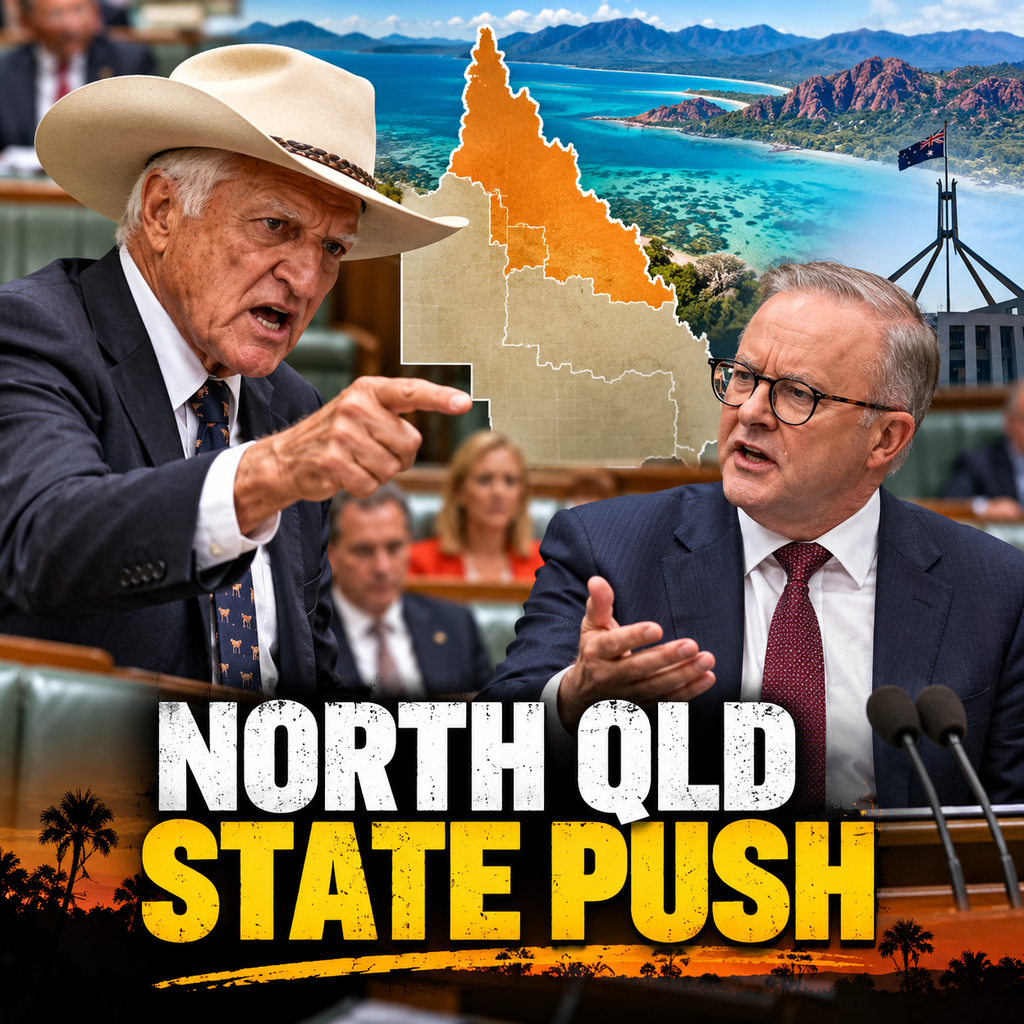
Katter has long argued that North Queensland’s economic needs differ from those of the south-east corner. In his parliamentary question, he pointed to distance from the state capital and what he sees as delayed resource and agricultural development.
The argument appeals to people who feel that decisions about northern roads, ports, agriculture and mining are made far from where the impacts are felt. But there are competing considerations, including the cost of new government institutions, distribution of revenue and whether regional priorities could be improved without changing state boundaries.
A northern administration would have to serve a large and geographically dispersed population, with transport, health and disaster-response needs differing from those in south-east Queensland. A shorter distance to government decision-makers might appeal to residents, but establishing new departments and parliamentary institutions would also consume funds. The comparison is therefore not just between Brisbane and a hypothetical northern capital. It is between the cost of the present arrangements, the price of establishing a new state and other ways to direct more resources to regional services.
According to the parliamentary record, Albanese reacted with humour, saying the question was not on his bingo card. He entertained the hypothetical image of Premier Katter and referred to Queensland sporting identity, while highlighting existing federal investments in northern infrastructure.
Albanese’s parliamentary answer was light-hearted. His reference to ‘Premier Katter’ did not signal an endorsement of statehood, nor did he agree to commission the report requested by the member for Kennedy.
Even before constitutional steps, supporters would need to decide where the borders would run, how existing Queensland obligations and assets would be allocated, and how services such as health, education, policing and courts would operate. The economics would depend on how revenue, infrastructure costs and ongoing spending were calculated.
Section 124 of the Australian Constitution allows for the formation of a new state from territory within an existing state, but only with the consent of the parliament of the state concerned. That makes Queensland’s agreement central to any North Queensland proposal; an answer from a federal prime minister alone cannot create a seventh state.
The Australian Constitution sets a substantial legal hurdle. Section 124 provides that a state formed by separating territory from an existing state requires the consent of that state’s parliament. Section 121 gives the Commonwealth Parliament a role in admitting or establishing states and determining terms such as representation. That is different from suggesting a federal prime minister can create a new state by announcing a report. Katter’s request for a feasibility study would not itself satisfy those constitutional requirements, and Albanese did not agree to commission one.
A proposal would need careful work on the boundary, representation, administration and transfer of functions. Questions could include how a new parliament, public service and court system would operate, how policing and emergency services would be funded, and what relationship would exist with the remaining Queensland government. A report exploring those issues would not itself achieve statehood. Katter asked for an investigation of feasibility; Albanese did not promise one during the 12 October exchange.
A national referendum is not automatically the single constitutional requirement for forming a state out of existing state territory. The relevant consent requirements, boundaries and legislative arrangements would have to be worked through with Queensland and the Commonwealth.
Katter’s argument centres on whether North Queensland receives a fair return from economic activity generated in the region. Mining, agriculture, ports and tourism are important elements of the economy, and decisions about their infrastructure can have consequences far beyond Brisbane. Yet a claim that one region ‘pays for’ another needs a detailed assessment of taxes, royalties, grants, public services and existing debt. Gross production is not the same as revenue available for a new state budget.
Financing a new state would require more than assigning a percentage of Queensland’s mining royalties to the north. A proposal would need to estimate its likely share of taxes, grants, royalty receipts and borrowing, and set those against spending on hospitals, schools, roads, policing and disaster recovery. Revenue from commodity industries is volatile: a high-price year can look attractive on paper but does not guarantee stable funding for services. Debt, public assets and pension liabilities would also need an agreed division. None of those arrangements was detailed in Katter’s parliamentary question.
A serious financial model would examine what income could be raised locally, which services the new state would need to finance and which assets or liabilities would have to be divided. Hospitals, schools, roads, police, courts and disaster recovery all require dependable operating budgets even when commodity prices fall. A state with substantial resource exports may still have high per-capita infrastructure costs because of long distances and dispersed communities.
Business groups would also need answers about investment approvals and regulation. Changing a border does not erase existing mining leases, agricultural businesses or port contracts, but it could require transitional legislation and agreement on responsibilities. Investors and lenders would want clarity about ownership, taxes and regulatory continuity. These are possible practical issues, not reported effects of a proposal that has not moved beyond debate.
For residents, arguments over statehood often become concrete when linked to the cost of freight, electricity reliability, housing availability and the distances involved in medical care or education. A new government closer to the region might be more responsive to those issues. Equally, setting up a separate bureaucracy could absorb money before any service improves. The right comparison is not merely between geographic distance and local pride, but between workable budgets, infrastructure priorities and measurable service outcomes.
Mining approvals, irrigation and agricultural investment were central to Katter’s case, but jurisdictional change does not automatically remove the need for environmental assessments, water allocations or finance. Investors still weigh transport links, power supply, workforce availability and regulatory certainty. For households, the more immediate concerns may be freight prices, insurance affordability after cyclones, access to hospitals and whether major road projects are delivered. Those issues could be examined in a feasibility study alongside statehood, rather than assumed to be solved by a new border.
Katter’s concerns about northern investment and his criticism of Brisbane-centric decision-making are political claims that can be investigated with public data. Albanese responded by pointing to infrastructure commitments made by the Commonwealth, although the parliamentary exchange did not settle whether those programs met local needs. A feasibility study could theoretically test the competing assertions; no such study was authorised in the exchange at issue.
Statehood is only one possible response to perceived neglect. Other models might include stronger regional planning powers, different funding formulas or agreements to prioritise northern infrastructure within the existing Queensland government. A credible feasibility exercise would compare those options against the cost of creating new institutions. It would need to say who pays during transition and whether the service improvements sought by residents are realistically achievable.
The idea of a separate northern state has appeared in Queensland politics for decades, often when local leaders argue that decisions made in the south-east do not adequately reflect the north’s distance and needs. Katter’s latest question has put that long-running grievance back in the parliamentary spotlight.
There are alternatives between the existing system and full separation. More regional agency authority, binding investment agreements and a different distribution of infrastructure funds could be considered without creating an additional legislature. Statehood proponents would argue those changes might still leave final power in Brisbane. Opponents would ask whether splitting administration and public finances could reduce economies of scale. A meaningful study would have to cost both claims; a slogan about northern independence cannot substitute for a public budget.
Some of those investment choices are already made through federal-state agreements, infrastructure programs and local planning decisions. A new-state proposal would have to show which powers or funding streams would improve materially under separation, rather than attributing every delayed road, dam or port project to the location of Queensland’s capital. Katter’s question speaks to a real regional grievance, but whether statehood is the most effective remedy would need costed alternatives and the consent of the political institutions involved.
North Queensland remains part of Queensland. Katter has formally asked for a feasibility report and Albanese has replied without agreeing to order one. The more immediate dispute is over regional investment and whether existing state and federal arrangements serve northern communities effectively.






