Opinion writer John Grant has argued that growing numbers of Australians are rejecting what he describes as “Modern Australia”, contending that many are either physically leaving major cities for regional communities or psychologically disengaging from civic life altogether.
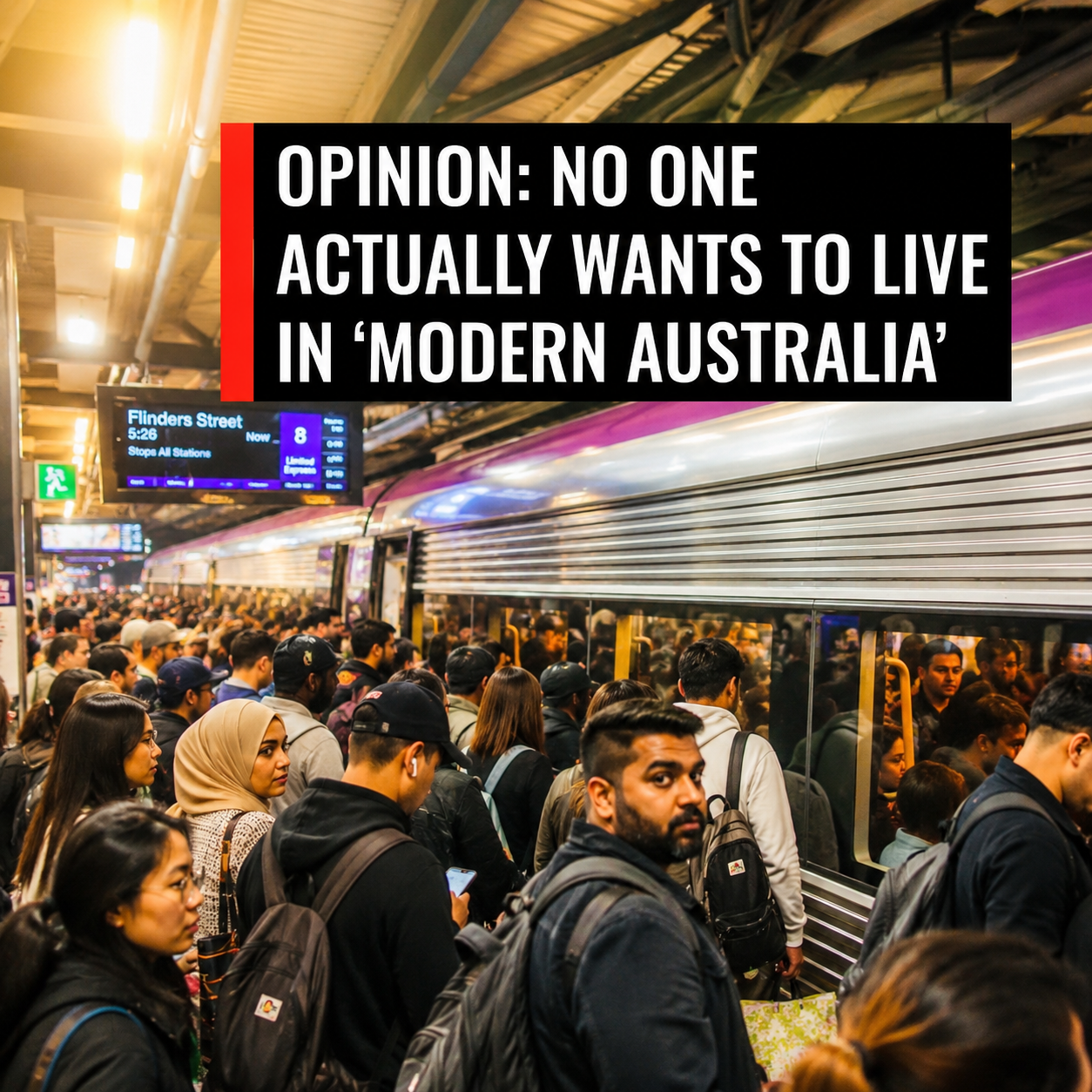
Grant’s commentary forms part of a broader and increasingly polarised debate about immigration, multiculturalism, social cohesion and national identity that has become more prominent in Australian politics following the federal election and the rise in support for parties such as One Nation.
His central argument is that the vision of “Modern Australia” promoted by political, business and cultural elites—characterised by multiculturalism, rapid population growth, urbanisation and progressive social values—does not reflect what many Australians actually want.
Instead, he argues that Australians are increasingly seeking alternatives, whether by relocating to regional communities or withdrawing from public life altogether.
Grant points to recent internal migration data showing that more Australians have continued moving from capital cities to regional areas than in the opposite direction. He argues that this represents more than a search for affordability or lifestyle, suggesting it reflects dissatisfaction with life in Australia’s largest metropolitan centres.
Australia has experienced elevated regional migration since the COVID-19 pandemic, helped by remote work opportunities, rising housing costs in Sydney and Melbourne, and changing lifestyle preferences. Property analysts have repeatedly reported sustained demand in many regional centres, although economists note that housing affordability, employment opportunities and family considerations remain major drivers of these moves alongside lifestyle choices.
Grant interprets the trend differently. He argues that people are intentionally leaving increasingly diverse urban environments for communities that remain more culturally homogeneous.
Beyond physical relocation, Grant also claims many Australians have mentally “checked out” of public life.
He cites declining participation in volunteering, lower trust in institutions, weaker civic engagement, falling marriage and fertility rates, rising welfare dependency among some younger Australians, increased social isolation and growing concerns about men’s mental health.
Many of these trends are documented individually by government agencies and academic researchers, although experts generally caution against attributing them to any single cause.
Social researchers frequently point to multiple interacting factors including housing affordability, economic insecurity, technological change, declining religious participation, social media, changing work patterns, loneliness and broader demographic shifts.
A key pillar of Grant’s argument is the work of Harvard political scientist Robert Putnam.
Putnam’s influential research into ethnic diversity and social capital found that communities experiencing rapid demographic change sometimes displayed lower levels of interpersonal trust and civic participation in the short term.
Grant argues that Australia’s current experience reflects many of Putnam’s findings.
However, Putnam himself later emphasised that his research should not be interpreted as an argument against immigration. Instead, he argued that diverse societies could build strong social cohesion over time through successful integration and the creation of shared identities.
The relationship between diversity and social cohesion remains one of the most contested topics in social science.
Australia’s own Scanlon Foundation surveys have consistently found broad public support for multiculturalism while simultaneously identifying declining trust in institutions and increasing concern about economic pressures, housing affordability and immigration levels. Researchers generally conclude that public attitudes are shaped by a combination of economic conditions, confidence in government and perceptions of how well migration is managed rather than diversity alone.
Grant also argues that rising crime contributes to dissatisfaction with city life.
He references recent violent incidents in Melbourne, including fatal stabbings involving teenagers, arguing these reflect broader concerns about community safety.
Victoria has experienced intense public debate over youth crime and knife violence during recent years, with state governments introducing tougher laws and increased police powers in response.
Crime statistics, however, present a more complex picture depending on the offence category and the time period being examined. Experts generally caution against drawing broad conclusions from individual incidents alone.
The opinion piece further links dissatisfaction with Australia’s changing political landscape.
Grant argues that declining trust in mainstream institutions has contributed to increasing support for populist parties and the weakening of Australia’s traditional two-party system.
Recent polling has indeed shown stronger support for One Nation than in previous election cycles, although analysts attribute that trend to a range of issues including housing affordability, cost-of-living pressures, dissatisfaction with major parties and immigration policy.
The debate over multiculturalism has intensified throughout 2026.
Opposition Leader Angus Taylor faced repeated questions over whether he supported multiculturalism, while senior Coalition figures publicly defended Australia’s multicultural society after his remarks generated controversy.
Meanwhile, Labor ministers have continued promoting multiculturalism as a defining feature of modern Australia while acknowledging concerns about social cohesion, housing pressures and infrastructure.
Commentators across the political spectrum increasingly agree that social cohesion has become a central public policy issue, although they disagree sharply over both its causes and potential solutions.
Some researchers argue Australia’s greatest challenge is not diversity itself but ensuring that population growth is matched by adequate housing, infrastructure, education and community integration.
Others contend that declining trust stems primarily from economic inequality, institutional performance and the fragmentation of media and social life rather than immigration alone.
Grant rejects those explanations as incomplete.
Instead, he argues Australia’s governing class has focused on managing the symptoms of declining civic trust while refusing to confront what he sees as its underlying causes.
Whether readers accept that conclusion depends largely on how they interpret the evidence.
What is clear is that debates surrounding immigration, national identity, regional migration, housing affordability and social cohesion have become increasingly central to Australia’s political conversation.
As cost-of-living pressures continue and Australia’s population grows, questions about how to maintain social trust while accommodating demographic change are likely to remain prominent in both public policy and political campaigning.
Grant’s article therefore reflects not simply an argument about multiculturalism, but a broader contest over competing visions of Australia’s future—one that continues to shape political debate well beyond the pages of opinion journalism.