More than 2,000 journalists working across 185 Australian news publishers are having part of their wages subsidised by taxpayers under a $67.6 million federal program, fuelling a renewed argument over whether government support can save struggling newsrooms without compromising the independence needed to hold that same government to account.
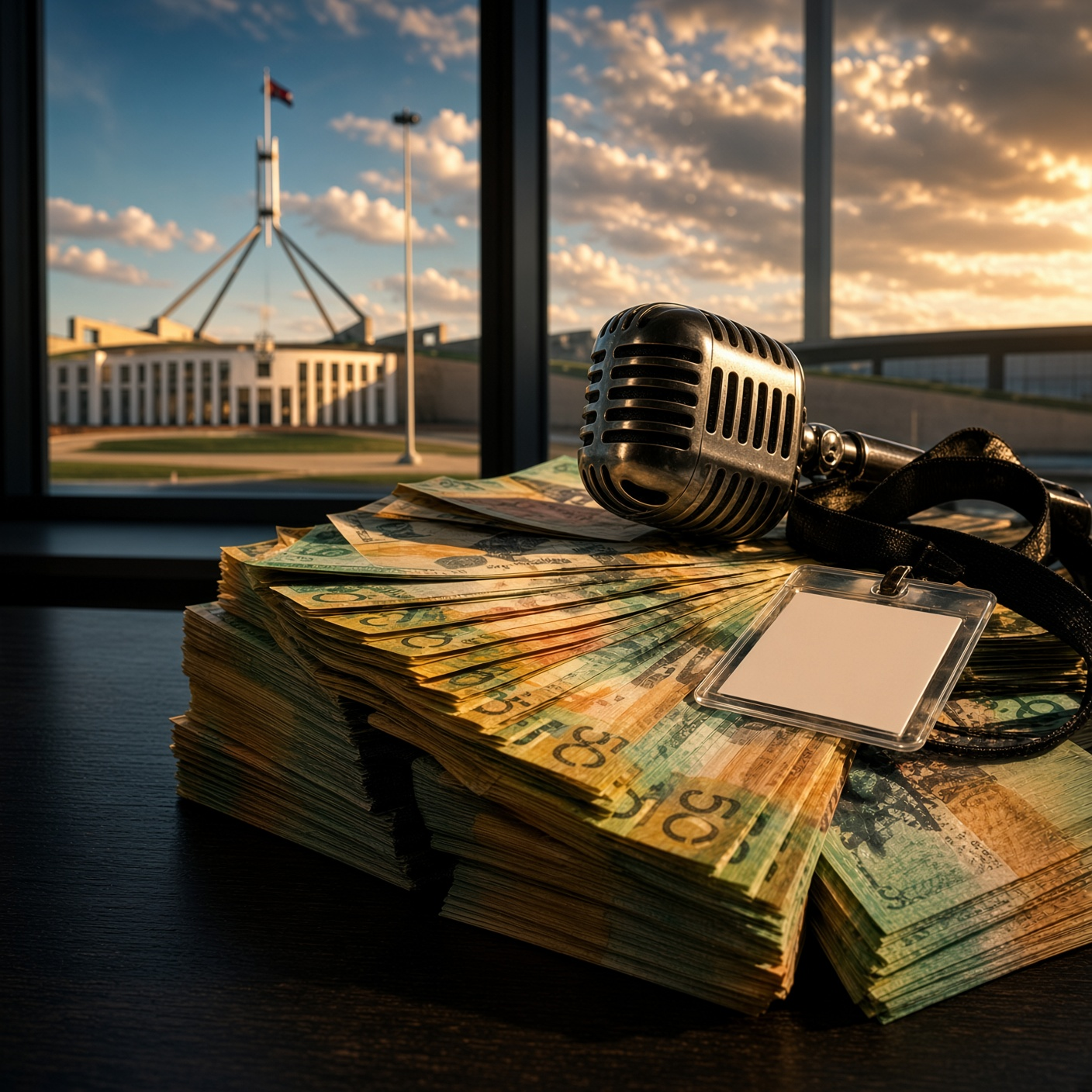
The Albanese government’s Journalism Assistance Fund was launched on November 21 last year as part of the broader News Media Assistance Program, or News MAP.
Its stated purpose is straightforward: keep journalists employed as traditional advertising revenue disappears, local newspapers close and digital platforms reshape the economics of Australian news.
But the scale of the program has created an equally straightforward question.
When a government is helping cover the salaries of journalists whose job includes investigating that government, how should the public be assured those newsrooms remain genuinely independent?
The answer is more complicated than claims that Canberra is simply “paying journalists”.
The Commonwealth does not employ the reporters, choose their stories or pay their full salaries.
Instead, grants are paid to eligible publishing organisations to cover a portion of the cost of journalists producing digitally distributed public-interest news.
Each eligible full-time-equivalent journalist attracts $13,000 a year, or $39,000 across the three-year program.
That means the subsidy is meaningful, particularly for small publishers, but is only part of the cost of employing a journalist.
Who received the money?
The government says the fund is supporting more than 2,000 journalists across 185 publishers.
Recipients include some of Australia’s largest commercial media companies as well as small regional, suburban, multicultural and independent outlets.
According to the publicly released grant information, companies within Nine received about $16.1 million across two grants.
Fairfax Media Limited, publisher of The Sydney Morning Herald, The Age and The Australian Financial Review, received an individual grant worth about $8.16 million, while Nine Entertainment received a further grant of about $7.96 million.
Seven West Media-related operations received about $11.33 million in total, including a $5.6 million grant to its television network.
Regional and independent publishers also received substantial support.
SA Today was allocated about $2.7 million, Regional Publishers in western Victoria about $2.28 million and The Conversation just over $1 million.
The government says the overall recipient list includes 93 regional publishers, 23 culturally and linguistically diverse publishers, 22 suburban publishers and two First Nations publishers.
That distribution is important because the program was developed amid a prolonged contraction in local journalism.
Research cited by the Reuters Institute says more than 350 Australian news outlets either closed or contracted during the five years leading into 2025.
The loss has been particularly serious outside major metropolitan areas, where one newsroom closure can leave an entire community with little or no dedicated reporting on councils, courts, local business, emergencies or elections.
This is not a blank cheque for every type of media content
The grant rules narrowly define the journalism eligible for taxpayer support.
“Core news content” must report, investigate or explain issues relevant to Australian public debate, democratic decision-making or current events of public significance at a local, regional, state or national level.
Government funding cannot be claimed for journalists producing print-only material that does not also qualify for digital distribution under the program.
Sponsored material, lifestyle coverage, real estate, entertainment, celebrity stories and opinion or editorial pieces are specifically excluded from the definition of core news.
The scheme therefore does not simply calculate how many people a media company employs and hand over money.
Applicants had to identify eligible journalists, provide payroll evidence and commit to maintaining the relevant number of journalist positions for the grant period.
The program was administered through the Business Grants Hub rather than by ministerial offices directly selecting stories or reporters.
Applications were assessed against eligibility requirements on a demand-driven basis, and the available funding was exhausted well before the original closing date.
Not every media company could apply
Eligibility rules also explain some conspicuous absences from the list.
Applicants had to be Australian-owned or controlled.
That excluded foreign-controlled publishers including News Corp Australia and Guardian Australia.
ABC and SBS were also outside the fund because they already receive direct public funding through separate parliamentary arrangements.
The guidelines additionally exclude an applicant affiliated with a foreign government, political party, union, financial institution, NGO or policy lobby group where that affiliation influences, or could be seen to influence, its content.
Those provisions were designed to establish some distance between direct political interests and grant-funded journalism.
They have not ended the independence debate.
The central concern is not necessarily an explicit order from Canberra
Critics are generally not arguing that a minister rings an editor each morning with instructions about what to publish.
The more subtle concern is dependency.
If a newsroom knows a significant portion of its journalism payroll depends on a government-created program, could that create an unconscious incentive to avoid antagonising the government responsible for continuing or replacing that support?
News24 commentator Andrew Bolt has argued the arrangement creates a potentially corrupting influence and says publishers receiving the grants should disclose the relationship to readers.
That is a question worth taking seriously because trust in journalism depends not only on actual independence but also on the appearance of independence.
A journalist does not need to have received an editorial instruction for readers to wonder whether a financial relationship matters.
Transparency is therefore one of the strongest arguments raised by critics of the fund.
The current rules do not require a funded publisher to attach a government-funding declaration to every political story it produces.
If an outlet chooses to refer to the JAF support, however, the grant guidelines prescribe wording stating that the program covers part of the cost of employing journalists but does not influence production of specific content.
That creates an unusual position: the government has formally addressed the independence issue in the grant documentation, while leaving individual publishers without a universal obligation to disclose the subsidy to readers on every article.
There is no evidence the government is buying favourable stories
There is an equally important distinction between a legitimate concern about incentives and a claim that corruption has actually occurred.
No evidence has emerged showing the Albanese government directing JAF-funded newsrooms to produce favourable political coverage.
Nor is there evidence demonstrating that recipients have altered reporting because of the grants.
University of Sydney media academic Joanne Gray told SBS that government funding of journalism exists in multiple forms internationally and can operate without political control when funding is transparent and journalistic standards remain in place.
Deakin University communications professor Matthew Ricketson similarly said government funding creates issues that deserve scrutiny but noted Australia has a long history of public support intersecting with journalism.
The ABC and SBS are the most obvious examples.
Both receive taxpayer funding and routinely report critically on governments responsible for their budgets.
Commercial newspapers have also received government advertising for generations without that financial relationship automatically making their editorial coverage government-controlled.
The difference with the JAF is its direct connection to journalist employment.
That makes the perceived conflict easier for critics to explain and arguably strengthens the case for strong disclosure and arm’s-length administration.
The government’s case: without support, there may be nobody left to scrutinise power
Communications Minister Anika Wells has rejected suggestions the fund compromises journalism.
Her argument is that a collapsing media industry presents its own threat to democracy.
A newspaper with no government subsidy but no journalists is not more capable of holding politicians accountable.
It simply does not exist.
That problem has become increasingly visible in regional Australia.
Local publications have closed, reduced print frequency, merged newsrooms or cut reporting positions as advertising shifted to Google, Meta and other digital platforms.
The Public Interest Journalism Initiative has repeatedly warned that areas without sustainable local media risk becoming news deserts.
The consequences extend beyond newspaper businesses.
Less local reporting means fewer journalists attending council meetings, covering local courts, examining development decisions and asking elected officials questions that may never attract the attention of national media.
The government therefore argues that spending public money to preserve journalism can strengthen accountability rather than weaken it.
Wells has said the grants are not conditional on the stories publishers write and that funded outlets remain free to hold Labor ministers accountable.
The JAF is only one part of a much larger government media strategy
The $67.6 million fund sits within News MAP, a package that now includes $99.1 million in direct news-sector grants.
A separate $31.5 million News Innovation Fund was launched this year to help publishers develop new revenue models, reach underserved audiences and improve production capability.
The government is also providing $33 million over three years to Australian Associated Press and has committed at least $3 million a year for two years from Commonwealth advertising expenditure to regional newspapers.
Another $10.5 million has been provided to the Australian Communications and Media Authority to implement a national media diversity measurement framework.
Together, the measures represent one of the largest direct federal interventions in Australian journalism in decades.
That scale ensures the debate over independence will not disappear when the first JAF grants expire.
The real test is the architecture around the money
Public funding and press freedom are not automatically incompatible.
Neither are they automatically compatible.
The crucial questions are who determines eligibility, whether funding can be withdrawn because of critical reporting, how transparent the recipients are, how far ministers are removed from individual decisions and whether future governments can manipulate the rules.
The current Journalism Assistance Fund contains safeguards and does not give the Albanese government editorial approval over stories.
That is materially different from the claim that Canberra is simply buying favourable reporting.
But critics are entitled to ask whether readers deserve clearer disclosure when a private newsroom receives taxpayer support and whether a permanent system of direct media subsidies should be placed even further from day-to-day political control.
Australia faces two risks at the same time.
One is a media industry weakened to the point where communities lose the journalists needed to scrutinise governments.
The other is a media industry that becomes sufficiently dependent on government assistance that audiences begin to question whether that scrutiny is genuinely independent.
The $67.6 million Journalism Assistance Fund was created to address the first problem.
The political challenge now is proving it does not create the second.






